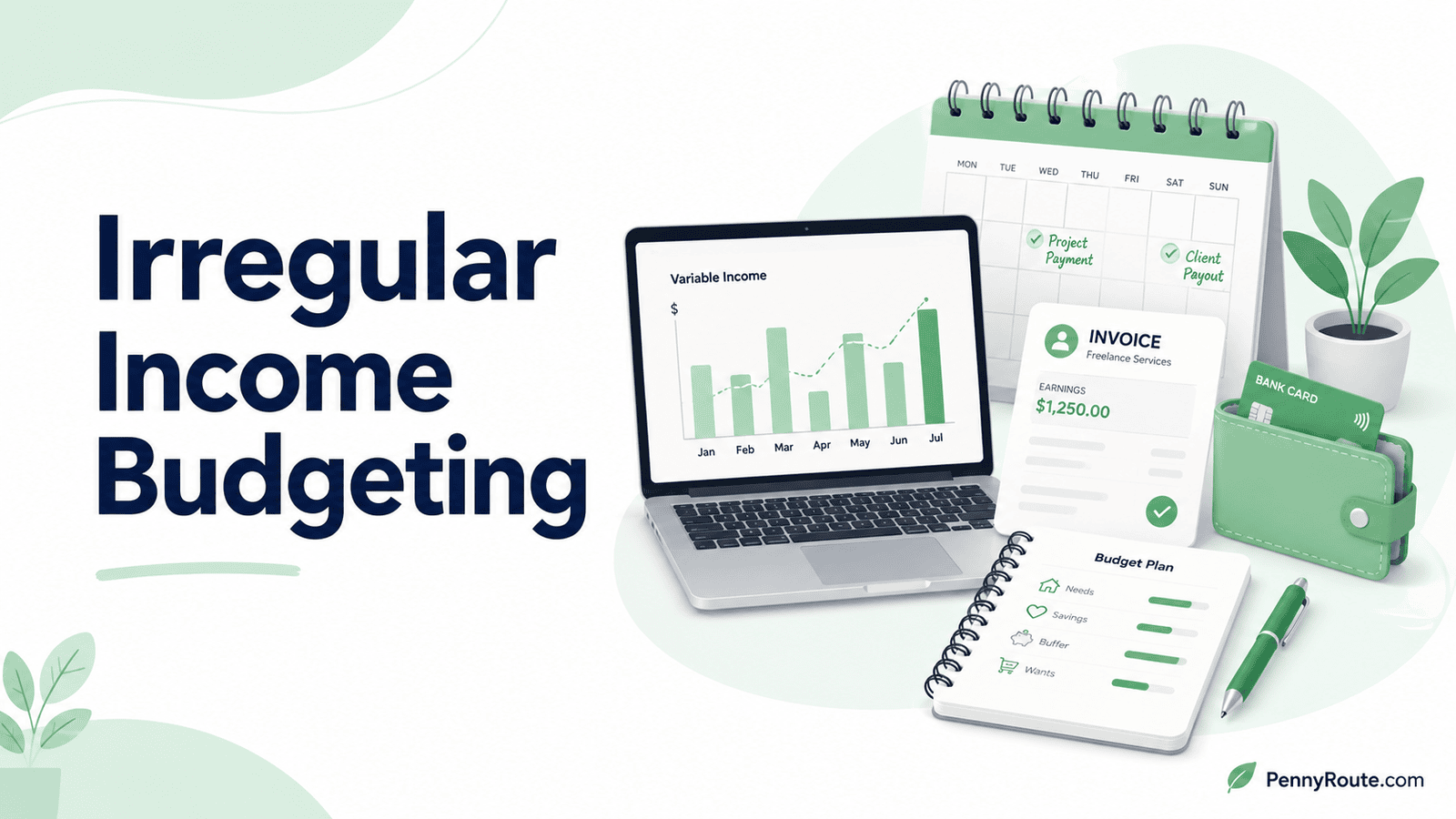
Budgeting gets harder when you cannot predict exactly how much money will arrive or when it will show up.
A strong month can make the budget feel comfortable. Then a slow month arrives with the same rent, insurance, groceries, and debt payments but much less income to cover them.
Budgeting with irregular income works better when you stop treating every month as if it should look the same. You need a cautious income number to plan around, a clear floor for essential expenses, and a way to carry money from stronger periods into weaker ones.
Disclaimer: This content is for informational purposes only and does not constitute financial or tax advice. Income, expenses, tax obligations, and financial circumstances vary.
Quick Overview
- First identify whether your income changes in amount, timing, or both.
- Choose a realistic income baseline and compare it with your essential spending floor.
- Give extra income from stronger periods a job before increasing everyday spending.
- Build an income buffer to handle normal fluctuations and late payments, not a permanent income shortfall.
What Counts as Irregular Income?
Irregular income does not always mean the same thing.
For some people, the amount changes from month to month. A freelancer might bring home $2,600 one month and $4,000 the next.
For others, the amount is fairly predictable but the timing changes. You may earn enough overall, but client payments arrive after major bills are due.
Some households deal with both.
That distinction matters because the solution is different.
If the amount changes sharply, you need a cautious number to build the budget around.
If timing is the main problem, the monthly income may be sufficient but the cash is arriving at the wrong time. A budget calendar can help line up paydays, due dates, and transfers when timing is the bigger issue.
Choose a Realistic Income Baseline
A fixed-income budget can start with one monthly paycheck amount.
With irregular income, you need a planning number that does not depend on every month being unusually strong.
Start with your actual income history.
For example:
| Month | Income available for household use |
|---|---|
| January | $3,400 |
| February | $2,700 |
| March | $4,100 |
| April | $2,900 |
| May | $3,600 |
| June | $2,500 |
The average is about $3,200, but building every month around $3,200 would assume that several stronger months repeat consistently.
At the other extreme, automatically using the single lowest month is not always useful either. A one-time unusually low month could have been caused by illness, time off, delayed invoices, or another temporary event.
A better baseline is a cautious amount your income history suggests is reasonably repeatable.
In this example, $2,700 could be a reasonable starting point because income has repeatedly landed near that level, while anything above it can be treated as extra rather than guaranteed money.
There is no universal formula for choosing the perfect baseline.
If your income stays within a narrow range, a recent average may be reasonable. If the swings are large, planning closer to the lower end usually gives you more room when a weaker month arrives.
With very little income history, start conservatively and adjust as you collect more real numbers.
Find Your Essential Spending Floor
Your income baseline tells you what you can reasonably plan around.
Now calculate the minimum amount your household needs to keep the essentials covered.
That may include:
- housing;
- basic utilities;
- groceries;
- necessary transportation;
- insurance;
- essential medical costs;
- minimum debt payments;
- childcare or other required household costs.
This is your essential spending floor.
Suppose your baseline income is $2,700 and your essential expenses total $2,450.
Baseline income − essential spending floor = baseline margin
$2,700 − $2,450 = $250
That $250 is the amount left before flexible spending, additional savings, extra debt payments, or other goals.
Now suppose the numbers are:
$2,200 baseline income − $2,450 essential spending floor = −$250
A negative result means your cautious income baseline does not fully cover essential costs. The next question is whether stronger periods regularly make up the difference or whether the shortfall keeps returning.
A bare-bones budget can help when you need a closer look at which expenses truly belong in the essential floor.
An Income Buffer Cannot Fix a Permanent Shortfall
An income buffer is useful when the problem is temporary variation.
For example, one month may come in $400 below normal and the next month $900 above normal. Money saved from the stronger month can help smooth the weaker one.
That only works if stronger periods realistically replace what weaker periods use.
Suppose your essential spending floor is $2,500 but sustainable household income averages only about $2,200.
A $2,500 buffer could cover the $300 monthly difference for a while, but the account would eventually run down if nothing changes.
Use a buffer to handle:
- normal income swings;
- delayed client payments;
- uneven pay dates;
- temporary slow periods.
If essential expenses regularly exceed sustainable income, the problem is no longer normal income volatility. The household needs a longer-term change in income, expenses, or both.
Decide What Each Payment Needs to Cover
When money arrives irregularly, one large deposit can look more spendable than it really is.
Before moving the money into everyday spending, separate anything that does not actually belong to the household budget.
For someone receiving ordinary wages, most of the paycheck may already represent household take-home income.
A freelancer or self-employed worker may need to separate business costs or other money that belongs outside the household budget before deciding what is available for personal use.
Once you know the amount actually available to the household, give it jobs such as:
- current essential expenses;
- upcoming bills;
- income buffer;
- savings;
- debt goals;
- flexible spending.
You do not need a separate bank account for every purpose. These categories can exist in your budget, spreadsheet, app, or account setup.
If physical separation makes those jobs easier to see, budgeting with multiple bank accounts is one way to organize the money without changing the underlying plan.
What to Do in a Slow Month
When income comes in below your normal planning amount, start with the essentials.
A practical order is:
- Cover housing, utilities, food, necessary transportation, insurance, and required payments.
- Reduce flexible spending where possible.
- Pause or reduce optional goals if the month cannot support them.
- Use the income buffer for any temporary gap that remains.
Adjust the month as soon as the shortfall becomes clear rather than continuing to spend as though a stronger payment will still arrive in time.
Suppose your essential spending floor is $2,450 but only $2,250 is available this month.
After cutting flexible spending, the remaining $200 essential gap could come from the income buffer.
That is the type of temporary shortfall the buffer is meant to handle.
What to Do in a Strong Month
A strong month creates choices that a slow month does not.
Without a plan, the extra income can disappear into higher spending simply because more money is sitting in the account.
Give the surplus an order before expanding flexible spending.
A useful sequence is:
- Set aside money that belongs outside normal household spending, such as business costs or taxes where applicable.
- Cover any current essential shortfall.
- Refill money previously taken from the income buffer.
- Prepare for known irregular expenses.
- Add to savings, debt payoff, or other financial goals.
- Decide how much, if any, is available for extra flexible spending.
The exact order can change with your circumstances. Someone facing an urgent debt or an upcoming annual insurance bill may prioritize those differently.
A $1,500 stronger-than-usual month should not automatically create $1,500 of new lifestyle spending.
Build an Income Buffer Over Time
An income buffer is money reserved specifically for normal income variation.
It is different from an emergency fund.
An emergency fund is generally for unexpected financial problems, such as a major repair, medical expense, or job loss.
An income buffer is for fluctuations you already know are part of your normal earning pattern.
If your essential spending floor is $2,450, a full month of essentials could eventually become a useful buffer milestone.
You do not need to build the entire amount immediately.
You might work toward:
- one week of essential expenses;
- then two weeks;
- then a larger amount as stronger months allow.
How much buffer you need depends on how unpredictable your income is and how long weaker periods tend to last.
Someone whose pay varies by $200 from month to month needs less smoothing than a freelancer who occasionally waits six weeks for a large invoice.
A Steadier Household Paycheck Can Make Budgeting Easier
Once you have enough buffer to absorb normal swings, you can separate when income arrives from how much the household spends each month.
Instead of increasing personal spending every time a large payment arrives, let uneven income accumulate and transfer a steadier amount into the household budget.
For example, your income may arrive as $4,000 one month and $2,600 the next, while the household continues operating around a planned $2,700.
The income is still variable. The steady transfer simply keeps household spending from rising and falling with every payment.
This works only when enough money remains behind to support the slower periods. The household transfer should not be higher than your longer-term income can sustain.
If Taxes Are Not Withheld From Your Income
If taxes are not withheld from some or all of your income, treat the tax portion as unavailable for household spending.
This commonly affects self-employed workers and independent contractors, but it can also matter when regular paycheck withholding is not enough.
A large payment can otherwise make the month look far stronger than it really is.
For example, receiving $5,000 does not mean the full $5,000 belongs in the household budget if part of it needs to cover taxes.
If your tax is not fully covered through withholding, you may need to make estimated tax payments during the year.
Income that arrives unevenly can make estimated-tax planning more complicated, so tax-specific questions may require current IRS guidance or qualified tax help.
Irregular Income Budget Example
Suppose a freelancer has already separated business expenses and money needed for taxes.
The amounts below are what remain available for household use.
Their essential spending floor is $2,450 per month.
| Month | Household income available | Essential floor | Margin or gap | What happens |
|---|---|---|---|---|
| January | $3,200 | $2,450 | +$750 | Add to buffer and upcoming goals |
| February | $2,600 | $2,450 | +$150 | Keep spending close to the baseline plan |
| March | $4,000 | $2,450 | +$1,550 | Refill buffer, prepare for irregular costs, then fund other goals |
| April | $2,200 | $2,450 | −$250 | Use $250 from the income buffer for essentials |
January and March provide the surplus that makes April manageable. The $250 April gap is temporary, so the buffer has a clear job.
If that $250 gap started appearing month after month, the problem would no longer be normal income volatility. The household would need to address the ongoing mismatch between income and essential expenses.
Keep the System Focused on the Next Payment
You do not need to predict your income perfectly six months in advance. Work with the money you have, protect the obligations that need funding first, and let stronger periods prepare you for the weaker ones.
Once that system is working, different budgeting methods can add as much or as little structure as you find useful.