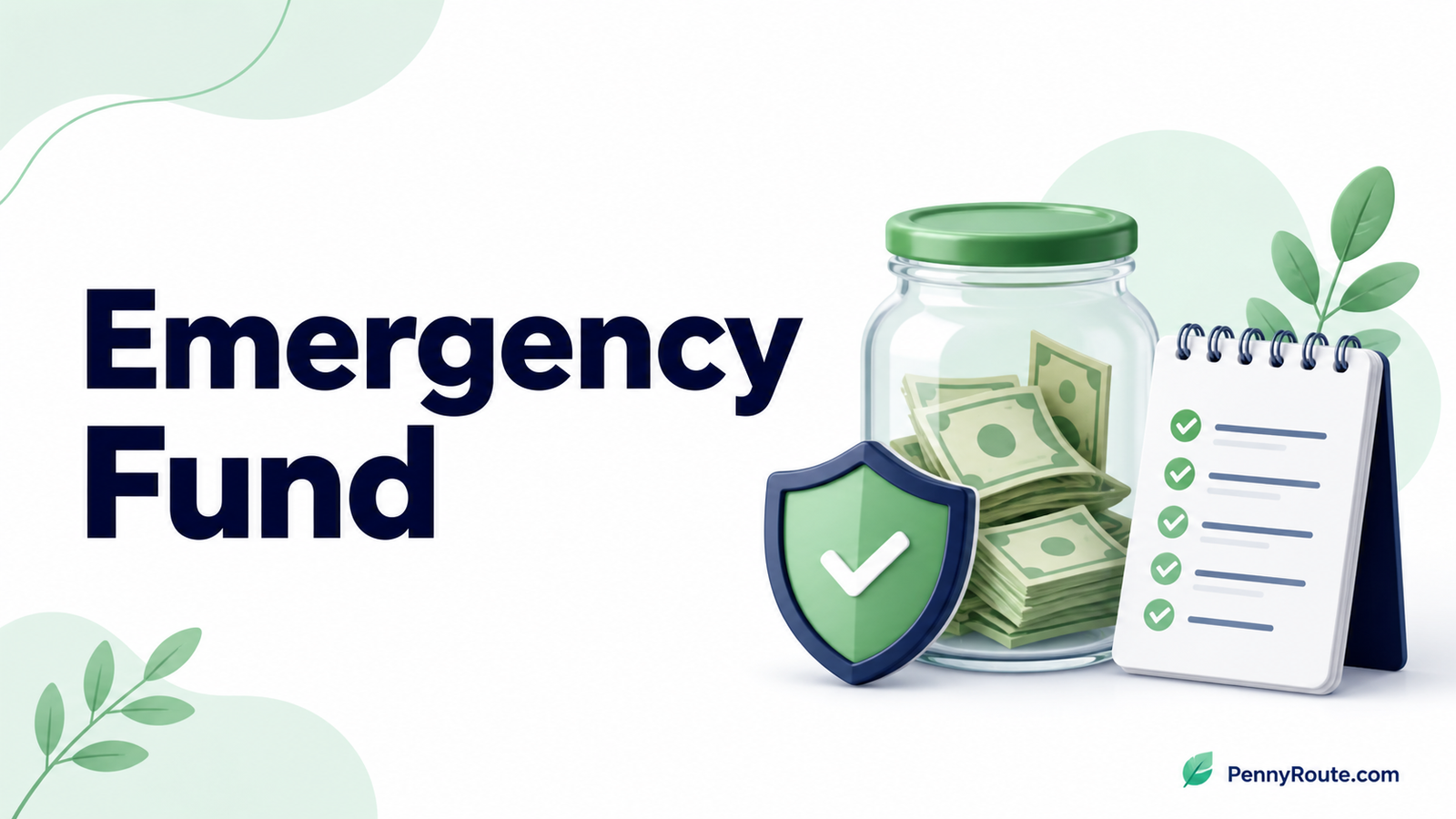
An emergency fund gives you money to fall back on when a larger financial shock threatens the bills and expenses you still need to cover.
That could mean losing income for a period of time, facing a major necessary repair, or dealing with an urgent expense that is too large to absorb comfortably from one paycheck.
The amount you need is not the same for everyone. A useful emergency fund starts with your essential monthly expenses, then adjusts for things like income stability, household responsibilities, and how long it could take you to recover from a financial setback.
Disclaimer: This content is for informational purposes only and does not constitute financial advice. Choose emergency savings targets and account options that fit your own financial situation.
Quick Overview
- Start with a smaller first cushion if you are building from zero.
- Base your longer-term target on essential monthly expenses, not total income.
- Three to six months of essential expenses is a common range, but your situation can justify more or less.
- Income shocks usually require a larger reserve than one-time spending shocks.
- Keep emergency savings safe, accessible, and separate from everyday spending.
What Is an Emergency Fund?
An emergency fund is money set aside for a financial shock that could make it harder to cover your essential expenses.
It can help when income drops or an urgent cost is too large to absorb comfortably from your normal monthly cash flow. Job loss, a major necessary repair, or a significant medical expense are common examples.
If you keep a separate rainy day fund, smaller unexpected expenses may come from that first. Your emergency fund is the deeper reserve for situations that could affect your finances more seriously or for longer.
How Much Should You Have in an Emergency Fund?
There is no single emergency fund amount that fits every household. A useful target depends on your essential monthly expenses, how stable your income is, and how long you would need the money to support you if something went wrong.
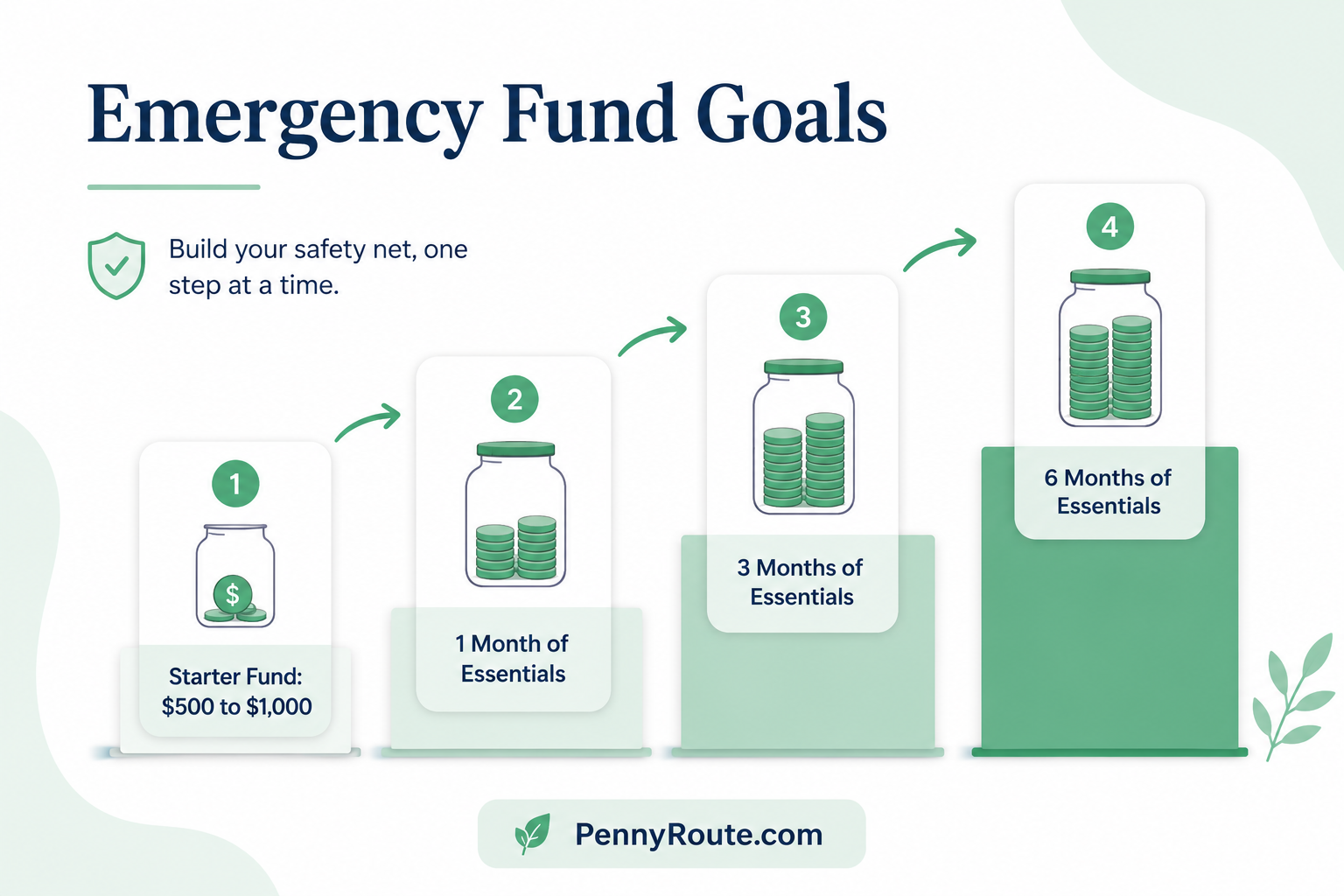
It helps to think about the fund in stages rather than treating several months of expenses as the only number that matters.
| Emergency fund stage | What it provides | When it may fit |
|---|---|---|
| First emergency cushion | Some immediate protection while you build | Starting from zero or with limited savings |
| 1 month of essential expenses | One month of core bills | A stronger short-term reserve |
| 3 to 6 months of essential expenses | More protection against a longer disruption | A common longer-term range |
| More than 6 months | Additional time if income takes longer to recover | Higher income uncertainty or fewer backup options |
If you are starting from zero, the first cushion does not need to match your full long-term target. Its job is to give you some protection while you continue building.
From there, one month of essential expenses creates a more meaningful buffer. A longer-term target of several months gives you more time to handle a job loss, reduced income, or another disruption without immediately falling behind on necessary bills.
Three to six months of essential expenses is a common benchmark, but it is not a rule everyone needs to follow. Someone with stable income and another reliable household income may be comfortable closer to the lower end. A self-employed worker, single-income household, or someone whose income could take longer to replace may prefer a larger reserve.
The target should reflect what it actually costs to keep your household running during a difficult period, not your full monthly spending with every optional expense included.
Emergency Fund Formula: How to Calculate Your Number
Once you know your essential monthly expenses, you can turn them into a more personal emergency fund target.
Use this simple formula:
Monthly essential expenses × number of months = emergency fund target
Calculation
Start with the expenses you would still need to cover during a financial disruption, such as housing, basic groceries, utilities, insurance, necessary transportation, minimum required debt payments, essential healthcare, and childcare needed for work.
For example, if those expenses total $2,500 per month, your targets would look like this:
| Emergency fund target | Calculation | Amount |
|---|---|---|
| 1 month | $2,500 × 1 | $2,500 |
| 3 months | $2,500 × 3 | $7,500 |
| 6 months | $2,500 × 6 | $15,000 |
The formula gives you a target to work toward. It does not mean you need the full amount saved before your emergency fund starts being useful.
If your essential expenses change, recalculate the number. A move, new childcare cost, higher insurance premium, or change in household income can all affect the amount you would need to keep the basics covered.
What Can Change the Amount You Need?
Two households with the same essential monthly expenses can still need different emergency fund targets.
The main difference is how much financial risk each household would have to absorb if income dropped or a major expense appeared.
Income Stability
If your income is steady and predictable, you may be comfortable with a smaller reserve than someone whose income changes from month to month.
Self-employment, commission-based work, seasonal income, or unstable hours usually create more uncertainty because it can take longer to know when the next full paycheck will arrive.
How Many People Depend on the Income
A household with children, a nonworking partner, or other dependents has more essential expenses to protect if income stops.
That does not automatically mean you need the largest possible emergency fund, but it does make the consequences of a longer income gap more serious.
How Quickly You Could Replace Lost Income
Think about what would happen if your current income disappeared.
If your skills are in steady demand and another household income could cover most essentials for a while, you may need less time in cash.
If replacing your income could take several months, a larger reserve gives you more breathing room while you look for the next source of income.
Your Fixed Essential Costs
Housing, insurance, minimum debt payments, childcare, and other costs that are difficult to reduce can make a financial setback harder to absorb.
The more of your monthly budget is locked into essential expenses, the less flexibility you have to cut spending quickly during an emergency.
Other Reliable Backup Resources
A second household income, strong insurance coverage, or other dependable resources can reduce how much pressure falls on the emergency fund alone.
The key is to count only backup options you could realistically rely on. Credit cards are not the same as savings because using them creates another obligation you still have to repay.
A larger balance is not automatically better if building it leaves other important expenses or goals underfunded. The useful target is one that gives your household enough time to recover without keeping more cash aside than you realistically need.
Spending Shock vs. Income Shock
Not every emergency hits your finances in the same way. Sometimes you are dealing with one large unexpected bill. Other times, the bigger problem is that income drops while your regular expenses keep coming.
Spending Shock
A spending shock is a large, unexpected cost that arrives while your income is still coming in.
That could be:
- a major necessary car repair
- an urgent home repair
- a significant medical bill
- emergency travel for a serious situation
Once the expense is paid, your normal cash flow can usually resume. The emergency fund mainly needs to absorb that one hit without forcing you to miss essential bills or take on new debt.
Income Shock
An income shock is different because the problem lasts longer.
A job loss, reduced hours, or an extended period away from work can leave you with less income while housing, food, utilities, insurance, transportation, and other essentials still need to be paid.
That is why income risk often has a bigger effect on the size of an emergency fund. A one-time expense eventually ends. An income gap keeps drawing on the reserve until earnings recover.
What Should Your Emergency Fund Cover?
Your emergency fund is for costs that would be hard to absorb without disrupting essential bills.
Good examples include:
- covering basic expenses during a period of lost or reduced income
- paying for an urgent repair you cannot reasonably delay
- handling a significant medical or dental cost
- covering another necessary expense that would otherwise force you to borrow or fall behind elsewhere
Expected costs belong somewhere else. Routine maintenance, annual bills, holidays, and planned purchases are better handled through regular budgeting or a sinking fund.
If you keep a separate rainy day fund, smaller surprises can come from that first. Your emergency fund is better reserved for costs that would otherwise put real pressure on the rest of your finances.
A useful test is simple:
Would paying this from normal cash flow make it difficult to cover essentials?
If so, emergency savings may be the right source.
Emergency Fund vs. Rainy Day Fund vs. Sinking Fund
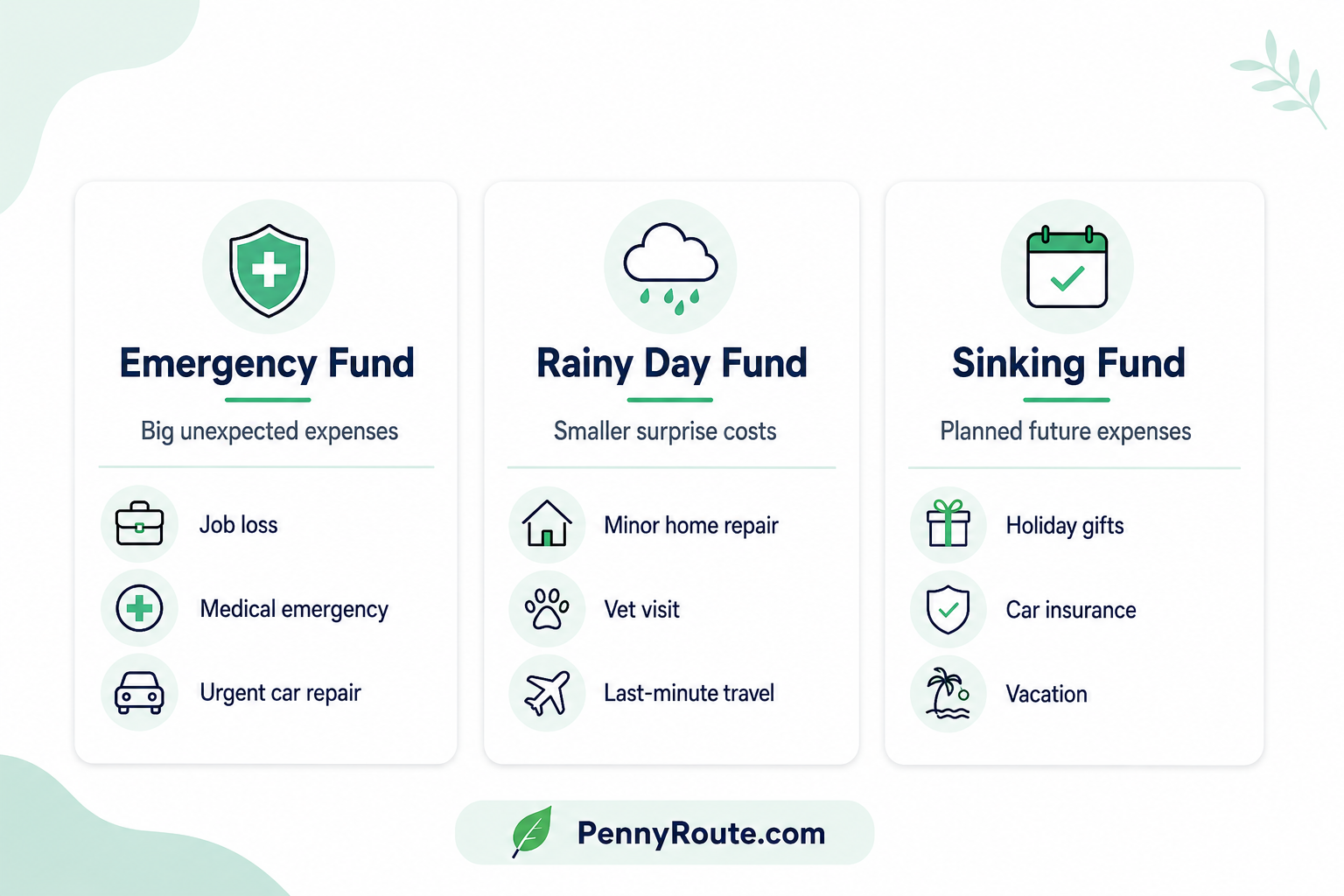
These three funds solve different problems, even though all of them help keep unexpected or irregular costs from disrupting the rest of your budget.
| Fund | Best used for | Example |
|---|---|---|
| Emergency fund | Larger financial disruptions | Job loss or a major urgent expense |
| Rainy day fund | Smaller, unplanned costs | An unexpected minor repair |
| Sinking fund | Expenses you know are coming | An annual insurance bill |
The clearest difference is predictability. If you know an expense is coming and have time to prepare for it, a sinking fund is usually the better fit.
The line between emergency savings and rainy day money is less exact. A smaller surprise may fit comfortably within a rainy day fund, while a larger cost or income disruption may need the deeper reserve of an emergency fund.
The dollar amount alone does not decide which fund to use. What matters more is how much pressure the expense puts on your ability to keep essential bills covered.
Where Should You Keep Your Emergency Fund?
Emergency savings should be easy to reach when something serious happens, but separate enough that you are not tempted to spend the money on everyday expenses.
For many people, a savings account works well because the money remains accessible while staying separate from everyday checking.
The CFPB recommends keeping emergency savings somewhere safe and accessible, where you are less likely to spend it on non-emergencies.
When choosing where to keep the fund, look for:
- easy access when you genuinely need the money
- no unnecessary withdrawal barriers
- low or no monthly fees
- deposit insurance when using a bank or credit union
- enough separation from everyday spending to protect the balance
You generally do not need to invest emergency money in stocks or other assets that can lose value just when you need to withdraw it.
The account does not need to be complicated. The main job is to keep the money available, protected, and out of your normal spending flow.
How to Build an Emergency Fund
Once you have a target, the next challenge is building toward it without putting too much pressure on the rest of your budget.
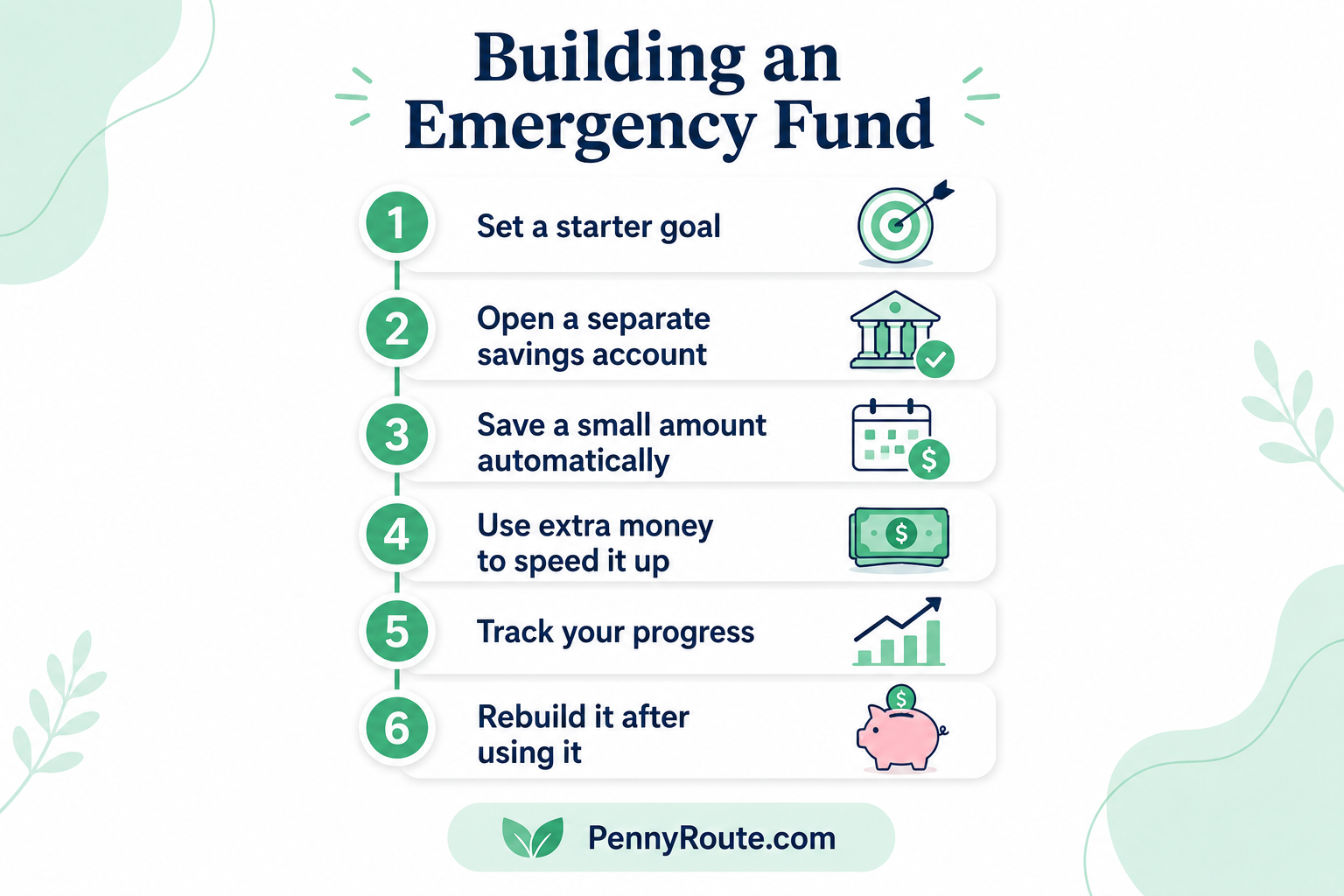
Save an Amount You Can Repeat
A contribution that fits comfortably into your normal cash flow is more useful than an ambitious amount you can only manage once or twice.
That could be $25 per paycheck, $100 a month, or another amount that works alongside your essential expenses and required payments. You can increase it later as more room becomes available.
Automate It if That Makes Saving Easier
An automatic transfer can move money into savings before it gets mixed into everyday spending.
The transfer does not need to be large. Choose an amount that is unlikely to leave you moving the money back into checking before the next paycheck.
If your income changes from month to month, a fixed automatic transfer may be less practical. You might instead move a percentage or choose the amount after each paycheck arrives.
Use Extra Money Without Committing All of It
A tax refund, bonus, cash gift, or other extra income can move the fund forward faster, but you do not have to put the entire amount into emergency savings.
How much makes sense depends on what else needs attention at the time. You might add part to the emergency fund while keeping some available for another priority.
The fund can grow gradually. A slower contribution that fits your monthly cash flow is more useful than a larger amount you repeatedly have to pull back out.
Should You Build an Emergency Fund or Pay Off Debt First?
You do not always have to choose one and ignore the other.
If you have no cash cushion at all, building some emergency savings first can reduce the chance that the next urgent expense goes straight onto a credit card. At the same time, required debt payments still need to stay current.
Once you have a basic cushion, the balance between extra saving and extra debt payoff depends on factors such as the interest rate, how expensive the debt is to carry, and how secure your income is.
High-interest debt can become costly quickly, but draining emergency savings to pay it down can leave you exposed to the next financial setback. In that situation, keeping some accessible savings while sending additional money toward expensive debt can reduce the chance that the next emergency puts you straight back into borrowing.
The exact split will depend on your situation, especially if your debt carries very high interest or your income is unstable.
Once you have some emergency savings in place, your debt payoff plan should account for that cash cushion rather than treating every available dollar as extra debt money.
What to Do After You Use Your Emergency Fund
Using your emergency fund for a real emergency means the money did its job.
Once the immediate problem is handled, look at how much of the fund is left and what the expense revealed about your current target.
If the withdrawal was smaller than expected and your remaining balance still gives you enough protection, you may be comfortable rebuilding gradually. A larger withdrawal may deserve more attention, especially if it leaves you with very little cash for another setback.
It also helps to ask whether the emergency changed what you now need from the fund. A long period without income, a major medical bill, or another expensive disruption can show that your original target was too small for the risks your household actually faces.
You do not have to replace the full amount immediately if doing so would squeeze essential expenses or required payments. Rebuild at a pace that fits your current cash flow, then adjust the target if the experience gave you a clearer idea of how much protection you need.
When Should You Recalculate Your Emergency Fund?
Your emergency fund target does not need to stay fixed forever. It should change when the expenses or risks it is meant to cover change.
It is worth recalculating after changes such as:
- a move that significantly changes housing costs
- adding a child or another dependent
- a major change in income
- switching to self-employment or more variable work
- taking on a new essential monthly expense
- losing a second household income
- a change in insurance coverage or out-of-pocket costs
You do not need to rebuild the calculation after every small budget change. Focus on changes that would noticeably affect how much money your household would need during a serious setback.
Build the Fund Around the Risks You Actually Face
An emergency fund works best when the target reflects your essential expenses and how long your household could realistically need support.
Start with the protection you can build now, then increase it as your savings and circumstances change. The right target is the one that gives you enough room to handle a serious setback without immediately falling behind on the basics.
Frequently Asked Questions
Is $1,000 enough for an emergency fund?
It can be a useful first cushion, especially if you are starting from zero. Whether it is enough long term depends on your essential monthly expenses, income stability, and the kind of financial disruption you want the fund to cover.
Should I keep my emergency fund in checking or savings?
A savings account is usually the better fit because it keeps the money separate from everyday spending while still leaving it accessible when needed. The account should also have low fees and appropriate deposit insurance.
Should I invest my emergency fund?
The core emergency fund is generally better kept somewhere stable and accessible rather than in investments that can lose value. You do not want to be forced to sell during a market drop just because an emergency happens at the wrong time.