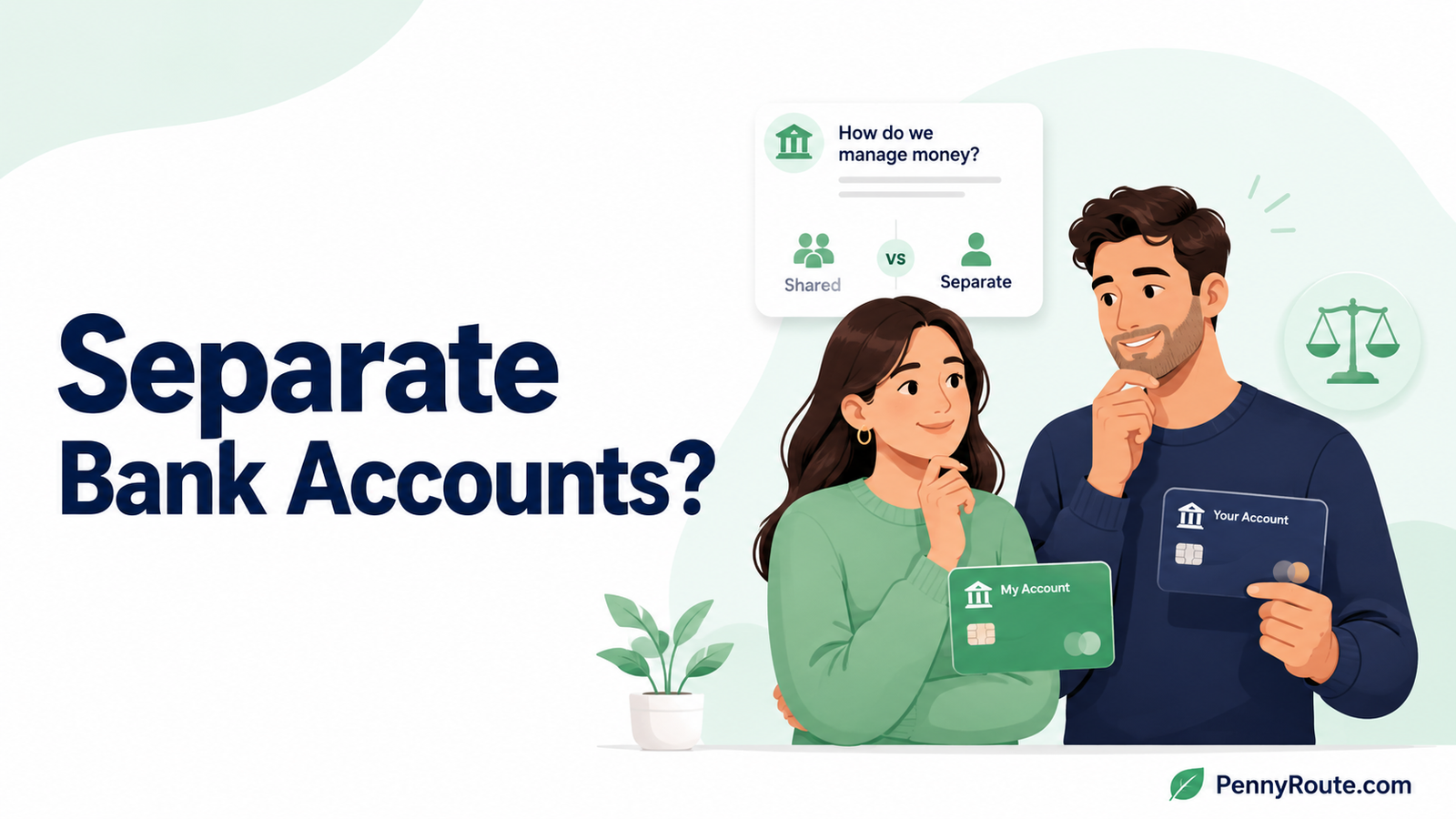
If you’re wondering whether couples should have separate bank accounts, there is no setup that automatically works better for every relationship. Separate accounts can give each person more control over personal spending, while joint accounts can make shared money easier to see and manage.
There is also a middle option. Some couples keep personal accounts while using one joint account for agreed household expenses.
The better question is whether the setup makes shared responsibilities clear while giving both of you the amount of financial independence you want.
Disclaimer: This content is for informational purposes only and does not constitute financial or legal advice. Consider contacting a qualified financial or legal professional if you need guidance based on your specific situation.
Quick Overview
- Joint accounts make shared money easier to manage in one place.
- Separate accounts give each person more control over personal spending.
- A hybrid setup combines a joint household account with individual accounts.
- Keeping separate accounts does not remove the need to agree on shared financial responsibilities.
- The best fit depends on how much visibility, independence, and coordination you both want.
Separate, Joint, or Hybrid Accounts: The Three Main Setups
Couples generally organize their bank accounts in one of three ways. The difference is not just where the money sits. Each setup changes how much coordination is needed and how visible everyday spending is to both partners.
Fully Joint Accounts
With a fully joint setup, most or all household income goes into accounts both partners can access.
Bills, groceries, shared purchases, savings, and personal spending may all come from the same pool of money.
This can make household cash flow easier to see because both people are looking at the same balances. The tradeoff is that there is less separation between shared money and individual spending.
Joint-account access is also worth understanding before choosing this setup. In most circumstances, either owner of a joint checking account can withdraw money and may be able to close the account, depending on the bank’s terms and applicable law, according to the CFPB.
Fully Separate Accounts
With separate accounts, each partner keeps income and personal spending in accounts held individually.
The couple still needs a system for shared expenses. One person might pay certain household bills while the other handles different ones, or each person might transfer an agreed amount when shared costs are due.
Separate accounts can preserve more individual control, but they usually require more coordination because the household money is spread across different places.
Hybrid: Yours, Mine, and Ours
A hybrid setup keeps some money separate while combining the part used for shared expenses.
For example, each person might keep an individual checking account and transfer money into one joint account for housing, utilities, groceries, or other agreed household costs.
This can give both partners personal spending independence while making shared bills easier to manage from one place.
It does require clear expectations about what belongs in the joint account and how it will be funded. The actual method for dividing those costs belongs in the couple’s wider financial plan rather than being determined by the account setup itself.
Separate vs. Joint Bank Accounts
| Setup | Main advantage | Main tradeoff |
|---|---|---|
| Joint | Shared money is easier to see in one place | Less separation for personal spending |
| Separate | More individual control over money | Shared bills require more coordination |
| Hybrid | Combines shared visibility with personal accounts | Requires clear rules for what stays shared |
The account setup does not decide whether your finances are fair or organized. A joint account can still create confusion if neither person knows what the money is for, while separate accounts can work smoothly when shared responsibilities are clear.
When Separate Bank Accounts Work Well
Separate accounts can be a good fit when both partners value having their own spending money and are comfortable coordinating shared expenses separately.
They can be especially practical when you both already have established accounts, manage personal obligations independently, or simply prefer not to discuss every small personal purchase.
Separate accounts can also make boundaries clearer. If you agree that a certain amount remains personal after shared responsibilities are covered, each person knows what money is available without needing approval for every purchase.
And separate accounts do not necessarily mean completely separate finances. You can still coordinate household spending, savings, and larger decisions while keeping individual checking accounts.
When Separate Accounts Can Create Problems
Separate accounts become harder to manage when the shared part of the finances is unclear.
For example, problems can appear when:
- neither person is sure who is paying a particular bill
- transfers into shared accounts happen late or inconsistently
- one partner does not know whether enough money is available for upcoming household costs
- one person carries much more of the financial administration
- each partner assumes the other is setting money aside for a shared expense
The accounts themselves are not necessarily the problem. The friction usually comes from shared money having no clear owner, amount, or purpose.
Separate accounts also provide less automatic visibility into the household’s overall cash position. If that visibility matters to either of you, you need another way to keep shared obligations easy to understand.
When Joint Accounts May Be Easier
A joint account can simplify things when most of your spending and financial priorities are already shared.
Housing, utilities, groceries, childcare, and other household costs can all be paid from one place, which reduces the need to move money back and forth.
It can also make the available household balance easier for both partners to see.
The tradeoff is that both people generally have access to the shared money. For couples with very different spending styles, that can create tension if there is no agreement about which purchases come from the joint account.
Joint accounts tend to work better when both partners are comfortable with the level of access and visibility that comes with sharing the account, rather than because combining money is automatically simpler.
When a Hybrid Account Setup Makes Sense
A hybrid setup can work well when you want to manage household expenses together without combining every dollar.
For example, each partner could keep an individual account for personal expenses while using one joint checking account for agreed household bills.
That gives shared expenses one place to land while personal spending stays separate.
How those shared costs fit into the rest of your finances is part of budgeting as a couple, while the actual contribution calculation can be handled separately when you split bills based on income.
How to Decide Whether Couples Should Have Separate Bank Accounts
The best setup is usually easier to identify when you focus on how you actually manage money rather than what other couples do.
How Much Personal Independence Do You Both Want?
Some couples are perfectly comfortable with every purchase appearing in the same account. Others prefer having money they can spend independently after shared responsibilities are handled.
Neither approach is automatically better. What matters is whether both of you are comfortable with the level of independence and visibility it creates.
How Much Visibility Do You Need?
Joint accounts naturally give both owners a view of the shared balance and transactions.
With separate accounts, you need another way to know whether household expenses are covered.
If one of you wants much more visibility than the other is comfortable with, changing accounts will not solve that difference by itself.
Would Combining Accounts Actually Make Things Simpler?
If you already coordinate shared bills without difficulty, separate accounts may not be causing a problem that needs fixing.
On the other hand, if you constantly send reimbursements, wonder whose account a bill should come from, or lose track of shared balances, one joint household account could remove some unnecessary work.
Changing the structure should solve a real problem rather than create a new system simply because it seems more conventional.
Are Your Spending Styles Very Different?
Separate personal accounts can reduce friction when each person likes to spend discretionary money differently.
That does not remove the need to agree on shared financial responsibilities. It simply keeps personal spending from being mixed into the same transaction history as every household bill.
A joint setup can also work with different spending styles if both partners are comfortable with clear personal-spending amounts inside the shared system.
One important distinction is easy to miss: where you keep the money and how you divide household expenses are separate decisions.
Keeping separate accounts does not automatically mean splitting every bill 50/50. A couple with significantly different incomes may decide that equal dollar contributions do not fit their situation.
Likewise, having joint accounts does not tell you whether both partners are contributing fairly. Money can be combined while the underlying arrangement still needs discussion.
Choose the account structure based on how you want to hold and access the money. Decide how shared expenses are divided based on your incomes, responsibilities, and the arrangement you both consider reasonable.
Can Married Couples Keep Separate Bank Accounts?
Married couples can have bank accounts held in one spouse’s name as well as joint accounts. But having an account in one spouse’s name does not automatically settle every legal question about who owns the money.
State marital-property rules and individual circumstances can affect how property or income is treated, particularly in situations involving divorce, death, creditors, or estate planning. IRS guidance, for example, recognizes separate and community property distinctions that vary under applicable state property regimes.
Joint accounts also come with their own account-access rules. The CFPB notes that removing a spouse from a joint checking account generally requires the spouse’s consent, though account terms and state law matter.
If ownership of a significant amount of money matters in your situation, check the account agreement and get advice that applies to your state.
When Should You Reconsider Your Account Setup?
An account setup that worked when your finances were simple may become awkward after a major change.
It can be worth reconsidering the setup after changes such as:
- moving in together or getting married
- buying a home
- having a child
- one partner leaving work or reducing hours
- a major change in either income
- taking on new shared financial responsibilities
You do not need to change accounts just because you get married, buy a home, or have a child. Reconsider the setup when it starts making shared money harder to manage or no longer gives both of you the visibility and independence you want.
Separate accounts can work well, joint accounts can work well, and a hybrid setup can work well. The better choice is the one both of you understand and can manage without confusion.
If your current setup already makes shared responsibilities clear and gives each of you the level of independence you want, there may be no reason to change it.