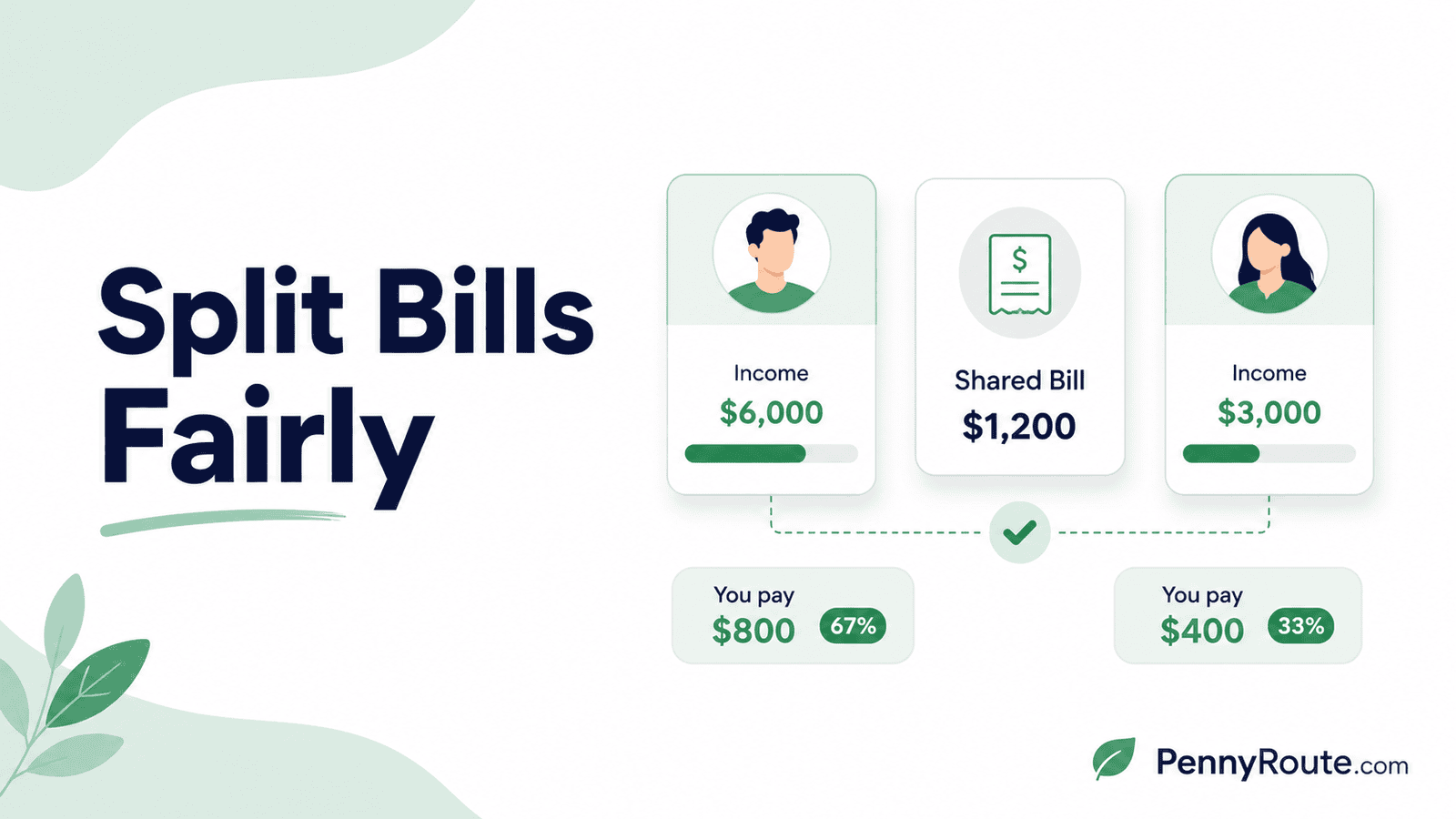
Splitting household bills based on income can make shared expenses easier to manage when two people earn different amounts.
Instead of each person paying the same dollar amount, you divide shared costs according to each person’s share of the combined income. If one person earns 60% of the household income and the other earns 40%, shared expenses can be divided 60/40.
The calculation is simple, but the setup still requires a few decisions. You need to agree on which expenses count as shared, which income figure to use, and when the percentages should be updated if earnings change.
Disclaimer: This content is for informational purposes only and does not constitute financial advice. Choose a bill-splitting arrangement that fits your household situation, and consult a qualified professional when needed.
Quick Overview
- Income-based bill splitting divides shared expenses according to each person’s share of the combined income.
- Use the same income definition for both people, typically take-home pay for a practical household calculation.
- Agree on which expenses count as shared before applying the percentages.
- Recalculate the split when income or household circumstances change enough to make the current percentages outdated.
How to Calculate an Income-Based Bill Split
The basic calculation has four steps.
1. Add Both Take-Home Incomes
Start with the monthly take-home income for each person.
For example:
- Person A: $4,000
- Person B: $2,500
- Combined take-home income: $6,500
2. Calculate Each Person’s Income Percentage
Divide each person’s take-home income by the combined take-home income.
$4,000 ÷ $6,500 = 61.5%
Person A
$2,500 ÷ $6,500 = 38.5%
Person B
Together, the percentages add up to 100%.
3. Add the Shared Expenses
Next, total the expenses both people have agreed to share.
Suppose the monthly shared expenses are $3,200.
4. Apply the Percentages
Multiply the shared expense total by each person’s income percentage.
$3,200 × 61.5% = $1,968
Person A
$3,200 × 38.5% = $1,232
Person B
So Person A would contribute $1,968 and Person B would contribute $1,232 toward the shared monthly expenses.
Income-Based Bill Split Formula
Your take-home income ÷ combined take-home income × shared expenses = your contribution
Calculation
The formula works the same way whether the split is 60/40, 70/30, 55/45, or another proportion. The percentages come from each person’s share of the income rather than being chosen in advance.
50/50 vs. Income-Based Bill Splitting
A 50/50 split and an income-based split use different starting points.
| Method | How It Works | Main Advantage |
|---|---|---|
| 50/50 split | Each person pays the same dollar amount | Simple to calculate and manage |
| Income-based split | Each person pays according to their share of combined income | Contributions adjust for income differences |
A 50/50 arrangement can work well when incomes are similar and both people are comfortable contributing the same amount.
An income-based split can be more practical when earnings differ enough that an equal dollar contribution would affect each person very differently.
If you are deciding between the two approaches, whether couples should split bills 50/50 depends on affordability, financial obligations, and what both people consider workable.
You also do not have to use one method for every expense. A couple might split core household bills based on income while dividing certain optional expenses evenly or handling them separately.
A mixed approach can work when both people understand which rule applies to which costs.
Should You Use Gross Income or Take-Home Pay?
For most household bill-splitting calculations, take-home pay is the more practical starting point because it reflects the money each person actually receives after taxes and payroll deductions.
Use the Same Income Definition for Both People
Whichever income figure you choose, use the same definition for both partners.
Comparing one person’s gross income with the other person’s take-home pay would distort the percentages and make the split less meaningful.
Consider Large Voluntary Deductions
Take-home pay can still require some judgment when one person has unusually large voluntary deductions, such as higher retirement contributions.
In that situation, it can be worth discussing whether those deductions should reduce the income used for the split. The calculation should reflect an arrangement both people understand and consider workable.
Use Available Income for Self-Employment
For self-employed income, avoid treating gross business revenue as personal income.
Business expenses and taxes reduce the amount actually available for household spending, so the figure used for the split should reflect income available after those costs.
The main point is consistency. Use income figures that reasonably represent the money available to each person, then apply the same approach when the percentages are recalculated later.
If you need a clearer picture of the income and expenses you are working with, the CFPB’s budgeting and cash-flow tools can help you organize income, bills, expenses, and other financial priorities before calculating the split.
Which Expenses Should Be Included in an Income-Based Split?
An income-based split should apply only to expenses both partners agree are shared. Personal costs do not automatically become household costs simply because the couple uses proportional contributions.
The clearest approach is to define shared and personal expenses before calculating the monthly contribution.
Common Shared Expenses
Shared expenses may include:
- Rent or mortgage
- Utilities
- Groceries
- Internet
- Childcare
- Shared insurance
- Household supplies
- Transportation used by both partners
- Joint subscriptions
- Agreed savings goals
- Shared debt payments
These costs support the household or a goal both partners have chosen together.
Common Personal Expenses
Personal expenses may include:
- Individual credit card debt
- Student loans from before the relationship
- Personal subscriptions
- Clothing
- Hobbies
- Gifts
- Individual travel
- Personal medical costs
- Support provided to relatives
- Personal savings goals
A personal expense can still be included in the shared plan when both partners agree. The important point is to make that decision deliberately rather than assuming every cost should be divided by income.
Decide How to Handle Housing
Housing is usually shared, but the amount may require a separate discussion.
Suppose the higher earner prefers a more expensive home than the lower earner would choose alone. A proportional split may still leave the lower earner paying more than they consider comfortable.
In that case, the couple could:
- Choose a lower-cost home
- Ask the higher earner to cover more of the added cost
- Set a maximum contribution the lower earner can manage
- Treat part of the housing cost differently from other bills
The formula should support the housing decision, not make an unaffordable choice appear fair.
Separate Household Spending From Personal Lifestyle Choices
Some expenses sit between shared and personal.
Examples include:
- Premium streaming packages
- Expensive furniture
- Frequent dining out
- A luxury vehicle used mainly by one person
- Travel that one partner values more
- Upgraded internet or phone plans
Ask whether the expense is necessary for the household, mutually chosen, or mainly connected to one person’s preferences.
A useful question is:
Would both partners choose this expense at the current price if they were making the decision together today?
When the answer is no, the person who wants the upgrade may cover part or all of the added cost.
Include Shared Savings Only When the Goal Is Agreed
Savings can be treated as a shared expense when both partners agree on the purpose and contribution amount.
Examples include:
- Emergency savings
- A home down payment
- Travel
- Vehicle replacement
- Future childcare
- Major household repairs
Personal retirement accounts and individual investment goals may remain separate unless the couple decides otherwise.
Create One Written Expense List
A simple table can prevent confusion:
| Expense | Shared or personal? | How it will be handled |
|---|---|---|
| Rent | Shared | Split by income |
| Groceries | Shared | Split by income |
| Partner A student loan | Personal | Paid by Partner A |
| Childcare | Shared | Split by income |
| Partner B gym membership | Personal | Paid by Partner B |
| Vacation fund | Shared | Equal monthly contribution |
Review the list when a new recurring expense appears.
The calculation becomes much easier once both partners agree on what belongs in the shared total.
How to Split Bills When Income Changes From Month to Month
An income-based split gets harder when one or both incomes change regularly because the percentages can move from month to month.
Choose a Consistent Income Figure
Use an income amount you can realistically plan around rather than recalculating from every unusually high or low paycheck.
A recent average or another dependable planning amount can work, depending on how variable the income is.
If the variation is substantial, budgeting with irregular income can help you choose a more workable baseline for the broader household budget.
Recalculate on a Reasonable Schedule
You do not necessarily need to change the percentages after every paycheck.
For income that fluctuates modestly, reviewing the split monthly or every few months may be enough. If income changes significantly, update it sooner.
Keep the Method Predictable
Both people should understand which income period is being used and when the percentages will be reviewed.
That consistency makes the arrangement easier to plan around and reduces the chance that the contribution rule changes unexpectedly from one month to the next.
What If the Lower Earner Is Still Stretched?
An income-based split can be proportional and still be difficult for one person to afford comfortably.
Look at What Each Person Has Left
After calculating the shared contribution, compare what remains for personal expenses, debt payments, savings, transportation, medical costs, and other obligations.
For example, two people may contribute in proportion to income but still end up with very different amounts left after everything else is paid.
Include Necessary Personal Obligations
Some costs may not belong in the shared-expense total but still affect what each person can realistically contribute.
That can include:
- personal debt payments;
- medical costs;
- commuting expenses;
- child support or family support;
- other necessary individual obligations.
Adjust the Arrangement if the Formula Does Not Work
If the lower earner is consistently stretched, the percentage does not have to be treated as permanent.
Possible adjustments include lowering shared household costs, changing the contribution percentages, or using a temporary arrangement while income or expenses are changing.
Nonfinancial responsibilities can matter too. Childcare, caregiving, or other unpaid household work may affect what both people consider a workable contribution.
How to Set Up the Split Each Month
Once you know each person’s contribution, decide how the shared money will actually be handled.
Decide Where Shared Money Will Go
You might use a joint account for household expenses, keep separate accounts and transfer money as needed, or use another setup that both people can follow easily.
Couples can still keep separate bank accounts while using an income-based split for shared expenses.
Transfer Each Person’s Share
Each person can contribute the full monthly amount at once or divide it across paychecks.
For example, if one person’s monthly share is $1,200 and they are paid twice a month, they could transfer $600 from each paycheck.
Track Shared Spending and Small Differences
Some shared expenses, such as groceries or utilities, will not be identical every month.
Keep a simple record of the shared total and adjust small overages or shortfalls without recalculating the income percentages every time a bill changes slightly.
The setup should make it easy to see whether each person has contributed the agreed amount without creating more tracking than the household actually needs.
When to Recalculate the Income Percentages
You do not need to redo the calculation every time a grocery bill or utility payment changes. Those changes affect the shared-expense total, not necessarily each person’s income percentage.
Recalculate After a Meaningful Income Change
Update the percentages when one person’s income changes enough that the current split no longer reflects the household’s actual earnings.
That could happen after a raise, job change, reduced hours, leave from work, or another sustained shift in income.
Revisit the Arrangement When Responsibilities Change
Income is not the only reason to review the split.
A major change in childcare, caregiving, medical costs, or other household responsibilities can also make the existing arrangement less practical.
Review the Split Periodically
Even if nothing major changes, it helps to review the percentages from time to time to make sure the income figures and shared-expense list are still current.
There is no need to use a rigid threshold such as a specific percentage change. Recalculate when the existing split no longer reflects the situation you are actually working with.
Keep the Split Practical
An income-based bill split gives you a clear starting point when earnings are different, but the percentage is only useful if the overall arrangement works in real life.
Use consistent income figures, agree on what counts as shared, and revisit the calculation when income or household responsibilities change. If the numbers stop working for either person, adjust the arrangement rather than treating the original percentage as permanent.
Frequently Asked Questions
How Do You Calculate a 60/40 Bill Split?
Multiply the shared expense total by 60% for one person and 40% for the other. For $3,000 in shared expenses, that would be $1,800 and $1,200.
Should Couples Split Bills Based on Income if One Person Earns More?
They can. An income-based split adjusts each person’s contribution according to earnings, which can be useful when incomes differ significantly. It is still only one option, so the arrangement should fit both people’s finances and responsibilities.
Do You Have to Recalculate the Split Every Month?
Not necessarily. If incomes are stable, the same percentages can continue. Recalculate when income or household circumstances change enough that the current split no longer reflects the situation.