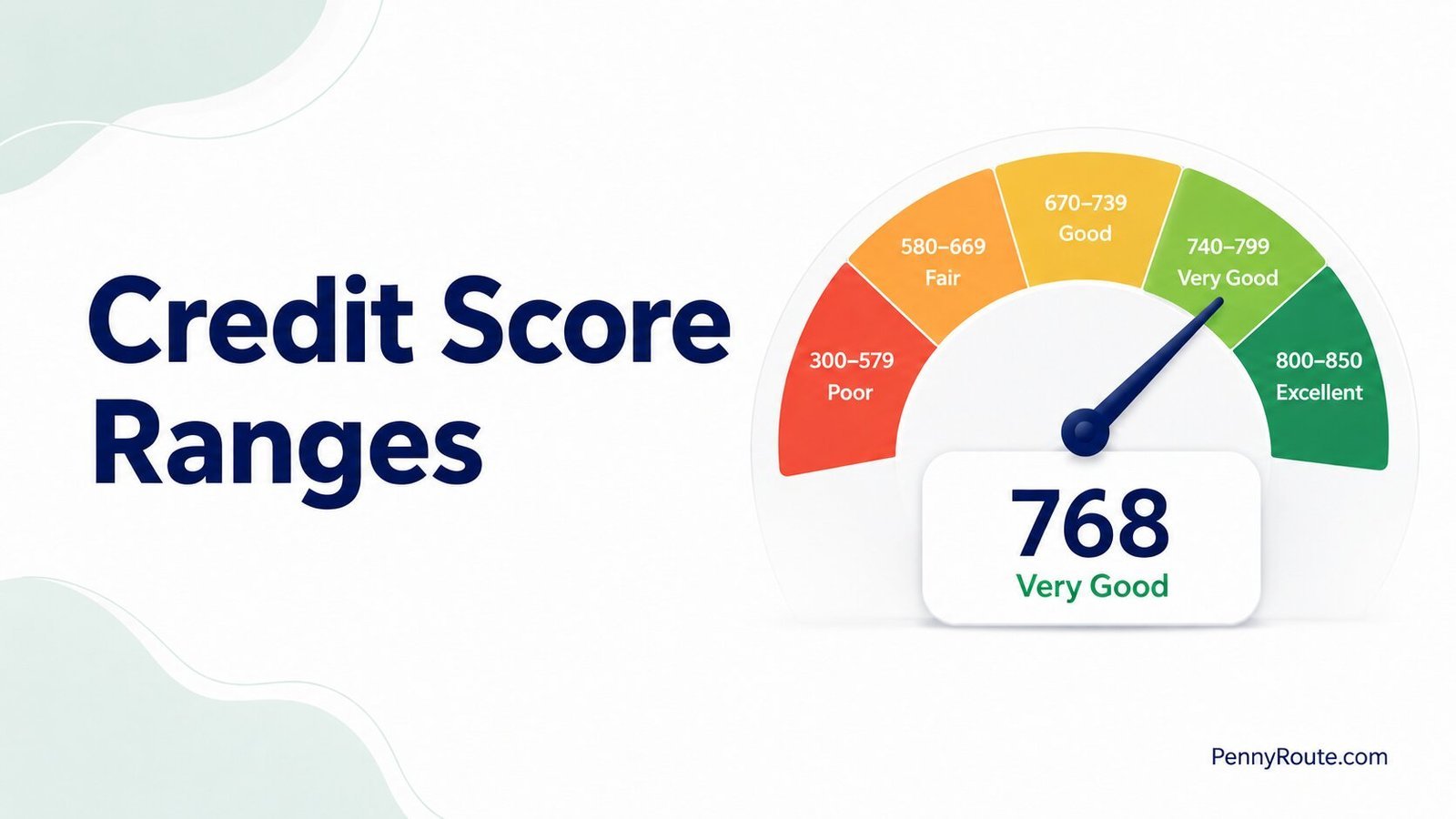
Credit scores are usually shown on a scale from 300 to 850, but the number alone does not tell the whole story. A score may be labeled poor, fair, good, very good, or exceptional depending on where it falls and which scoring model produced it.
Under the standard base FICO scale, a score from 670 to 739 is considered good. However, FICO and VantageScore use different category boundaries, and lenders may rely on different score versions, credit bureaus, or approval standards.
Understanding the range helps you see where your score stands, but it does not guarantee approval, a specific interest rate, or a particular credit limit. Before comparing your number with a chart, check which scoring model produced it and how that model defines the ranges.
Disclaimer: This content is for informational purposes only and does not constitute financial advice. Please consult a qualified professional before making financial decisions.
Credit Score Chart: FICO Score Ranges at a Glance
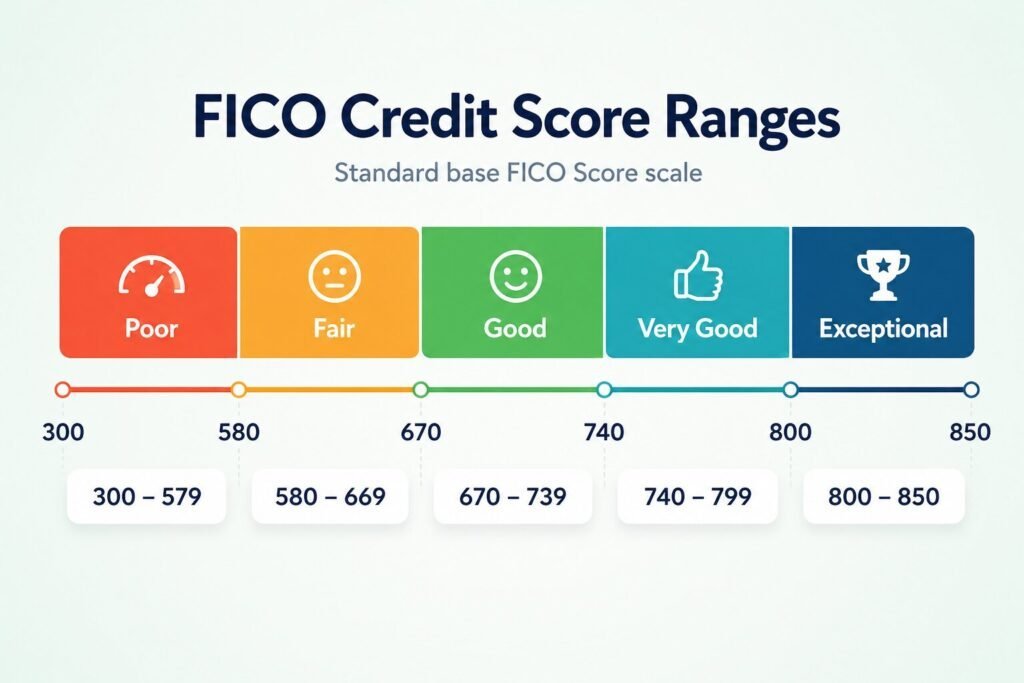
According to FICO’s credit score guidance, most FICO Scores range from 300 to 850, and a score from 670 to 739 falls within the good range.
| FICO score range | Rating | General meaning |
|---|---|---|
| 800–850 | Exceptional | Falls within the highest base FICO range |
| 740–799 | Very good | Generally reflects a strong credit profile |
| 670–739 | Good | Commonly viewed as lower credit |
| 580–669 | Fair | May lead to fewer options or less favorable terms |
| 300–579 | Poor | May make it harder to qualify for some credit products |
These categories provide a useful starting point, but they are not universal approval rules. A lender may use a different scoring model, score version, credit bureau, or internal cutoff when reviewing an application.
Important
Check the name of the score before using a credit score chart. A base FICO Score, an industry-specific FICO Score, and a VantageScore may use different ranges or category labels.
What Is a Good Credit Score Range?
A base FICO Score from 670 to 739 falls within the good range. Scores from 740 to 799 are considered very good, while scores from 800 to 850 are exceptional.
A good score can improve access to credit products and more favorable terms, but it does not guarantee approval or the lowest available rate. Lenders can also consider income, debt, payment obligations, the type of credit requested, and their own underwriting rules.
You do not need a perfect 850 to have strong credit. Once a score is already in a higher range, maintaining accurate reports, paying on time, and keeping balances manageable is usually more useful than chasing a few extra points.
What Each FICO Score Range Means
The category gives you a general sense of where a base FICO Score falls. It does not explain why the score reached that level or predict how every lender will respond.
Poor Credit Score: 300–579
A score in this range may make it harder to qualify for some credit products. When approval is available, the interest rate, fees, credit limit, or other terms could be less favorable.
The most useful next step is to review your credit reports for missed payments, collections, unfamiliar accounts, or inaccurate information. The score itself cannot show which issue is having the greatest effect.
Fair Credit Score: 580–669
A fair score may still qualify for certain loans or credit cards, but your available choices may be more limited. Lenders may also offer less favorable terms than they would to someone in a higher range.
A score of 580 is the first point in the fair FICO range. A score of 669 remains fair, even though it is only one point below the good range.
Good Credit Score: 670–739
A good score generally suggests a stronger credit profile and may open access to a broader range of offers. However, the lowest advertised rate or best product terms may still require a higher score or additional financial qualifications.
A base FICO Score of 670 is the first score in the good range. That does not mean every lender will treat it the same way. A lender may use a different scoring model, review another credit bureau, or consider factors such as your income, current debts, and recent applications.
Very Good Credit Score: 740–799
A score of 740 begins the very good FICO range. Scores in this category may help you compete for more favorable rates and terms, although the exact outcome depends on the lender and product.
At this level, protecting your existing habits may matter more than chasing small score increases. Continue paying on time, keep revolving balances manageable, and avoid unnecessary applications before a major credit decision.
Exceptional Credit Score: 800–850
Scores from 800 to 850 fall within the highest base FICO category. They generally reflect a long history of reliable credit management.
A perfect score is not required for every competitive offer. Moving from 820 to 850 may not create a meaningful difference with every lender, so maintaining a stable credit profile is usually more practical than trying to reach the maximum number.
Why Some Credit Scores Do Not Use the 300–850 Scale
The 300-to-850 scale applies to base FICO Scores and commonly used versions of VantageScore. However, you may occasionally see a score below 300 or above 850 because some lenders use specialized scoring models.
FICO offers industry-specific scores designed for particular lending decisions. These include:
- FICO Auto Scores for vehicle financing
- FICO Bankcard Scores for credit card applications
- Other specialized versions used for certain credit products
FICO’s explanation of its score versions states that base FICO Scores range from 300 to 850, while industry-specific versions generally range from 250 to 900. Higher numbers still indicate lower predicted credit risk, but the score should be interpreted using the scale for that specific model.
For example, an auto lender might review a FICO Auto Score rather than the base FICO Score shown by your bank or credit-monitoring service. A score of 875 would therefore not be possible on the base scale, but it may be valid on an industry-specific scale.
Before placing a number into a credit score chart, check the full score name and version. This helps you avoid comparing two scores that were created for different purposes.
FICO vs. VantageScore: Why Your Credit Scores May Differ
FICO and VantageScore both produce consumer credit scores, and their widely used models commonly use a scale from 300 to 850. However, they do not divide that scale into identical categories.
| General category | Base FICO Score | VantageScore 3.0 and 4.0 |
|---|---|---|
| Highest range | 800–850: Exceptional | 781–850: Excellent |
| Strong range | 740–799: Very good | Included within the broader good range |
| Good range | 670–739: Good | 661–780: Good |
| Fair range | 580–669: Fair | 601–660: Fair |
| Lowest range | 300–579: Poor | 300–600: Poor |
This means the same number may be described differently depending on the scoring model. A score of 665, for example, falls within the fair FICO range but within the good VantageScore range.
The model is only one reason your scores may not match. Differences may also come from:
- Credit bureau: One score may use an Experian report while another uses Equifax or TransUnion data.
- Reporting date: Account balances and payment updates may reach each bureau at different times.
- Score version: FICO and VantageScore have released several versions of their models.
- Credit product: A lender may use an auto, mortgage, or bankcard score designed for a particular decision.
- Information reported: Not every creditor reports to all three credit bureaus.
The Consumer Financial Protection Bureau’s credit score guidance explains that scores may differ based on the reporting agency, scoring model, type of credit product, and even the date they were calculated.
Example
Your banking app may show a VantageScore based on TransUnion data, while an auto lender may review an industry-specific FICO Score based on a different credit report. Both scores may be valid even when the numbers do not match.
A score shown by an app is not necessarily incorrect simply because a lender sees a different number. Before comparing scores, check the model, version, bureau, and date attached to each one.
What Your Credit Score Range Does Not Tell You
A credit score range gives useful context, but it cannot explain every part of a lending decision. Two people with the same score may receive different outcomes because their incomes, debts, credit histories, and applications are not identical.
Your score range alone does not reveal:
- Whether a specific application will be approved
- The interest rate, fees, or credit limit you may receive
- Which scoring model or credit bureau a lender will use
- Why the score increased or decreased
- Whether your credit report contains inaccurate information
- Whether your income and monthly debts meet the lender’s requirements
- How recent applications or account changes may affect the decision
Your credit score also does not measure every part of your financial life. For example, opening a bank account usually does not affect your credit score because checking and savings accounts are generally not credit products.
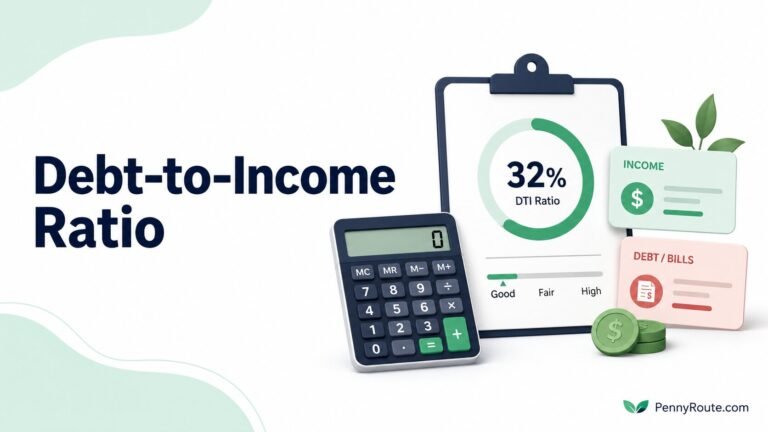
A lender may consider both your credit profile and your debt-to-income ratio when reviewing an application. Your credit score reflects information from your credit history, while the ratio compares your monthly debt payments with your income. These are related but separate parts of your financial picture.
Treat the score range as context, not a promise. The lender’s criteria, the product, and the rest of the application can all affect the decision.
Credit Score vs. Credit Report
A credit report and a credit score are connected, but they are not the same thing. Your credit report contains the information used to calculate a score, while the score summarizes parts of that information as a number.
| Credit report | Credit score |
|---|---|
| Lists reported accounts, balances, payment history, inquiries, and other credit-report information | Is calculated from information in a credit report |
| Is maintained by Experian, Equifax, or TransUnion | Is produced through a scoring model such as FICO or VantageScore |
| May contain information that needs to be reviewed or corrected | May change when report data or the scoring model changes |
| Does not represent one permanent universal score | May differ by bureau, model, version, and reporting date |
An error in a credit report may affect any score calculated from that report. For example, an incorrectly reported late payment or an account that does not belong to you could influence the result.
You can review reports from Equifax, Experian, and TransUnion through AnnualCreditReport.com, the federally authorized source for free credit reports. Checking your own credit report does not lower your credit score because it is treated as a soft inquiry, not a lender-initiated hard inquiry.
It is also possible to have a credit report without receiving a free credit score alongside it. When reviewing a score, check which bureau supplied the underlying report and which scoring model produced the number.
What to Check Before Trying to Improve Your Credit Score
Before focusing on a higher range, identify what is influencing the score you already have. A lower number may come from missed payments, high revolving balances, limited credit history, recent applications, or inaccurate report information.
1. Confirm which score you are viewing
Check the scoring model, version, credit bureau, and date. This gives you the right context for the number and helps you compare future changes accurately.
2. Review the related credit report
Look for unfamiliar accounts, incorrect balances, inaccurate late payments, or other information that may need attention. Check all three reports because the information may not be identical.
3. Look at the factors listed with your score
Many score providers show the main factors affecting the result. These may point to payment history, revolving balances, account age, recent credit activity, or a limited mix of accounts.
4. Choose the issue you can address consistently
Paying bills by their due dates and reducing high card balances may support your credit profile over time. If revolving debt is the main concern, a realistic plan for paying down credit card debt may be more useful than trying several quick-fix strategies at once.
5. Track progress without checking obsessively
Scores can move as creditors update information and models recalculate the result. A small short-term change does not always signal a major shift in your credit profile.
Avoid services that promise an exact point increase or a guaranteed timeline. Credit improvement depends on the information in your reports and the scoring model being used.
What Should You Do With Your Credit Score Range?
Your credit score range is most useful when it points to a next step.
If your score is lower than expected, review your credit reports and identify the factors affecting it. If it is already in a good or higher range, focus on maintaining accurate reports, on-time payments, and manageable balances.
The number gives you context, but your next action matters more than moving into a different label by a few points. Focus on the part of your credit profile that needs attention, or continue the habits that are already working.
FAQs About Credit Score Ranges
What do credit scores range from?
Most base FICO Scores and commonly used VantageScore models range from 300 to 850. Some industry-specific FICO Scores, including certain auto and bankcard versions, use a broader scale from 250 to 900.
What is considered a good credit score range?
A base FICO Score from 670 to 739 is considered good. VantageScore uses different category boundaries, so check the scoring model before comparing your number with a chart.
Is a credit score of 670 good?
Yes. A base FICO Score of 670 is the first score in the good range. Approval, rates, and credit limits still depend on the lender, the product, and the rest of your financial information.
What is the highest possible credit score?
The highest possible score on the standard base FICO and commonly used VantageScore scales is 850. Some specialized FICO models extend to 900.
What is the lowest possible credit score?
The lowest score on the standard 300-to-850 scale is 300. A score at the bottom of the range does not explain the cause, so reviewing the related credit reports and score factors may provide more useful context.
Why are my credit scores different?
Your scores may differ because they use different scoring models, model versions, credit bureaus, report dates, or product-specific formulas. The score shown by a bank or app may therefore differ from the one a lender uses.
Do all lenders use the same credit score ranges?
No. Lenders may use different scoring models, score versions, credit bureaus, and internal approval standards. A category such as “good” provides general context but does not create one universal qualification rule.
Is a credit score the same as a credit rating?
The terms are sometimes used interchangeably in everyday conversation, but they are not always identical. A consumer credit score is a number based on credit-report information, while “credit rating” may also refer to assessments of businesses, governments, or debt issuers.