
Budgeting as a couple involves more than adding two incomes and dividing the bills.
You may have different spending habits, debts, savings priorities, pay schedules, or ideas about what counts as fair. A shared budget gives you one place to work through those differences and decide how household money will be handled.
The setup does not have to mean combining every dollar or tracking every purchase together. It needs to make shared expenses, personal spending, savings goals, and financial responsibilities clear enough that both of you know what the plan is.
Disclaimer: This content is for informational purposes only and does not constitute financial advice. Build a budgeting arrangement that fits your household situation, and consult a qualified professional when needed.
Quick Overview
- Start by agreeing on what is shared, what stays personal, and which financial priorities matter most.
- Decide how shared expenses will be funded without assuming one approach is automatically fair for every couple.
- Choose an account and tracking setup that both partners can understand and maintain.
- Review the budget regularly so changes in income, bills, debt, or household responsibilities do not quietly make the plan outdated.
What to Discuss Before Making a Couple’s Budget
Before building the budget, make sure you both understand the financial information and decisions that will shape it.
Income and Pay Schedules
Start with take-home income and when each person is paid.
If one income varies, avoid assuming every month will look like a strong one. When pay changes significantly, budgeting with irregular income can help you choose a more workable amount to plan around.
Shared and Personal Expenses
Decide which costs belong to the household and which remain personal.
Shared expenses might include housing, utilities, groceries, insurance, childcare, or transportation. Personal expenses could include individual subscriptions, hobbies, clothing, or other spending each person handles separately.
The exact split matters less than making the boundary clear.
Existing Debt
Talk openly about minimum payments, interest rates, and any debt that affects the household budget.
You do not necessarily need to combine responsibility for every debt. You do need to understand how those payments affect the money available for shared expenses and goals.
Savings and Financial Priorities
Identify the goals you are trying to fund together and the ones that remain individual.
That could include an emergency fund, home purchase, vacation, retirement contributions, education costs, or paying down debt.
If several priorities compete for the same money, agree on which ones come first.
Personal Spending Expectations
Decide whether each person will have money they can spend without needing approval for individual purchases.
A clear personal spending amount can reduce unnecessary friction, especially when your spending habits are different.
Account Access and Bill Responsibility
Agree on who pays which bills, where shared money will be kept, and whether both partners will have access to important accounts and financial information.
One person can handle more of the day-to-day administration, but both should understand how the household system works.
What “Fair” Means to Both of You
Fair does not always mean identical.
Some couples split shared costs evenly, while others contribute different amounts based on income or other circumstances. The right arrangement is one both of you can understand, afford, and revisit when your situation changes.
Couples who are engaged or planning to combine finances may also find it helpful to discuss these money questions before marriage.
How to Create a Budget as a Couple
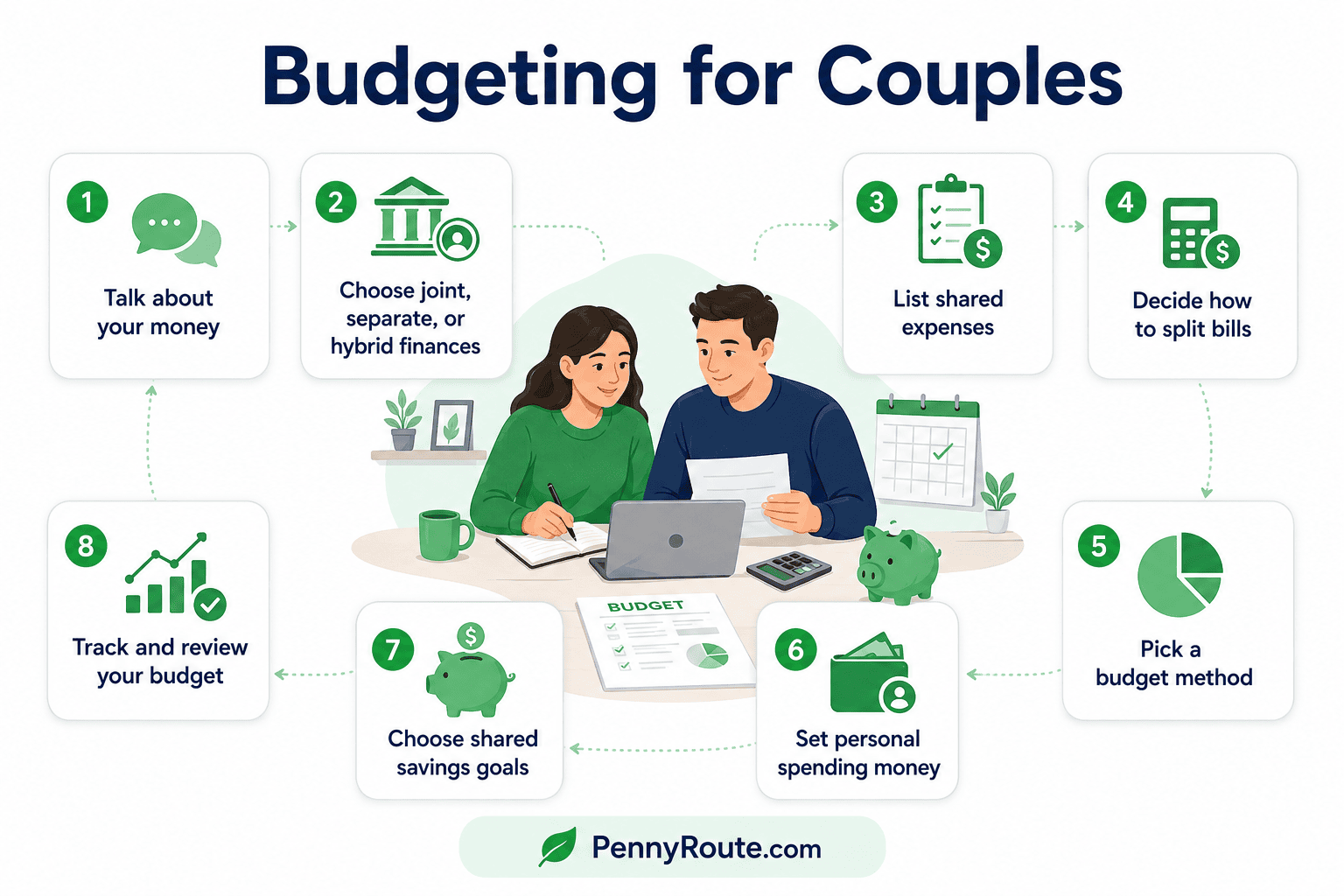
1. Put Both Incomes and Required Expenses in One Place
Start with the income each of you can realistically plan around, then list the household expenses that need to be covered.
The purpose is to create one shared view of the money coming in and the obligations competing for it.
2. Decide What Is Shared and What Stays Personal
Agree on which expenses belong in the household budget and which ones each person will handle separately.
This keeps the shared budget from becoming either too vague or unnecessarily intrusive.
3. Decide What Money, If Any, Will Be Combined
You can combine all income, keep everything separate, or use a hybrid setup with a shared account for household expenses.
The account structure should support the budget rather than determine it.
4. Agree on How Shared Costs Will Be Funded
Decide how each person will contribute toward shared expenses.
That could mean an equal split, different contribution amounts, assigned bills, or a mix of approaches. The detailed comparison belongs in the dedicated bill-splitting sections, so there is no need to calculate the split here.
5. Protect Some Personal Spending
Include room for individual spending that does not require approval for every purchase.
This can be especially useful when your interests or spending habits are different.
6. Add Shared Savings and Debt Priorities
Decide which goals belong in the household plan and how much you want to put toward them.
Examples could include emergency savings, a future purchase, extra debt payments, or another shared priority.
7. Choose One Tracking and Review Routine
Agree on where the budget will be tracked and how often you will review it together.
A shared spreadsheet may be enough for a simple setup, while a budget app for couples can provide separate logins, shared categories, account syncing, and goal tracking.
One person can handle more of the updates if that works for you, but both partners should still know where the numbers are and how the plan is changing.
Joint, Separate, or Hybrid Finances
There is no single account setup that works for every couple. The better choice is the one that makes shared expenses clear while giving both partners an arrangement they can understand and maintain.
Joint Finances
With a joint setup, most or all household income and expenses are managed through shared accounts.
This can make shared bills and goals easier to see in one place, but both partners should understand how the accounts are being used and what money is available for personal spending.
At an FDIC-insured bank, joint accounts are treated as a separate deposit insurance ownership category, with coverage rules that differ from individually owned accounts.
Separate Finances
With separate finances, each person keeps individual accounts and contributes toward agreed household expenses.
This can preserve more financial independence, but it requires clear decisions about who pays what and how shared costs will be tracked.
Hybrid Finances
A hybrid setup combines shared and individual accounts.
For example, each person might keep a personal checking account while contributing to a joint account used for rent, utilities, groceries, or other household expenses.
This can give couples a shared system for common costs without combining every part of their finances.
If you use several accounts for different purposes, budgeting with multiple bank accounts can help keep that structure organized.
How to Choose an Account Structure
Think about how you want to handle shared bills, personal spending, access to money, and financial independence.
Comparing joint and separate bank accounts can help you evaluate how ownership, bill payments, personal spending, and shared goals would work under each setup.
The best structure is the one that keeps responsibilities clear without adding more complexity than your household needs.
Couples do not have to use the same contribution method for every household expense.
Common approaches include:
- 50/50: each person contributes the same amount toward shared costs;
- based on income: each person contributes a different share based on earnings;
- assigned bills: each person takes responsibility for specific expenses;
- mixed approach: different methods are used for different parts of the budget.
An equal split can be simple, but it does not always leave both partners with similar room after shared expenses. If you are considering an even split, the question of whether couples should split bills 50/50 depends on more than the percentage alone.
When incomes differ significantly, splitting bills based on income can provide a more proportional starting point.
Income is not the only factor worth considering. Existing debt, caregiving responsibilities, personal obligations, and how much financial independence each person needs can also affect what seems workable.
Whatever method you choose, both partners should understand the arrangement and be able to revisit it when income or household responsibilities change.
How Often Should Couples Review Their Budget?
A couple’s budget does not need a long meeting every week, but both partners should know when the plan has changed and what needs attention.
Have a Short Weekly Check-In
A quick weekly check can cover:
- bills due before the next payday;
- unusual or higher-than-expected spending;
- transfers or payments that still need to happen;
- anything that needs to be adjusted before the week gets tighter.
This can be brief. The purpose is to catch small issues before they turn into larger ones.
Do a Fuller Monthly Review
Once a month, look at how the budget actually worked.
You can compare planned and actual spending, check progress on shared goals, and decide whether any contribution amounts or categories need to change for the next month.
Revisit the Budget After a Major Change
Do not wait for the usual review if something significant changes.
A new job, reduced income, moving, childcare costs, caregiving responsibilities, or a major debt change can all affect what the household budget needs to cover.
One person can handle more of the day-to-day updates, but both partners should still understand the overall plan and have access to the information they need.
Example Monthly Budget for a Couple
Here is a simple example for a couple with a combined monthly take-home income of $6,000.
| Category | Monthly Amount |
|---|---|
| Rent | $1,800 |
| Utilities | $250 |
| Groceries | $700 |
| Transportation | $450 |
| Insurance | $350 |
| Minimum debt payments | $400 |
| Shared savings | $600 |
| Personal spending ($250 each) | $500 |
| Dining and entertainment | $350 |
| Irregular expenses | $300 |
| Buffer | $200 |
| Total Planned | $5,900 |
That leaves $100 unassigned, which the couple could add to savings, debt repayment, an upcoming expense, or another priority.
The useful part of this example is not the exact percentages. Both partners can see how household costs, shared goals, and personal spending fit within the same plan.
Including personal spending also gives each person some room for individual purchases without turning every small expense into a shared decision.
What If One Partner Earns More?
A large income difference can affect more than how household expenses are divided.
The lower earner may have less room for personal spending, savings, debt payments, or other obligations even when the household budget works overall. That is why it helps to look at what each person has left after shared commitments, not just the amount each person contributes.
Income is also only part of the picture. Childcare, caregiving, medical costs, existing debt, or other responsibilities can change what is practical for either partner.
Earning more should not automatically give one person more control over shared financial decisions. Both partners should understand the budget and have a meaningful say in how household money is managed.
Revisit the arrangement when income, expenses, or responsibilities change rather than assuming the original setup should stay permanent.
What If One Partner Does Not Want to Budget?
A partner who resists budgeting may not be resisting the idea of managing money itself. The problem could be the amount of tracking, fear of being controlled, past arguments about spending, or simply a dislike of detailed systems.
Find the Real Point of Resistance
Before adding more rules or categories, figure out what is making the current approach difficult.
If detailed tracking is the issue, the solution may be a simpler system. If the concern is control, the budget may need clearer personal spending boundaries and shared decision-making.
Start With the Smallest Shared System That Solves the Problem
You do not need both partners to track every purchase in the same way.
A basic shared setup could include:
- household bills that must be covered;
- one or two shared financial goals;
- agreed personal spending;
- a short regular check-in.
Once that works consistently, you can add more detail only if it helps.
Keep Financial Access and Decisions Clear
Even if one partner handles most of the budgeting work, both should know the important account information, major bills, debts, and shared financial commitments.
A budgeting system should make household money easier to understand, not give one person unnecessary control over the other person’s access to money or financial decisions.
Build a Budget Both of You Can Use
A couple’s budget does not need to combine every account or make every spending decision shared.
It needs to make household expenses, personal spending, savings priorities, and responsibilities clear enough that both of you understand how the plan works.
Keep the system simple enough to maintain, and revisit it when income, expenses, or responsibilities change. A budget that works for both partners is easier to keep using than one that looks perfect on paper but creates friction in practice.