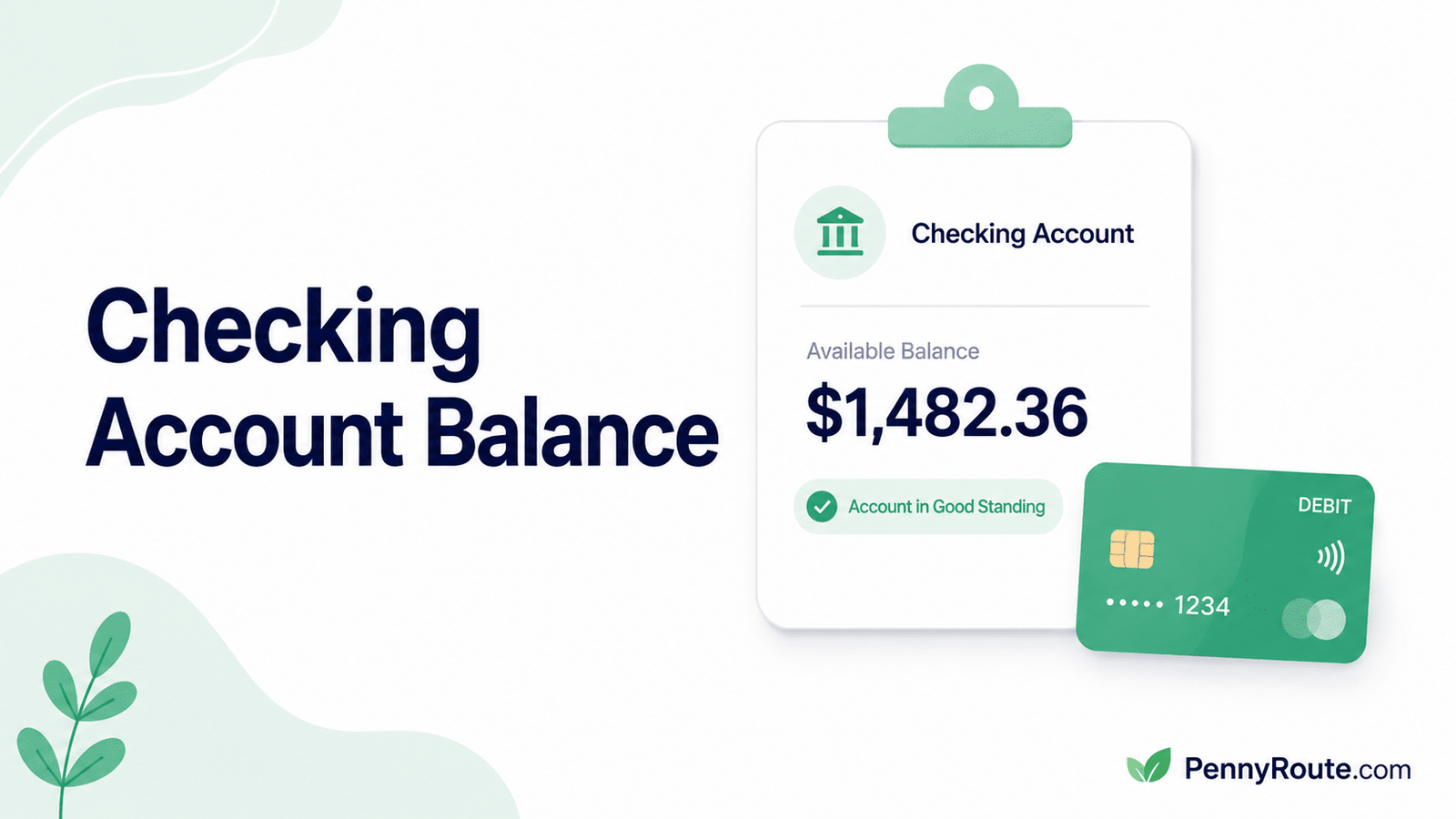
Keeping too little money in checking can leave you short when several bills clear close together. Keeping too much can leave cash sitting in an everyday spending account even though you do not expect to use it soon.
A practical checking balance should cover the payments due before your next income arrives, along with normal spending and a cushion for timing differences.
That amount depends on when you get paid, when bills leave the account, how predictable your expenses are, and how much room you want before the balance gets uncomfortably low.
Disclaimer: This content is for informational purposes only and does not constitute financial advice. Checking-account balances, fees, minimum-balance rules, transaction timing, and account terms vary by financial institution and personal circumstances.
How Much Money Should You Keep in Checking?
A practical checking balance should cover:
- Bills due before your next income deposit
- Normal spending during that period
- A buffer for timing differences and small changes in cost
For some households, that works out to about one month of expenses plus a cushion. For others, especially those paid more frequently or with evenly spaced bills, the amount could be lower.
The better approach is to calculate what needs to stay in the account between income deposits rather than choosing a round number.
For example, if you expect $1,400 in bills, $450 in everyday spending, and want a $300 buffer, your checking target would be:
$1,400 + $450 + $300 = $2,150
Calculation
That amount is not meant to stay untouched. It is the working balance that supports your normal cash flow while leaving some room for payments that arrive earlier or cost slightly more than expected.
What Should Count Toward Your Checking Target?
Your checking target should include money that is likely to leave the account before your next income deposit.
Focus on three areas: upcoming bills, everyday spending, and payments that are easy to overlook because they do not reduce the balance immediately.
Upcoming Bills and Automatic Payments
Include payments scheduled before your next deposit, such as:
- Rent or mortgage
- Utilities
- Insurance
- Childcare
- Minimum debt payments
- Subscriptions
- Scheduled transfers
- Loan payments
Use the amount you realistically expect to pay, especially when a bill changes from month to month.
Everyday Spending
Estimate what you will need for normal purchases before the next deposit.
This could include:
- Groceries
- Transportation
- Medication
- Household supplies
- Planned cash withdrawals
- Regular debit-card spending
You do not need to predict every small purchase perfectly. Use a realistic amount based on recent spending rather than an unusually low month.
Credit-Card Payments
Credit-card purchases do not reduce checking immediately, but the money is not truly available if it will be needed for the next card payment.
Include any credit-card amount you expect to pay before your next income deposit. Otherwise, the checking balance can look higher than the amount you can safely spend.
Count each expense only once. If a credit-card payment is due before your next income deposit, include that payment in the checking calculation. Do not also count the same card purchases as debit-card or cash spending during that period.
Minimum-Balance Requirements
Some checking accounts require a minimum daily or average monthly balance to avoid a maintenance fee.
If you intentionally use one of these waivers, your target must cover both your cash-flow needs and the balance requirement. Confirm how the bank measures the balance because a minimum daily balance is different from an average monthly balance.
When the requirement is difficult to maintain, it may be more practical to change accounts than keep extra money in checking only to avoid bank fees.
How Much Buffer Should You Keep in Checking?
A checking buffer gives you room for small timing differences and ordinary changes in spending.
It is separate from the money already assigned to bills and everyday purchases. It is also different from an emergency fund, which is meant for larger or less predictable financial setbacks.
A Small Fixed Buffer
A smaller buffer can work when your income is steady, bills are predictable, and you check the account regularly.
For example, keeping an extra $100 to $250 could help cover:
- A utility bill that is slightly higher than expected
- A small recurring charge you forgot about
- A card payment settling earlier than usual
- A minor change in grocery or transportation costs
The amount should be large enough to prevent an ordinary timing issue from pushing the account below zero.
A Larger Buffer for Variable Bills
A larger cushion can make sense when several expenses change from month to month or tend to clear close together.
You might prefer $300 to $500 or more when:
- Utility costs vary widely
- Several automatic payments arrive within a few days
- Household spending is shared
- Debit-card purchases often remain pending
- You want more room before a low-balance alert becomes urgent
The exact amount matters less than what the buffer is designed to absorb.
A Time-Based Buffer for Irregular Income
A fixed dollar amount can be harder to use when your income changes or deposits arrive at uneven intervals.
In that situation, an extra week of essential spending can provide a more useful target than a round number.
For example, if essential spending averages $700 per week, keeping that amount above your scheduled bills can give you more room when a client payment, commission, or freelance deposit arrives later than expected.
Review the buffer after a few pay cycles. If it is frequently used for normal expenses, the target might be too low. If it remains untouched for months, part of the money could have another purpose.
Find Your Lowest Safe Checking Balance
Your lowest safe checking balance is the amount you do not want the account to fall below.
For many people, this will be the larger of:
- The checking buffer they want to keep
- The minimum balance required to avoid a monthly fee
You usually do not need to add both amounts together.
For example, suppose you want a $300 checking buffer, but your account requires a $500 minimum daily balance to avoid a fee. In that case, $500 is the safer floor because it already provides more than the $300 cushion.
If your account has no minimum-balance requirement, your chosen buffer can serve as the floor.
Now consider a full checking target of $2,150:
- $1,400 is reserved for upcoming bills
- $450 is planned for everyday spending
- $300 is the checking buffer
As those bills and purchases leave the account, you would expect the balance to move closer to $300. Once the available balance approaches that floor, additional spending could begin using the cushion meant for timing differences or small cost changes.
Set a low-balance alert near your floor rather than at zero. An alert at zero arrives too late to help with pending purchases or automatic payments that have not posted yet.
Check the available balance, not only the posted balance, because pending transactions and deposit holds can reduce the amount you can actually use.
Your floor can change when your bills, spending, pay schedule, or account requirements change. Review it when those parts of your financial routine shift.
When You Might Need More Than One Pay Cycle in Checking
A pay-cycle calculation works well when income arrives regularly and upcoming expenses are easy to predict. Some situations call for a larger working balance.
You might keep more than one pay cycle in checking when:
- You are paid monthly rather than weekly or every two weeks
- Income arrives irregularly or varies from month to month
- Several large bills are due near the beginning of the month
- A shared household account covers spending for more than one person
- You expect travel, reduced account access, or a temporary income gap
- The account’s minimum-balance requirement is higher than your normal cash-flow target
The extra amount should still have a clear purpose. It could cover the next group of scheduled bills, provide room for a delayed deposit, or support a period when spending will be harder to monitor.
Keeping two full months of expenses in checking is not automatically safer. If much of that money is unlikely to be used soon, it may be easier to separate it from everyday spending and keep only the amount needed for normal account activity.
A larger checking balance makes sense when it solves a timing or access problem. It is less useful when it remains there by default without supporting an upcoming payment or account requirement.
Checking Buffer vs. Emergency Fund
A checking buffer and an emergency fund both provide financial breathing room, but they are meant for different situations.
Your checking buffer handles small, expected variations in everyday cash flow, such as:
- A bill clearing earlier than usual
- A utility payment costing slightly more
- A forgotten recurring charge
- A normal week with higher grocery or transportation costs
An emergency fund is meant for larger or less predictable setbacks, such as a major repair, medical expense, or loss of income.
For example, a $300 checking buffer could help when several payments settle close together. It is unlikely to provide enough protection for a $1,500 car repair or several weeks without income.
Keeping the two amounts separate also makes the checking target easier to manage. The buffer remains available for ordinary account timing, while emergency savings are less likely to be absorbed into routine spending.
You do not necessarily need separate banks for each purpose. The important distinction is knowing which money supports daily cash flow and which money is reserved for a genuine financial setback.
Signs You Are Keeping Too Little in Checking
Your target may be too low when normal account activity repeatedly brings the balance close to zero.
Common signs include:
- Low-balance alerts appear before most paydays
- You regularly move money back from savings to cover routine bills
- Automatic payments depend on the next deposit arriving exactly on time
- Pending transactions make the available balance difficult to trust
- Overdrafts or returned payments happen more than occasionally
- Small changes in groceries, utilities, or transportation create immediate pressure
One tight month does not always mean the target needs to change. A larger problem is a pattern where ordinary spending regularly uses the full buffer.
Review the timing of income and bills before increasing the balance. Sometimes the issue is not the total amount in checking, but several payments leaving within the same few days.
If the account still runs too close after adjusting payment dates or spending estimates, increase the target by a practical amount and watch the next few pay cycles. The aim is to create enough room for normal activity without moving your full emergency fund into checking.
Signs You May Be Keeping Too Much in Checking
A larger checking balance is not automatically a problem. It becomes worth reviewing when more money remains there than your normal spending, buffer, and account requirements can explain.
Possible signs include:
- The balance stays well above your target through several pay cycles
- Several months of expenses remain in checking without a near-term purpose
- Savings goals are underfunded while extra cash sits in the spending account
- You regularly spend more simply because the available balance looks high
- Money for emergencies or planned goals is mixed with everyday spending
- The account pays little or no interest compared with another suitable cash account
Before moving anything, confirm that upcoming bills, credit-card payments, scheduled transfers, and the checking buffer are fully covered.
Then decide what the extra money is meant to do. It could belong in emergency savings, a short-term goal, a sinking fund, debt repayment, or another longer-term priority.
The issue is not having a high checking balance. It is leaving money there without a clear purpose when another account or goal would suit it better.
What to Do With Money Above Your Checking Target
Once upcoming bills, everyday spending, your buffer, and any minimum-balance requirement are covered, decide what the remaining money is for.
Extra cash could go toward:
- Emergency savings: Money reserved for a larger unexpected expense or income loss
- A short-term goal: A car repair, insurance renewal, travel, home expense, or another planned cost
- A sinking fund: Money built gradually for an expense you know is coming
- Debt repayment: Additional payments when reducing debt fits your current priorities
- A longer-term goal: Money you do not expect to need soon and want to manage separately
Do not move the entire excess amount automatically. First check for credit-card payments, annual bills, scheduled transfers, or large expenses that have not yet reached the account.
When the money is meant for savings rather than everyday spending, separating it can make the purpose easier to protect. Checking and savings accounts serve different purposes, even when both are part of the same short-term plan.
The best destination depends on when you expect to use the money and what job it needs to do. The aim is not to keep checking as low as possible. It is to avoid leaving unassigned cash mixed with money you spend every day.
When to Recalculate Your Checking Target
Your checking target does not need to stay the same forever.
Review it when something changes in your income, bills, or household responsibilities, such as:
- A new pay schedule
- A raise, pay cut, or irregular income
- Moving to a different home
- Starting or ending childcare
- Taking on a new loan or debt payment
- Adding or removing automatic bills
- Combining finances with a partner
- A major change in transportation, insurance, or medical costs
You should also recalculate when the balance consistently behaves differently from what you expected. If the account regularly falls near the floor before payday, the target might be too low. If a large amount remains unused for several months, it might be higher than necessary.
Use a few recent pay cycles rather than one unusual month. That gives you a more reliable picture of normal bills, everyday spending, and timing differences.
The purpose of recalculating is not to find a perfect number. It is to keep the target aligned with the way money currently moves through the account.
Frequently Asked Questions
Is $1,000 Enough to Keep in Checking?
It can be, but the answer depends on your upcoming bills, normal spending, and preferred buffer. If $1,000 does not cover what needs to leave the account before your next deposit, the target is too low.
Should You Keep One or Two Months of Expenses in Checking?
Not necessarily. Some households are comfortable with one pay cycle plus a buffer, while others need more because income is irregular or large bills arrive close together. Use your cash-flow needs rather than a fixed number of months.
Does a Checking Buffer Count as Emergency Savings?
No. A checking buffer covers small timing differences and normal spending changes. Emergency savings are meant for larger setbacks such as a major repair, medical expense, or loss of income.