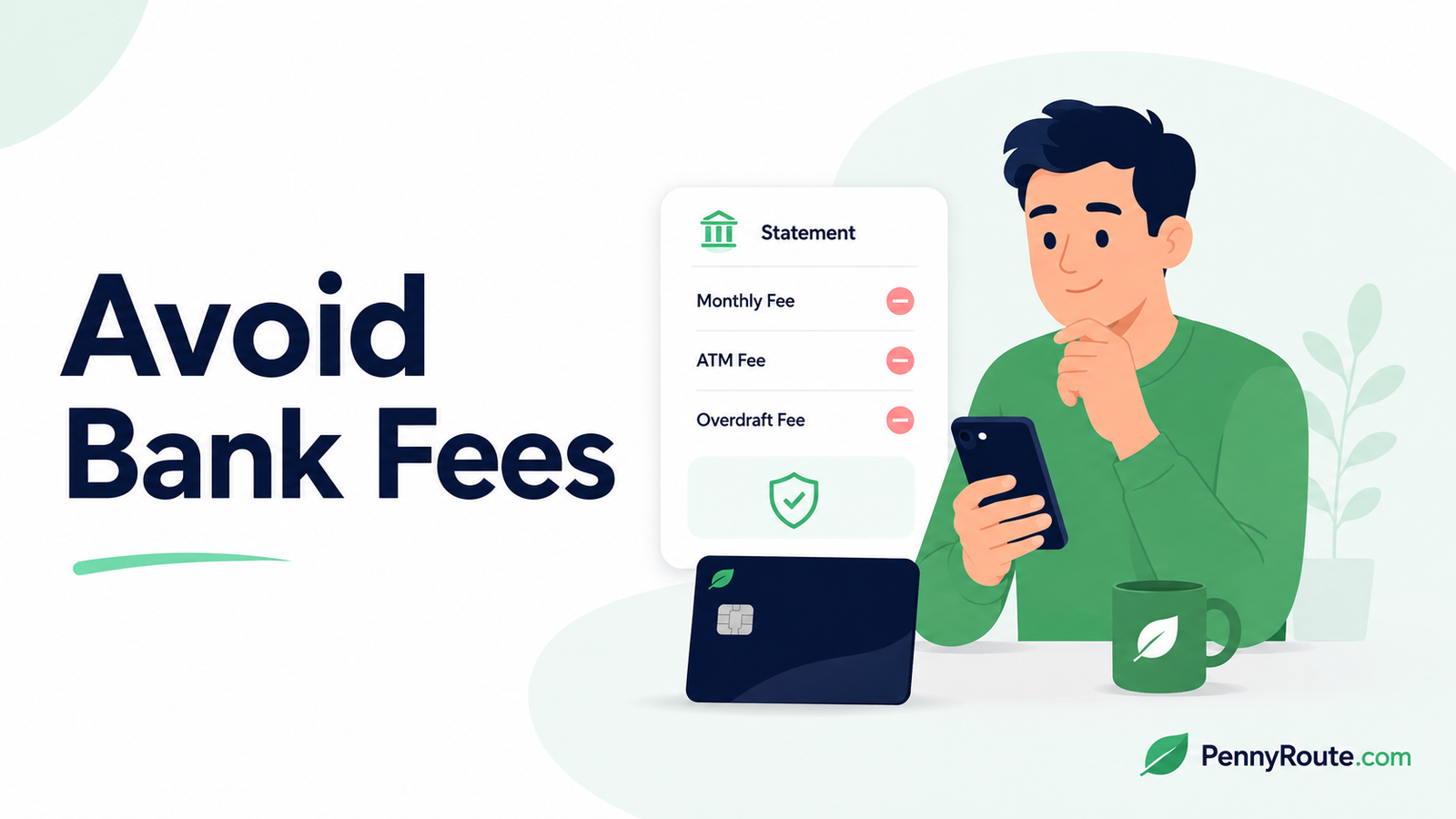
Bank fees can feel small at first.
A few dollars for using the wrong ATM. A monthly service fee you forgot about. A charge for a paper statement you barely read.
None of these fees may seem huge on their own, but they can quietly add up, especially when you’re trying to budget, save, or keep your checking account steady between paychecks.
The good news is that many common bank fees are avoidable once you know where to look. You do not need to understand every banking rule. You just need to know which fees show up most often, what usually triggers them, and what simple steps can help you avoid them.
This article breaks down the most common bank fees in 2026 and how to avoid bank fees without making your money life more complicated.
This content is for informational purposes only and does not constitute financial, investment, or professional advice.
Quick Overview: Common Bank Fees and How to Avoid Them
Most bank fees fall into a few common categories. Some are charged monthly, some happen only when you use a certain service, and others show up when your balance drops too low or a payment cannot go through.
Here is a simple overview before we go deeper.
| Bank Fee | What It Usually Means | Easy Way to Avoid It |
|---|---|---|
| Monthly maintenance fee | A regular fee for keeping the account open | Meet the waiver rules or choose a no-monthly-fee account |
| Minimum balance fee | A fee charged when your balance falls below the required amount | Pick an account with a balance requirement you can easily meet |
| ATM fee | A charge for using an out-of-network ATM | Use in-network ATMs or choose a bank with ATM fee reimbursements |
| Paper statement fee | A charge for receiving printed statements by mail | Switch to online statements |
| Wire transfer fee | A fee for sending or receiving money by wire | Use ACH transfers or other free options when possible |
| Foreign transaction fee | A charge for purchases or withdrawals in another currency | Use a card or account with no foreign transaction fees |
| Returned item or NSF fee | A fee when a payment cannot be completed because of low funds | Track autopay dates and keep a small buffer in checking |
| Stop payment fee | A fee to block a check or payment from being processed | Use only when needed and confirm the cost first |
| Account inactivity fee | A fee when an account sits unused for too long | Close unused accounts or keep occasional activity |
| Cashier’s check fee | A fee for getting an official bank-issued check | Ask if your account includes free cashier’s checks |
| Debit card replacement fee | A fee for replacing a lost or damaged debit card | Keep your card secure and ask if standard replacement is free |
| Overdraft fee | A fee when your bank covers a transaction that puts your account below $0 | Use alerts, track payments, and read our full overdraft fee guide |
The easiest way to avoid bank charges is not to memorize every fee schedule. It is to know which fees affect your account, remove the ones you can, and avoid accounts that make basic banking expensive.
Bank fees and waiver rules can change, so always check your current account’s fee schedule for the updated information.
What Are Bank Fees?
Bank fees are charges your bank adds when you use certain services, miss account requirements, or need extra help with a transaction.
Some fees are easy to spot, like an ATM fee after using a machine outside your bank’s network. Others are easier to miss, like a monthly service fee that appears quietly on your statement every month.
Common bank fees can include charges for:
- Keeping a checking or savings account open
- Falling below a required minimum balance
- Using an out-of-network ATM
- Sending wire transfers
- Receiving paper statements
- Replacing a debit card
- Stopping a payment
- Letting an account sit inactive
Not every bank charges the same fees. One bank may charge a monthly maintenance fee, while another may offer a free checking account with no minimum balance requirement.
That is why it helps to review your account’s fee schedule before opening an account and again whenever your bank updates its terms. It is not the most exciting reading, but neither is paying $15 a month for something you could avoid.
Monthly Maintenance Fees
A monthly maintenance fee is a regular charge for keeping your checking or savings account open. Some banks call it a “monthly service fee,” but the idea is the same: you pay the bank each month for the account.
This is one of the most common bank fees because it can show up even if you do nothing wrong.
For example, a checking account may charge a monthly fee unless you meet certain requirements, such as:
- Receiving a qualifying direct deposit
- Keeping a minimum daily balance
- Maintaining a combined balance across linked accounts
- Making a certain number of debit card transactions
- Being a student, young adult, senior, or military member
- Enrolling in a specific banking relationship or rewards program
The problem is that these rules can be easy to forget. You may avoid the fee one month because your paycheck arrived by direct deposit, then get charged the next month because your deposit amount changed or your balance dropped below the required level.
How to Avoid Monthly Maintenance Fees
Major banks often give you more than one way to avoid monthly service fees. For example, Chase Total Checking lists waiver options tied to electronic deposits, account balances, or linked qualifying accounts.
Start by checking your account’s monthly fee waiver rules. You can usually find them in your bank’s fee schedule, account terms, or mobile banking app.
Then ask yourself one quick question:
Can I meet these rules comfortably every month?
If the answer is yes, set up your account so the waiver happens automatically. For example, use direct deposit if that removes the fee, or keep a balance alert slightly above the minimum requirement.
If the answer is no, it may be better to switch to a no-monthly-fee checking account. Paying a fee just because the account rules do not fit your life is not a great money move.
A free checking account is often easier to manage, especially if your income changes from month to month or you are trying to keep your budget practical.
Minimum Balance Fees
Minimum balance fees are closely related to monthly maintenance fees, but they deserve a closer look because they catch a lot of people by surprise.
Some bank accounts require you to keep a certain amount of money in the account to avoid a fee. For example, your bank may say you need to keep a $500 minimum daily balance or a $1,500 average monthly balance.
Those two rules are not always the same.
A minimum daily balance usually means your account cannot drop below that amount on any day during the statement period. If it does, the fee may apply.
An average monthly balance usually means the bank looks at your balance across the month and calculates the average. This can be a little more flexible, but you still need to understand how your bank measures it.
How to Avoid Minimum Balance Fees
The safest way to avoid minimum balance fees is to choose an account with a requirement you can meet without stress.
If keeping $1,500 in checking makes your budget tight, that account may not be the right fit. Your checking account should help you manage money, not make you nervous every time rent, groceries, or bills come out.
You can also:
- Set a low-balance alert above the required minimum
- Keep your bill money and spending money organized
- Use direct deposit if that also waives the fee
- Move to a no-minimum-balance account if the rule does not fit your income
A minimum balance rule is only useful if it works for your real life. If you are constantly moving money around just to dodge a fee, a simpler account may save you both money and mental energy.
ATM Fees
ATM fees happen when you use a cash machine outside your bank’s network. This can feel extra annoying because you may get charged twice for one withdrawal.
One fee may come from the ATM owner. Another fee may come from your own bank for using an out-of-network ATM.
That means a quick $20 cash withdrawal can cost more than you expected. Not exactly the kind of surprise anyone wants from a machine that already asks too many questions.
According to Bankrate’s latest checking account and ATM fee study, out-of-network ATM withdrawals can cost several dollars once both the ATM operator fee and your bank’s fee are included.
How to Avoid ATM Fees
The easiest way to avoid ATM fees is to use your bank’s ATM network whenever possible. Most banks and credit unions have an ATM locator in their app or on their website, so it is worth checking before you withdraw cash.
You can also:
- Use cash back at grocery stores or pharmacies when available
- Withdraw a planned amount instead of making several small withdrawals
- Choose a bank or credit union with a larger ATM network
- Look for accounts that reimburse out-of-network ATM fees
- Avoid convenience ATMs in hotels, gas stations, bars, and event venues when possible
If you use cash often, ATM access should be part of choosing a bank account. A “free” checking account may not feel free if you keep paying ATM fees just to get your own money.
Paper Statement Fees
A paper statement fee is a charge for receiving printed bank statements by mail instead of using online statements.
This fee is usually small, but it is also one of the easiest bank fees to avoid. If your bank charges $2 or $3 each month for paper statements, that can turn into $24 to $36 a year for something you may not even open.
How to Avoid Paper Statement Fees
The quick fix is to switch to electronic statements.
You can usually do this from your bank’s website or mobile app by going to your statement or document delivery settings. Look for options like:
- Paperless statements
- Online statements
- E-statements
- Digital document delivery
Before switching, make sure your email address is current and you know how to download statements when needed.
A good habit is to download your monthly statement as a PDF and save it in a secure folder. That way, you still have records for budgeting, taxes, rental applications, loan applications, or anything else that requires proof of account activity.
Paper statements can be useful for some people, especially if online banking is difficult or unreliable. But if you are comfortable managing your account online, going paperless is one of the simplest ways to avoid a monthly bank charge.
Wire Transfer Fees
A wire transfer fee is a charge for sending or receiving money through a bank wire. Wire transfers are often used when money needs to move quickly or when the payment is large, such as for a home purchase, business payment, or international transfer.
The tricky part is that wire transfers can be expensive.
Your bank may charge for:
- Sending a domestic wire
- Receiving a domestic wire
- Sending an international wire
- Receiving an international wire
- Sending a wire in person instead of online
International wires usually cost more than domestic wires. Some banks also charge different fees depending on whether you start the wire online, by phone, or at a branch.
How to Avoid Wire Transfer Fees
Before sending a wire, ask whether you really need one. In many everyday situations, a free or cheaper option may work just as well.
You can consider:
- ACH transfers for regular bank-to-bank transfers
- Online bill pay for routine payments
- Zelle or similar services for people you know and trust
- A check, if the recipient accepts it
- A lower-cost international money transfer service, if you are sending money abroad
Wire transfers can still make sense when speed, security, or payment requirements matter. But for regular transfers, they are often more than you need.
Before confirming a wire, check three things: the fee, the delivery time, and whether the recipient’s bank may also charge a fee. That quick check can help you avoid paying more than expected.
Foreign Transaction Fees
A foreign transaction fee is a charge that may apply when you use your debit card or bank card for a purchase in another currency.
You may run into this fee when you:
- Travel outside your home country
- Buy something online from an international seller
- Use your debit card for a foreign currency payment
- Withdraw cash from an ATM abroad
Foreign transaction fees are often charged as a percentage of the purchase amount. For example, if your bank charges a 3% foreign transaction fee, a $100 purchase could cost you an extra $3.
That may not sound huge once. But during a trip, several meals, hotel payments, train tickets, and online bookings can turn that small percentage into a very real expense.
How to Avoid Foreign Transaction Fees
Before traveling or buying from international websites, check your bank’s debit card fee schedule. Look for terms like “foreign transaction fee,” “international service fee,” or “currency conversion fee.”
To avoid or reduce these fees, you can:
- Use a debit or credit card with no foreign transaction fees
- Check whether your bank has international ATM partners
- Avoid making many small ATM withdrawals abroad
- Compare travel-friendly checking accounts before a big trip
- Pay in the local currency when a card machine asks you to choose
That last one matters. Some card machines offer to convert the price into your home currency at checkout. This is called dynamic currency conversion, and it can come with a poor exchange rate or extra cost.
A simple rule: when traveling, paying in the local currency is often the better choice.
Returned Item or NSF Fees
A returned item fee, sometimes called a nonsufficient funds fee or NSF fee, can happen when a payment tries to go through but there is not enough money in your account to cover it.
This can happen with:
- Automatic bill payments
- Checks
- Scheduled transfers
- Loan payments
- Subscription payments
It seems like an overdraft fee, but it is not. Here is the difference in simple terms:
An overdraft fee may happen when the bank allows the payment to go through even though your account does not have enough money.
A returned item or NSF fee may happen when the bank rejects the payment because there is not enough money.
Either way, the result is frustrating. You may get charged by the bank, and the company you were trying to pay may also charge a late fee or returned payment fee. That is one fee turning into a tiny financial group project nobody asked for.
How to Avoid Returned Item or NSF Fees
The best way to avoid NSF fees is to know when money is leaving your account.
A few basic habits can help:
- Keep a list of automatic payments and their due dates
- Set calendar reminders before large bills come out
- Turn on low-balance alerts
- Keep a small buffer in checking if possible
- Move bill money into checking before the due date
- Cancel subscriptions you no longer use
- Avoid writing checks unless you are sure the money will stay available
Also, check your bank’s current fee policy. Some banks have reduced or removed NSF fees, while others may still charge them in certain situations.
If you get charged once, it may be worth asking your bank whether they can reverse the fee as a courtesy. It is not guaranteed, but a polite ask can sometimes save you money.
Stop Payment Fees
A stop payment fee is a charge for asking your bank to block a check or payment before it goes through.
You might request a stop payment if:
- You lost a check
- You mailed a check to the wrong person
- A payment amount is incorrect
- You canceled a service, but the payment may still process
- You suspect a payment could be unauthorized
This fee can be worth paying in some cases, especially if stopping the payment protects you from a bigger loss. But it is not something to use casually because the fee itself can be expensive.
How to Avoid Stop Payment Fees
The best way to avoid stop payment fees is to prevent payment mistakes before they happen.
Before sending a check or scheduling a payment:
- Double-check the recipient’s name
- Confirm the amount
- Review the payment date
- Keep a record of checks you write
- Cancel subscriptions directly with the company before asking the bank to block payment
If you do need a stop payment, ask your bank about the fee before confirming the request. Also ask how long the stop payment lasts, because some requests expire after a certain period.
For checks, timing matters. If the check has already cleared, a stop payment will not help.
Account Inactivity Fees
An account inactivity fee is a charge that may apply when you do not use an account for a long time.
This can happen with old checking or savings accounts you forgot about, especially if there is still a small balance sitting there. The bank may consider the account inactive if there are no deposits, withdrawals, transfers, or other customer-initiated activity for a certain period.
The exact rule depends on the bank, so it is worth checking your account terms if you have an old account you rarely use.
How to Avoid Account Inactivity Fees
Start by reviewing accounts you no longer use. If an old account is not helping you budget, save, or manage bills, closing it may be the simplest option.
You can also:
- Set up a small recurring transfer if you want to keep the account open
- Make an occasional deposit or withdrawal
- Keep your email, phone number, and mailing address updated
- Review old accounts at least once or twice a year
- Move money from forgotten accounts into your main banking setup
Unused accounts can also make your money harder to track. This does not mean having multiple savings accounts is a bad idea. It can work well when each account has a clear purpose, such as taxes, vacation, or an emergency fund. The problem starts when old accounts sit unused, and you forget to track them.
Keeping fewer, useful accounts is often easier than trying to manage accounts you no longer need.
Cashier’s Check and Money Order Fees
A cashier’s check fee is a charge for getting an official check issued by your bank. A money order fee is similar, but money orders are usually used for smaller payments and may be available from banks, post offices, grocery stores, or other providers.
You may need a cashier’s check or money order when a regular personal check is not accepted. Common examples include:
- Apartment deposits
- Used car purchases
- Certain government payments
- Large one-time payments
- Payments where the receiver wants guaranteed funds
These fees are not always avoidable because the person or company receiving the money may require a specific payment type. Still, it helps to know the cost before you request one.
How to Avoid Cashier’s Check and Money Order Fees
First, ask whether a free payment method is accepted. In some cases, ACH transfer, online bill pay, debit card payment, or a personal check may work instead.
You can also:
- Check whether your account includes free cashier’s checks
- Compare the fee at your bank, credit union, post office, or store
- Avoid using cashier’s checks for small payments unless required
- Ask the receiver exactly which payment methods they accept
- Plan ahead so you are not paying extra for urgency
If you often need official checks, it may be worth choosing a bank account that includes them for free or at a lower cost. For most people, though, this is an occasional fee to plan around rather than a monthly problem.
Debit Card Replacement Fees
A debit card replacement fee is a charge for getting a new debit card when your current card is lost, damaged, stolen, or expired.
Many banks replace expired cards for free because that is part of normal account service. But if you lose your card, damage it, or need a rush replacement, your bank may charge a fee.
The rush option is usually the expensive part. If you need the card delivered quickly, the bank may charge extra for expedited shipping.
How to Avoid Debit Card Replacement Fees
The simplest way to avoid this fee is to keep your card safe and use digital tools when possible.
You can also:
- Add your debit card to a secure mobile wallet as a backup
- Keep your card in the same safe place when not using it
- Avoid carrying extra cards you do not need
- Ask whether standard replacement is free before choosing rush delivery
- Use online banking or bill pay while waiting for a replacement card
If your card is stolen or there is suspicious activity, report it quickly. Avoiding a replacement fee is helpful, but protecting your account matters more.
Early Account Closure Fees
An early account closure fee is a charge some banks apply if you open an account and close it too soon.
For example, a bank may charge this fee if you close a checking or savings account within the first 90 or 180 days. The exact timeline depends on the bank.
This fee is less common than monthly maintenance fees or ATM fees, but it is still worth checking before opening a new account, especially if you are switching banks or opening an account for a bonus offer.
How to Avoid Early Account Closure Fees
Before opening a new bank account, read the account terms and fee schedule. Look for phrases like:
- Early account closure fee
- Account closing fee
- Closed within 90 days
- Closed within 180 days
If the account has this fee, avoid closing it too quickly unless you have a strong reason.
You can also:
- Wait until the fee period ends before closing the account
- Move most of your money out but keep the account open with the required minimum balance
- Make sure there are no pending payments, deposits, or transfers before closing
- Ask the bank whether closing the account will affect any bonus requirements
This is one of those fees that is easy to avoid with a little patience. Not exciting, but neither is paying money just to leave a bank.
Overdraft Fees
An overdraft fee can happen when a transaction takes your checking account below $0 and the bank allows the payment to go through.
This might happen with a debit card purchase, automatic bill payment, check, or scheduled transfer. The fee can be expensive, especially if more than one payment hits your account while your balance is low.
How to Avoid Overdraft Fees
A few simple habits can reduce the risk:
- Turn on low-balance alerts
- Track automatic payments and bill due dates
- Keep a small checking buffer if you can
- Link a savings account as backup if your bank offers this option
- Review your bank’s overdraft settings
- Consider turning off debit card overdraft coverage
Also, check whether your bank charges overdraft fees at all. Some banks have reduced them, added grace periods, or removed them completely.
How to Do a 10-Minute Bank Fee Audit
The easiest way to avoid bank fees is to first find out which ones you are already paying.
You do not need a complicated spreadsheet for this. Just review your recent bank activity and look for repeat charges.
Here is a practical bank fee audit you can do in about 10 minutes.
Check Your Last 3 Bank Statements
Open your last three checking account statements. If you use more than one bank account, start with your main checking account first.
Look for words like:
- Fee
- Service charge
- Maintenance
- ATM
- Wire
- Statement
- Overdraft
- Returned item
- Stop payment
- Minimum balance
Write down every fee you find, even if it looks small.
Add Up the Total
Next, add the fees together.
This number may be higher than expected, especially if you have monthly maintenance fees, ATM fees, or repeated small charges.
For example, a $12 monthly service fee may not feel like much once. But over a year, that is $144. Add a few ATM fees, and suddenly your bank account is doing paid subscription behavior without asking nicely.
Identify the Pattern
After you add up the fees, look for the reason behind them.
Ask yourself:
- Am I paying a monthly fee every month?
- Am I using out-of-network ATMs?
- Is my balance dropping below the required minimum?
- Are automatic payments hitting before payday?
- Am I paying for paper statements?
- Is this account still the right fit for me?
One fee may be a mistake. A repeated fee is usually a system problem.
Contact Your Bank
Once you know the pattern, contact your bank and ask what can be changed.
You can ask:
- “What do I need to do to avoid this monthly fee?”
- “Is there a no-fee version of this account?”
- “Can this fee be waived as a courtesy?”
- “Does direct deposit remove this charge?”
- “Is there a lower-cost account that fits my balance?”
The bank may not waive every fee, but asking gives you useful information. Sometimes the fix is simple. Other times, the answer tells you it may be time to switch banks.
Make One Change Right Away
Do not try to fix everything at once.
Start with the fee that appears most often or costs the most. That might mean switching to online statements, setting up direct deposit, turning on balance alerts, or moving to a no-monthly-fee checking account.
Small changes count. The goal is not to build a perfect banking system in one afternoon. It is to stop paying avoidable fees one by one.
What to Ask Your Bank to Waive Fees
Sometimes avoiding bank fees starts with one easy step: asking.
Banks do not always waive fees, but they may reverse a charge if it is your first time, you have a good account history, or you recently fixed the issue that caused the fee.
You do not need a perfect script. Keep it polite, clear, and direct.
If You Were Charged a Monthly Maintenance Fee
You can ask:
“Hi, I noticed a monthly maintenance fee on my account. Can you tell me what I need to do to avoid this fee going forward?”
This helps you find out whether direct deposit, a minimum balance, or a different account type can remove the charge.
You can also ask:
“Is there a no-monthly-fee checking account I can switch to?”
That question is useful because some banks offer lower-fee accounts, but they may not suggest them unless you ask.
If You Were Charged an ATM Fee
You can ask:
“I was charged an ATM fee. Does my account offer any ATM fee refunds or a larger no-fee ATM network?”
Even if the bank does not refund the fee, you may learn which ATM network to use next time.
If You Were Charged a Paper Statement Fee
You can ask:
“If I switch to online statements today, can this paper statement fee be removed?”
This is one of the easier fees to prevent going forward.
If You Were Charged a Fee by Mistake
You can ask:
“I believe this fee may have been charged by mistake. Can you review it for me?”
Be ready to explain why. For example, maybe your direct deposit posted late, your account type changed, or you thought you had already enrolled in paperless statements.
If You Want a Courtesy Refund
You can ask:
“I understand why the fee was charged, but this is my first time asking. Is there any courtesy refund available?”
A courtesy refund is never guaranteed, but it is worth asking, especially if the fee was unusual for your account.
The goal is not to argue with the bank. It is to understand the rule, ask for a possible refund, and make sure the same fee does not keep showing up every month.
When It Makes Sense to Switch Banks
Sometimes the easiest way to avoid bank fees is to choose a better account.
That does not mean you need to switch banks after one small charge. But if the same fees keep showing up, your current account may not fit your life anymore.
It may be worth comparing other banks or credit unions if:
- You keep paying monthly maintenance fees
- You cannot comfortably meet the minimum balance requirement
- You often use out-of-network ATMs
- Your bank charges for basic services you regularly need
- You rarely use the branch, but you are still paying branch-style fees
- A no-monthly-fee checking account would be easier to manage
Before switching, check more than the monthly fee. Look at ATM access, cash deposit options, transfer limits, mobile app reviews, customer service, and whether the account is FDIC or NCUA insured.
A good bank account should make your money easier to manage. If avoiding fees feels like a monthly puzzle, it may be time to look for a simpler account.
Monthly Checklist to Avoid Bank Fees
You do not need to think about bank fees every day. A quick monthly check can help you catch problems before they become expensive habits.
Use this checklist once a month:
- Check your statement for words like “fee,” “service charge,” “ATM,” “wire,” and “maintenance.”
- Confirm your direct deposit or balance still meets the monthly fee waiver rules.
- Review upcoming automatic payments so bills do not hit before money arrives.
- Make sure you are still enrolled in paperless statements.
- Check whether you used any out-of-network ATMs.
- Ask your bank about any fee you do not understand.
- Review old or unused accounts and close any you no longer need.
If you use separate accounts for goals, make sure each one has a clear purpose. Our guide on how many accounts you should have can help you decide what is useful and what is just adding clutter.
This small routine can help you spot avoidable charges early. You may not remove every fee forever, but you can stop small bank charges from quietly becoming part of your budget.
Frequently Asked Questions
What are the most common bank fees?
The most common bank fees include monthly maintenance fees, ATM fees, overdraft fees, paper statement fees, wire transfer fees, minimum balance fees, and returned item or NSF fees.
Not every bank charges the same fees, so it is worth checking your account’s fee schedule instead of assuming your account is free.
How can I avoid monthly bank fees?
You can usually avoid monthly bank fees by meeting your bank’s waiver rules. This may include setting up qualifying direct deposit, keeping a minimum balance, making certain transactions, or linking eligible accounts.
How do I avoid ATM fees?
Use ATMs inside your bank’s network whenever possible. You can usually find them through your bank’s mobile app or website.
Can banks waive fees?
Some banks may waive fees depending on the situation. However, you should check with your bank.
Is it better to use an online bank to avoid fees?
Online banks often have lower fees than traditional banks, but they are not perfect for everyone.
Before switching, check ATM access, cash deposit options, customer service, transfer limits, and whether the account is FDIC insured. A low-fee account is only helpful if it works for how you actually use money.
Is it worth keeping a minimum balance to avoid a fee?
Sometimes, but only if you can do it comfortably.
If keeping the minimum balance makes your budget tight, the account may not be a good fit. In that case, a no-minimum-balance checking account may be easier to manage.
How often should I check my bank account for fees?
Checking once a month is a good starting point.
Look through your statement for words like “fee,” “service charge,” “ATM,” “wire,” and “maintenance.” A quick review can help you catch small charges before they become normal.