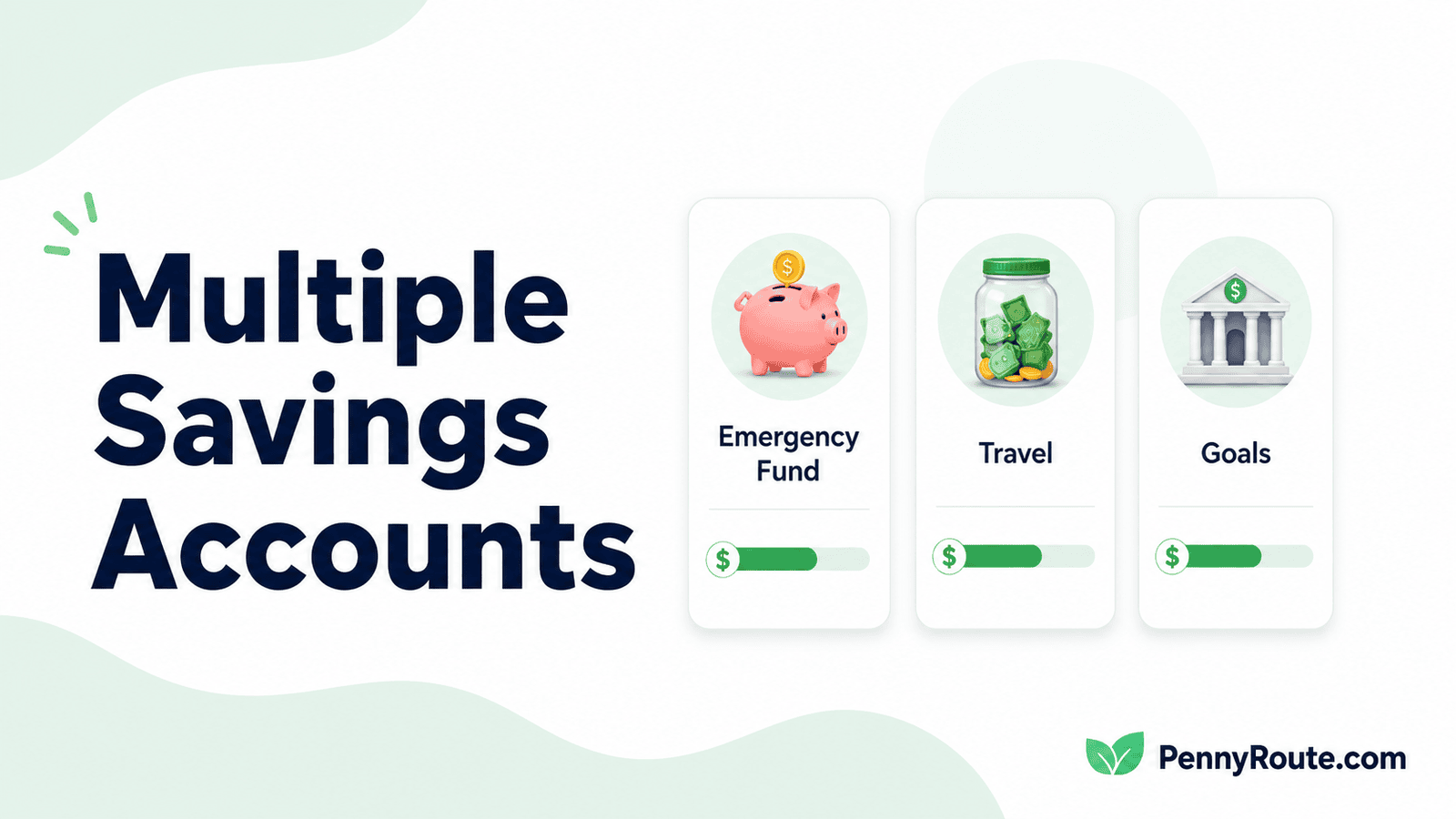
Yes, you can have multiple savings accounts. You may keep them at the same bank, spread them across different banks, or use a combination of both.
Each account remains separate, which means it can have its own balance, interest rate, transfer rules, fees, and account requirements. That separation may be useful, but it also gives you more terms and transactions to monitor.
Before opening another savings account, look beyond the number of accounts. Check what each account pays, what it costs, and how easily you can move or access the money.
Disclaimer: This content is for informational purposes only and does not constitute financial advice. Savings account rates, fees, balance requirements, transfer limits, withdrawal policies, and eligibility rules vary by financial institution.
Can You Have Multiple Savings Accounts?
There is no general restriction on how many checking or savings accounts you can open or how many banks and credit unions you can use, according to the Consumer Financial Protection Bureau.
A bank may still apply its own rules. For example, it might:
- Limit how many accounts of the same type one customer can open
- Require a minimum opening deposit
- Review your identity and banking history
- Restrict promotional offers to new customers
- Require each account to meet separate balance or activity conditions
Being allowed to open another account does not guarantee that every bank will approve every application or offer the same terms.
The more important question is whether an additional account offers something useful, such as a better interest rate, different access, or a separate ownership arrangement.
How Multiple Savings Accounts Work
Savings accounts do not combine simply because they belong to the same person or appear under one banking login.
Each account normally has its own:
- Account number
- Balance
- Transaction history
- Statement
- Annual percentage yield, or APY
- Minimum-balance requirement
- Deposit and withdrawal options
- Beneficiary or ownership details
Suppose you have $7,000 in one savings account and $3,000 in another. Your total savings may be $10,000, but each bank calculates interest, fees, and balance requirements using the money held in that specific account.
That distinction matters when one account offers a higher APY or requires a certain balance to avoid a monthly fee.
Accounts held at the same bank may be easier to view together, but they still operate under their individual terms.
Where to Keep Multiple Savings Accounts
You can keep several savings accounts at one bank or use accounts at different institutions. Neither approach is automatically better.
The practical difference is how the accounts are accessed, linked, funded, and monitored.
Multiple Accounts at the Same Bank
Keeping several savings accounts at one bank can make them easier to monitor.
The accounts may appear together under one online banking login, allowing you to view each balance without switching between different apps or websites. You may also be able to rename the accounts with labels that make them easier to identify.
Even when the accounts sit under the same login, they remain separate. Each one may have its own:
- Account number
- APY
- Monthly fee
- Minimum-balance requirement
- Statement
- Withdrawal rules
- Ownership or beneficiary details
Do not assume that benefits attached to one account automatically apply to another. A fee waiver, promotional rate, or balance requirement may need to be met separately for each account.
Keeping everything at one bank may be simpler, but the terms of the individual accounts still determine whether the arrangement is worthwhile.
Accounts at Different Banks
Using more than one bank may give you access to different rates, features, or methods of accessing your money.
For example, you might keep one savings account at your main bank for quicker transfers and another at an online bank offering a more competitive APY.
The tradeoff is additional administration. You may need to manage:
- Separate usernames and security settings
- Multiple statements and tax forms
- Different customer-service channels
- Separate alerts and account notices
- More than one banking app or website to monitor
Keeping money at another bank may also provide an alternative source of funds if your main institution experiences an outage, account restriction, or temporary access problem.
That backup is only useful when you know how to access the second account and have not allowed it to become an account you rarely check.
Do Multiple Savings Accounts Earn More Interest?
Opening more savings accounts does not increase your earnings by itself. Interest depends on each account’s APY, balance, compounding method, fees, and rate conditions.
Suppose you have $10,000 and both available savings accounts pay the same APY with no fees.
You would generally not earn more simply by dividing the money like this:
- $10,000 in one account
- $5,000 in each of two accounts
The combined balance and rate remain the same.
A second account may improve your earnings when it offers a higher effective return. That advantage can disappear, however, if the account charges fees or requires you to keep money in a lower-paying linked product.
Compare APYs, Not Just Interest Rates
APY reflects the interest rate and the effect of compounding over one year. It provides a more useful comparison than looking only at the stated interest rate.
Different savings accounts can have different APYs, even when they are offered by the same institution.
An advertised APY may also depend on conditions such as:
- Maintaining a qualifying balance
- Making a minimum deposit
- Linking another account
- Receiving direct deposits
- Staying within a particular balance tier
- Opening the account during a promotional period
Rates can change, particularly on variable-rate savings accounts. A strong introductory rate should not be treated as permanent unless the account terms say otherwise.
Compare the APY you are likely to receive after considering the balance you will actually keep in the account.
Fees and Minimum-Balance Requirements
Each savings account can have its own fee schedule.
Banks and credit unions may charge monthly maintenance fees for savings accounts, although the fee and available waiver conditions must be disclosed when the account is opened.
A fee may be waived when you:
- Keep a required minimum balance
- Maintain another account at the institution
- Set up a qualifying automatic transfer
- Meet age or student eligibility rules
- Use electronic statements
- Satisfy another account-specific condition
Opening several accounts can make these requirements harder to meet.
For example, suppose you have $3,000 available and two savings accounts each require a $2,000 minimum balance to avoid a fee. Dividing the money evenly would leave both accounts below the requirement.
A seemingly small monthly charge can also outweigh the interest earned on a modest balance.
Before opening another account, compare:
- The monthly fee
- The fee-waiver requirements
- The APY you are likely to earn
- The minimum opening deposit
- Any conditions tied to the advertised rate
An account with a slightly higher APY is not necessarily the better choice when its fees or requirements do not suit how you plan to use it.
Transfers Between Savings Accounts
Moving money between multiple savings accounts is usually straightforward, but the process depends on where the accounts are held.
Transfers Within the Same Bank
Transfers between accounts at one bank may be processed quickly, sometimes immediately.
You may be able to move money through:
- Online banking
- A mobile banking app
- Telephone banking
- A branch
- A scheduled recurring transfer
Check the bank’s processing rules before relying on an internal transfer for a time-sensitive payment. A transfer initiated on a weekend or holiday may be treated differently from one made during a business day.
Also confirm when the money becomes available to withdraw. A balance may appear updated before every type of transaction is fully available.
Transfers Between Different Banks
To transfer money between banks, you will normally need to link the accounts.
The bank may ask you to verify ownership through:
- Small test deposits
- Instant account verification
- Login-based verification through a third-party service
- Account and routing numbers
- Additional identity checks
Once linked, external transfers may take one or more business days. Processing times, daily limits, and incoming or outgoing transfer fees can vary.
The sending bank and receiving bank may also display the transaction at different times.
For example, money may leave one account before it becomes available in the other. Do not treat it as spendable in both places while the transfer is pending.
Review the bank’s limits before moving a large amount. Some institutions set different limits for new accounts, recently linked accounts, or transfers initiated from outside the bank.
Withdrawal and Account-Access Rules
Savings accounts are intended primarily for holding money rather than frequent everyday transactions.
A bank or credit union may set its own limits on savings-account withdrawals or transfers. It may also charge a fee after you exceed the permitted number of transactions or the maximum withdrawal amount.
Check whether each account limits or charges for:
- Online transfers
- Automatic transfers
- Telephone transfers
- ATM withdrawals
- Teller withdrawals
- Large withdrawals
- Transfers to external banks
Access can vary significantly between accounts.
One account may include an ATM card, while another may require you to transfer money into checking before you can use it. An online savings account may offer a competitive rate but no branches or cash-deposit option.
These differences matter more when you need the money quickly.
Before relying on a savings account for accessible cash, confirm:
- How you can withdraw the money
- How long transfers normally take
- Whether daily transfer limits apply
- Whether an ATM card is available
- Whether the bank charges for certain transactions
- What happens when you exceed a withdrawal limit
The best rate may not compensate for access that is too slow or restrictive for the account’s intended use.
Automating Deposits Across Several Accounts
Automation can help fund multiple savings accounts without requiring a manual transfer every payday.
Two common approaches are split direct deposit and scheduled bank transfers.
Split Direct Deposit
Some employers let you divide a paycheck among several accounts. Confirm how many accounts the payroll system supports and review the first paycheck after making a change.
Scheduled Transfers
Another option is to deposit your pay into checking and schedule transfers to each savings account. Set transfers after your expected payday so the money has time to arrive.
Leave enough in checking for bills, pending card transactions, and normal spending. Automatic saving should support your cash flow, not create an avoidable overdraft.
Review recurring amounts when your income, expenses, or account terms change. A transfer schedule should not continue unchanged simply because it was set up months ago.
FDIC Coverage for Multiple Savings Accounts
Opening several savings accounts at the same bank does not automatically multiply your FDIC insurance coverage.
The standard coverage amount is $250,000 per depositor, per FDIC-insured bank, for each ownership category. Deposits owned by the same person in the same ownership category at one insured bank are generally added together when coverage is calculated.
For example, suppose you individually own:
- Savings Account A with $160,000
- Savings Account B with $120,000
If both accounts are at the same FDIC-insured bank and fall within the same single-account ownership category, the combined $280,000 is used to calculate coverage. Opening the second account does not give each balance its own separate $250,000 limit.
Accounts at different FDIC-insured banks are generally covered separately, subject to the applicable ownership rules.
Different ownership categories may also receive separate coverage when all requirements are met. An individually owned account and a qualifying joint account, for example, are not necessarily treated as the same ownership category.
The FDIC’s deposit insurance guidance explains how accounts are combined and how ownership categories affect coverage.
Federally insured credit unions are covered through the National Credit Union Administration rather than the FDIC. Confirm the institution’s insurance status before depositing money.
Make Sure the Extra Account Adds Value
Multiple savings accounts can work well together, but another account should offer more than another balance to monitor.
It might provide a better rate, different access, easier transfers, or a useful relationship with another institution. When the account does not improve how your money is held or accessed, the additional terms and login may not add much.
The broader question of how many bank accounts you should have depends on your complete financial setup. For this decision, compare what the new savings account adds with the effort required to maintain it.