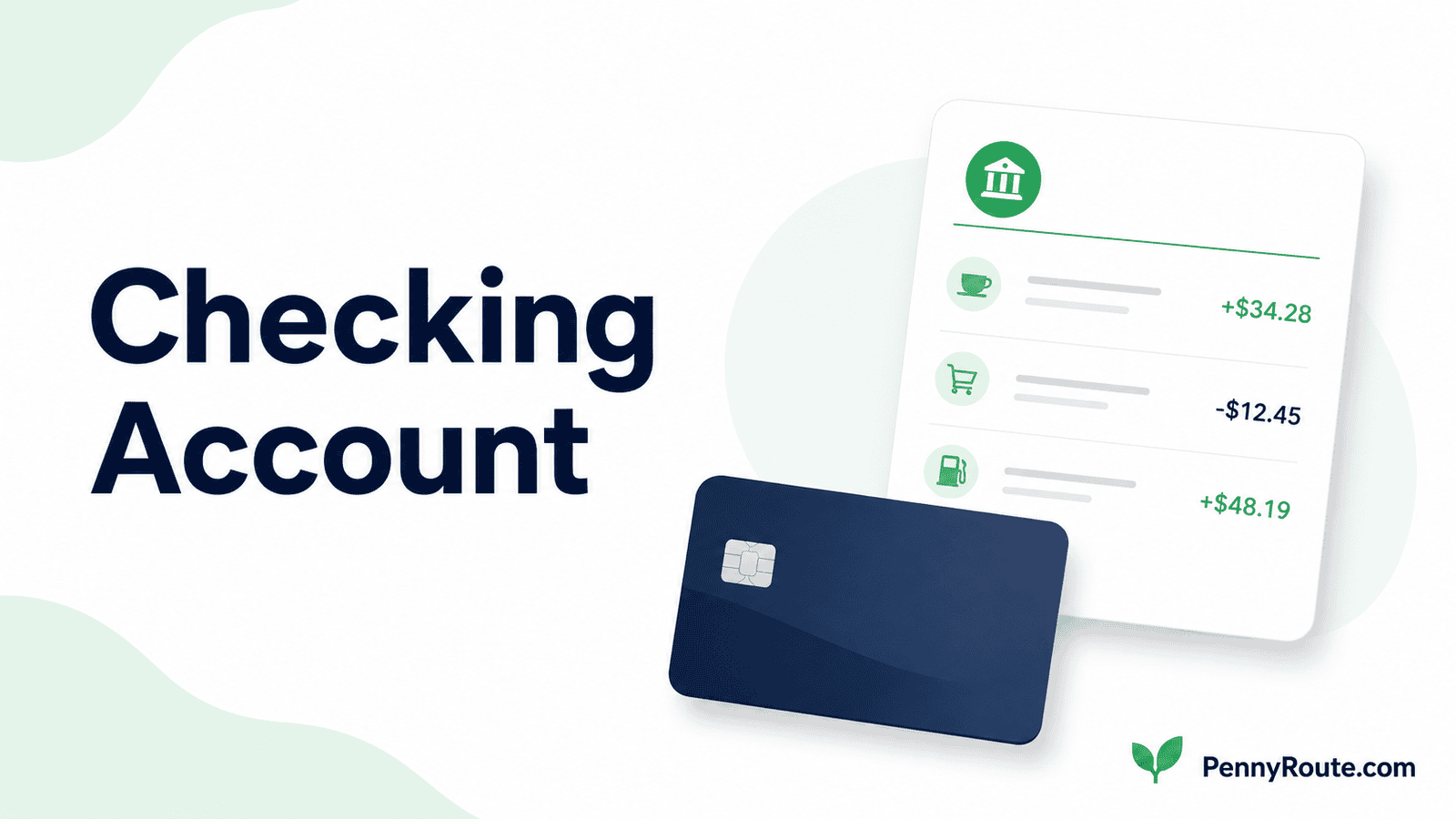
A checking account is a bank or credit union account designed for money you expect to use regularly. You can receive income, pay bills, make debit-card purchases, withdraw cash, and move money to other accounts.
Deposits, card purchases, checks, automatic payments, and transfers do not always update at the same time. That means the balance on the screen is not always the full amount you can safely spend.
Disclaimer: This content is for informational purposes only and does not constitute financial advice. Checking account features, fees, transaction processing, deposit availability, overdraft policies, and insurance coverage vary by financial institution and account.
What Is a Checking Account?
A checking account is a deposit account built for everyday money use.
It gives you a place to receive income and handle regular payments, purchases, withdrawals, and transfers.
Unlike money you are setting aside for a distant goal, money in checking is generally expected to move in and out regularly.
A Checking Account Is Not the Same as a Debit Card
A debit card is one way to access money in a checking account. It is not the account itself.
You may also access the same account through:
- online or mobile transfers;
- ATM withdrawals;
- paper checks;
- automatic bill payments;
- person-to-person payments;
- branch transactions.
If your debit card is lost, replaced, or expires, the checking account does not disappear. The card is simply one access method connected to it.
How Money Moves Through a Checking Account
Money can enter and leave a checking account in several ways, and transactions do not always settle immediately.
Money Coming In
Deposits may arrive through:
- direct deposit;
- transfers from another account;
- mobile check deposit;
- cash or check deposits;
- government benefits;
- refunds or other incoming payments.
A deposit appearing in your transaction history does not always mean every dollar is immediately available to use. Some deposits are subject to temporary holds or other availability rules.
Money Going Out
Money can leave through:
- debit-card purchases;
- ATM withdrawals;
- bill payments;
- checks;
- automatic payments;
- transfers to another account;
- person-to-person payments;
- account fees.
A debit purchase may first appear as pending before it fully posts. A check or scheduled payment may not appear until it reaches the account.
Current Balance vs. Available Balance
Your banking app may show more than one balance.
The current balance generally reflects transactions that have already posted to the account.
The available balance is the amount the institution currently treats as available for transactions after accounting for things such as pending activity and deposit holds.
Here is a simplified example:
| Account activity | Amount |
|---|---|
| Current balance | $1,200 |
| Pending card purchase | −$90 |
| Deposit amount still on hold | −$200 |
| Available balance | $910 |
In this example, the account shows $1,200 as the current balance, but only $910 is currently available.
The available balance is usually more useful than the current balance, but it is still not a complete picture of every payment you have already committed to.
Pending Transactions
A card transaction can reduce your available balance before it fully posts.
The amount can also change before settlement.
Restaurants may add a tip after the initial authorization. Hotels and rental-car companies can place temporary holds. Fuel stations sometimes authorize an amount that differs from the final purchase.
That is why a pending transaction is not always the final amount that will appear on the statement.
Deposit Holds
A deposited check may appear in the account before the full amount is ready to spend.
How quickly deposited funds become available depends on factors such as the deposit type, timing, account history, and the institution’s funds-availability policy.
Suppose you deposit a $1,000 check but only $300 becomes available immediately. The remaining $700 may still appear as part of the account balance while being temporarily unavailable for spending.
The hold does not necessarily mean something is wrong. It means the institution has not yet made the full deposit available.
Some Payments May Not Appear Yet
Your available balance can look comfortable even when part of the money is already committed.
For example, you may have:
- a check that has not cleared;
- a subscription renewing tomorrow;
- a scheduled transfer that has not processed;
- an automatic insurance payment due later in the week.
Suppose your available balance is $800, but a $600 rent payment is scheduled for tomorrow. Technically, $800 may be available at that moment, but treating all $800 as free spending money would create a problem when the rent payment arrives.
This is one reason tracking your expenses can still be useful when your banking app already shows recent transactions. The account tells you what has reached the bank; your own records can also account for money that is already committed.
Checking Accounts Can Come With Different Features
Checking accounts vary in how you access and manage them.
Depending on the account, you may have mobile check deposit, bill pay, account alerts, ATM access, paper checks, or other digital tools.
The same account can also be online, joint, student, interest-bearing, rewards-based, or free. Those labels describe different characteristics, which is why the types of checking accounts can overlap rather than forming completely separate categories.
Checking Account Fees to Know
A checking account may be inexpensive to maintain, or it may charge fees depending on the account and how you use it.
Common charges can include:
- monthly maintenance fees;
- out-of-network ATM fees;
- overdraft or returned-payment fees;
- wire-transfer fees;
- check-ordering or stop-payment fees;
- other optional service charges.
“Free checking” has a more specific meaning than simply having a low-cost account. Maintenance and routine activity fees do not apply in the same way, although certain optional services or account events can still carry charges.
What Happens If the Balance Is Too Low?
When a transaction reaches the account without enough available money to cover it, several things can happen.
The institution might:
- decline the transaction;
- return it unpaid;
- pay it and allow the account to go negative;
- transfer money from a linked account;
- cover the shortage through another overdraft arrangement.
An overdraft occurs when the institution pays a transaction that the available balance cannot fully cover.
How overdraft fees work depends on the transaction type, the account’s settings, and the institution’s policy. Not every shortage produces the same result or the same fee.
Is Money in a Checking Account Insured?
Eligible checking deposits at an FDIC-insured bank are automatically covered under federal deposit insurance rules.
The standard limit is generally $250,000 per depositor, per insured bank, per ownership category. Eligible products include checking and other insured deposit accounts.
At a federally insured credit union, eligible checking or share-draft deposits receive federal share insurance under NCUA coverage rules.
Deposit insurance protects eligible money if the insured bank or credit union fails.
It does not protect against every type of loss. Scams, stolen credentials, unauthorized transactions, and payment disputes involve different protections and procedures.
Checking Account vs. Savings Account
Checking and savings accounts are both deposit accounts, but they are designed for different jobs.
| Checking account | Savings account |
|---|---|
| Built for frequent money movement | Built mainly for money being set aside |
| Commonly used for bills and everyday purchases | Commonly used for emergencies and future goals |
| Usually provides broad payment and debit-card access | Usually places less emphasis on everyday payments |
| May pay little or no interest | More commonly designed to earn interest |
A simple way to separate them is to keep money you expect to use soon in checking and money you are intentionally setting aside in savings.
The differences in access, interest, and account rules become more important when comparing a checking vs. savings account.
Does a Checking Account Build Credit?
A standard checking account is a deposit account, not a credit account.
Receiving direct deposits, using a debit card, and keeping a positive balance do not normally build a traditional credit history in the same way that properly managed credit accounts can.
Problems connected to checking can still have financial consequences, but simply using the account responsibly is not the same thing as building credit.
What Comes Next?
Once you understand how checking-account balances and transactions work, the next step is comparing the accounts themselves.
Fees, ATM access, cash deposits, overdraft treatment, digital tools, and account requirements are some of the details that matter when you choose a checking account that fits the way you actually bank.