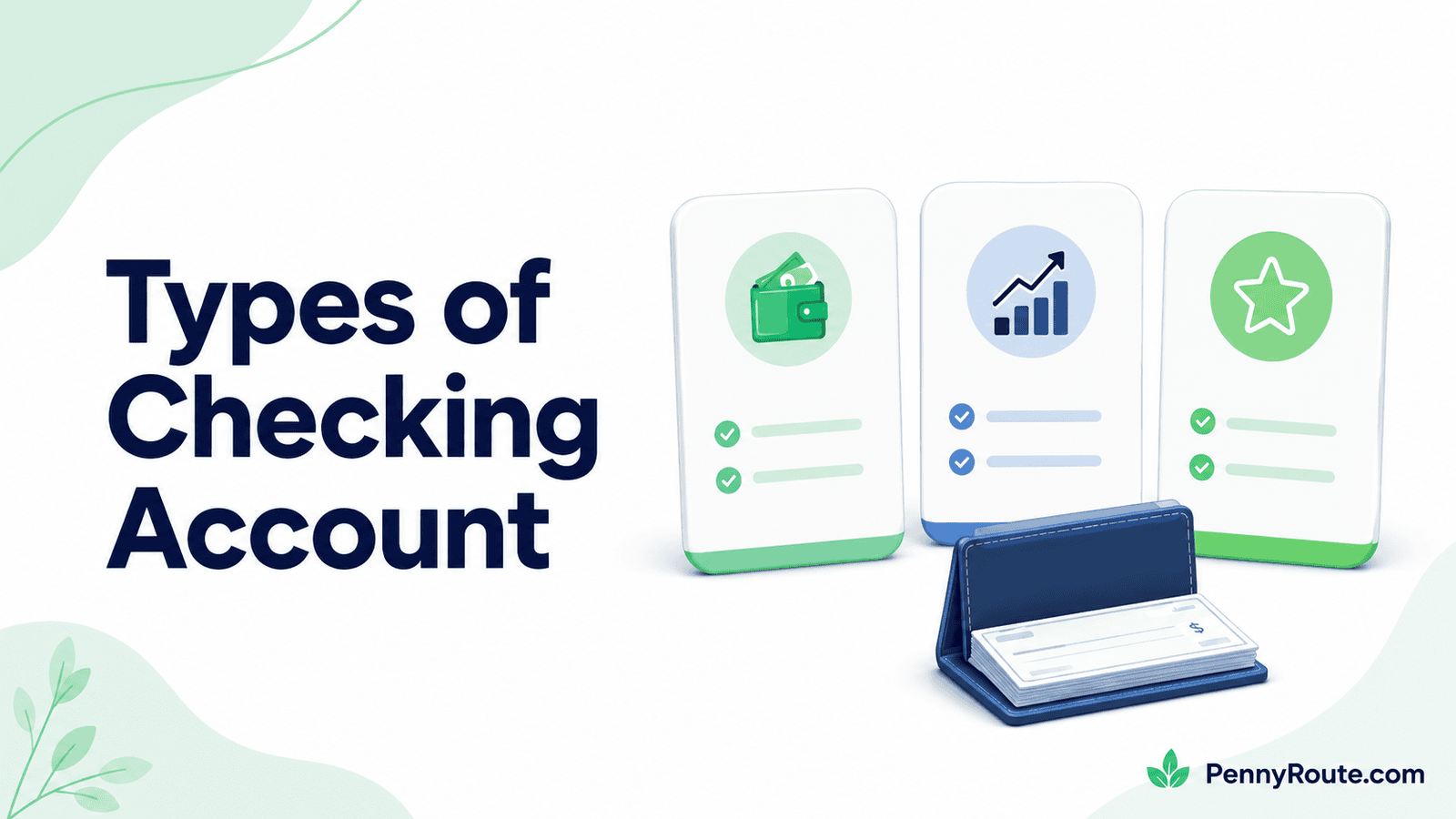
Checking accounts come with labels such as free, online, student, interest-bearing, rewards, or joint checking. The confusing part is that those labels do not always describe completely separate kinds of accounts.
Some tell you how the account is accessed. Others describe its fees, ownership, eligibility, or earning features. A single checking account can fit several categories at the same time.
Once you know what each label is actually telling you, comparing accounts becomes much easier.
Disclaimer: This content is for informational purposes only and does not constitute financial advice. Checking account features, fees, eligibility requirements, rates, and account terms vary by financial institution.
What the Different Types of Checking Accounts Actually Mean
Checking-account labels usually describe one characteristic of the account, not a completely separate banking product.
For example:
- Online checking describes how you primarily access the account.
- Free checking describes part of its fee structure.
- Student checking describes who the account is designed for.
- Interest-bearing checking describes an earning feature.
- Joint checking describes how the account is owned.
That is why the categories can overlap.
Banks and credit unions also use names such as “Everyday,” “Essential,” “Preferred,” “Opportunity,” or “Advantage.” Those names do not have one universal meaning.
The name gives you a clue, but the actual fees, access, ownership, and requirements tell you how the account really works.
| Checking label | What it mainly describes | Main tradeoff to check |
|---|---|---|
| Standard checking | General-purpose everyday banking | Fees and features vary widely |
| Free or low-fee checking | Fee structure | Other service charges may still apply |
| Online checking | Access and service model | Cash deposits and branch access may be limited |
| Student checking | Eligibility or customer group | Student benefits may expire |
| Teen checking | Age and account setup | Adult access or controls may apply |
| Interest-bearing checking | Earnings on the balance | Fees or requirements can offset the interest |
| Rewards checking | Incentives tied to account activity | Qualification rules may be demanding |
| Premium or relationship checking | Balance or banking relationship | Benefits may require substantial deposits |
| Second-chance checking | Banking-history eligibility | Features or terms may be more limited |
| Joint checking | Ownership | Co-owners usually share broad access |
1. Standard Checking Accounts
A standard checking account is the general-purpose version of checking.
It typically supports everyday transactions such as debit-card purchases, direct deposits, bill payments, ATM withdrawals, transfers, and sometimes paper checks.
The label itself tells you very little about cost. One standard account may have no monthly maintenance fee, while another charges one or waives it only when certain conditions are met.
Standard checking makes sense when you mainly need routine banking and the actual fees, ATM access, digital tools, and other terms fit the way you use the account. Specialized labels matter less if they do not give you a benefit you would actually use.
2. Free and Low-Fee Checking Accounts
Free checking and fee-waivable checking are not quite the same thing.
Under federal Regulation DD, an account generally cannot be advertised as “free” or “no cost” if routine maintenance or activity fees apply. An account that charges a monthly fee unless you meet a deposit-related waiver condition, such as maintaining a minimum balance or receiving qualifying direct deposits, is not the same as genuinely free checking.
A genuinely free checking account can still charge for certain services or events, such as out-of-network ATM use, wires, check orders, or other optional services.
Low-fee and fee-waivable accounts can also be inexpensive when the requirements already match your normal banking habits.
The better comparison is whether the account stays low-cost without making you change how you normally manage your money.
3. Online Checking Accounts
Online checking describes how you primarily bank, not a particular fee structure or feature set.
These accounts are usually managed through a website or mobile app and may come from online-only banks or institutions with limited branch networks.
Digital accounts can offer competitive fees, rates, and online tools, but cash deposits and face-to-face service may be less convenient. ATM access depends on the institution and its network.
Opening an account online does not make the deposit less eligible for federal insurance. Checking deposits held directly at an FDIC-insured bank are covered under FDIC rules up to the applicable insurance limits.
At federally insured credit unions, eligible share-draft accounts are covered under NCUA share-insurance rules.
An online account tends to fit best when most of your banking is already digital. If you regularly deposit cash, visit branches, or use services that are difficult to handle online, access deserves as much attention as fees or interest.
4. Student Checking Accounts
Student checking accounts are designed for eligible students or young adults and often come with lower fees, reduced balance requirements, or simpler terms.
Eligibility rules vary. An institution may use age, enrollment status, or other criteria, and the account may eventually convert to a regular checking product.
That future conversion matters.
A student account with attractive terms today can become much less appealing if a maintenance fee appears after graduation or after you reach a certain age.
If the account otherwise fits your needs, confirm how long the student benefits last and what happens afterward. Age, enrollment, identification, and other requirements involved in opening a student bank account are better checked before applying rather than assumed from the “student” label.
5. Teen Checking Accounts
Teen checking is aimed at younger users who are beginning to manage everyday money.
These accounts often involve a parent, guardian, or other adult in the setup or ownership, depending on the institution and account structure. Features may include transaction alerts, spending controls, transfer limits, or tools that make it easier to introduce independent banking gradually.
The details that matter most are not the teen branding itself.
Check:
- who legally owns the account;
- what the adult can see or control;
- whether spending or transfer limits apply;
- what happens when the teen reaches the account’s age limit.
A teen account can be useful while oversight still serves a purpose. Once those controls become unnecessary, the transition to a regular checking account matters more than the teen-specific features.
6. Interest-Bearing Checking Accounts
Interest-bearing checking pays interest on eligible balances while still functioning as a transaction account.
Some accounts marketed as high-yield checking fall into this category. They offer a comparatively higher rate, often in exchange for meeting balance, direct-deposit, debit-card, or other activity requirements.
A higher APY does not automatically make a checking account more valuable.
If you normally keep only a small amount in checking, the interest may be modest. A monthly fee or balance requirement can also erase much of the benefit.
Before choosing one, compare whether the interest you expect to earn outweighs the fees and requirements.
There is also a practical tradeoff: money sitting in checking for the interest should still have a reason to be there. If it is not needed for near-term spending or bills, compare whether another account is a better place for that money.
7. Rewards Checking Accounts
Rewards checking gives you something extra for qualifying account activity.
Depending on the account, the reward might be:
- cash back on eligible debit-card purchases;
- ATM-fee reimbursements;
- points or another incentive;
- another activity-based benefit.
The qualification rules deserve more attention than the headline reward.
An account might require a certain number of debit-card transactions, qualifying direct deposits, electronic statements, or other monthly activity before the reward applies.
A useful reward fits activity you already do.
If you start making extra debit-card purchases or rearranging deposits simply to qualify, the reward is now influencing your banking behavior rather than rewarding it.
8. Premium or Relationship Checking Accounts
Premium or relationship checking is usually designed for customers who maintain larger balances or keep several financial products with one institution.
Possible benefits include:
- waived banking fees;
- ATM reimbursements;
- higher transaction limits;
- preferred rates;
- additional service or support.
The value depends on what you must keep with the institution to receive those benefits.
Suppose maintaining a large checking balance removes a monthly fee. That sounds useful, but the balance itself has an opportunity cost if the money could earn more elsewhere.
Relationship checking makes the most sense when you already maintain the qualifying balances or use the linked services. Moving money solely to unlock benefits can make an attractive-looking perk much less valuable.
9. Second-Chance Checking Accounts
Second-chance checking is generally designed for people whose previous banking history makes it difficult to qualify for a regular account.
Banks and credit unions may use specialized checking-account consumer reports when reviewing an application. The CFPB explains that second-chance accounts are generally intended for people with negative banking history, such as past unpaid negative balances or account closures.
That is different from simply having a low credit score.
A second-chance account may offer fewer services or different terms than a standard account. If you are considering one, check the fees, available features, restrictions, and whether the institution offers a path to a regular checking account later.
Past banking problems and bad credit are not the same thing, which is worth understanding if you’re trying to open a checking account with bad credit.
10. Joint Checking Accounts
Joint checking describes ownership rather than the account’s fees, access model, or earning features.
Two or more people own the account and share access to the money.
In most circumstances, either owner can withdraw money and may be able to close the account without the other owner’s approval, although the account agreement and state law can matter. The CFPB explains the potential access rights of joint checking-account owners.
That makes joint ownership more significant than simply giving another person a debit card.
Deposit insurance also works by ownership category. For qualifying joint accounts at an FDIC-insured bank, each co-owner’s combined interests in joint accounts at that bank are generally insured up to $250,000.
The account itself may still be standard, online, free, interest-bearing, or rewards-based. “Joint” only tells you who owns it.
For couples, deciding between joint, separate, or combined bank accounts is a separate question from understanding what joint ownership means.
One Checking Account Can Fit Several Types at Once
The categories become much easier to understand once you stop treating them as ten separate boxes.
Consider a college student who opens an account that:
- has no monthly maintenance fee;
- is managed entirely online;
- pays interest;
- offers student-specific terms.
That one account could reasonably be described as student checking, online checking, free checking, and interest-bearing checking.
Or consider two spouses who share an online account with no maintenance fee. That account is both joint checking and free online checking.
Both descriptions can be accurate.
Each label tells you something different about the same account.
That is also why comparing only the account name can lead you in the wrong direction. The actual terms decide whether the account works for you.
Other Specialized Checking Labels
There is no single master list of checking-account types.
Financial institutions create additional labels around customer groups, account features, risk controls, and service levels.
| Label | What it usually describes |
|---|---|
| Senior checking | Accounts marketed to older customers, sometimes with age-based terms or benefits |
| Checkless or low-risk checking | Accounts with limited or no paper-check access and fewer ways to overdraw |
| Private banking checking | Checking linked to broader wealth-management or high-balance relationships |
| Military, employer, or membership checking | Terms or benefits available through a qualifying relationship |
These names are not standardized. “Senior,” “Preferred,” or “Opportunity” checking at one institution may work very differently from an account with the same label elsewhere.
Treat the label as a clue about the account, not a substitute for its fee schedule and terms.
Business Checking Is a Different Use Case
Business checking is designed for business income and expenses rather than personal household spending.
It can have different transaction limits, fees, documentation requirements, ownership arrangements, and account-management tools.
For someone comparing personal checking accounts, it is better treated as a separate banking need rather than another variation on the list above.
Compare the Terms Behind the Label
Once you know what the account label describes, compare the details that affect everyday use: fees, waiver conditions, ATM access, cash deposits, overdraft settings, transfers, branch access, earning requirements, and ownership.
Those are the details that matter when you choose a checking account that fits the way you actually bank.