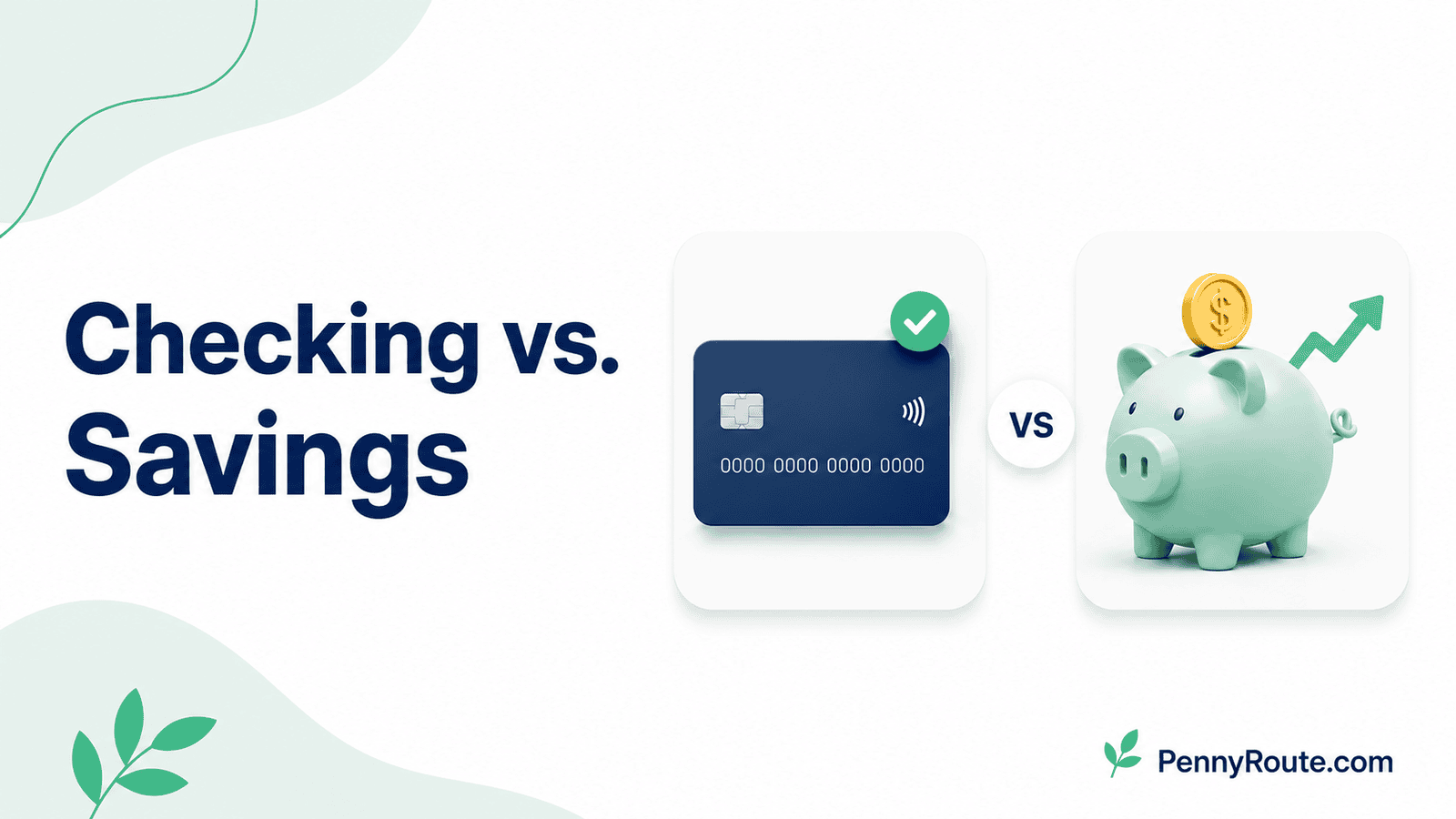
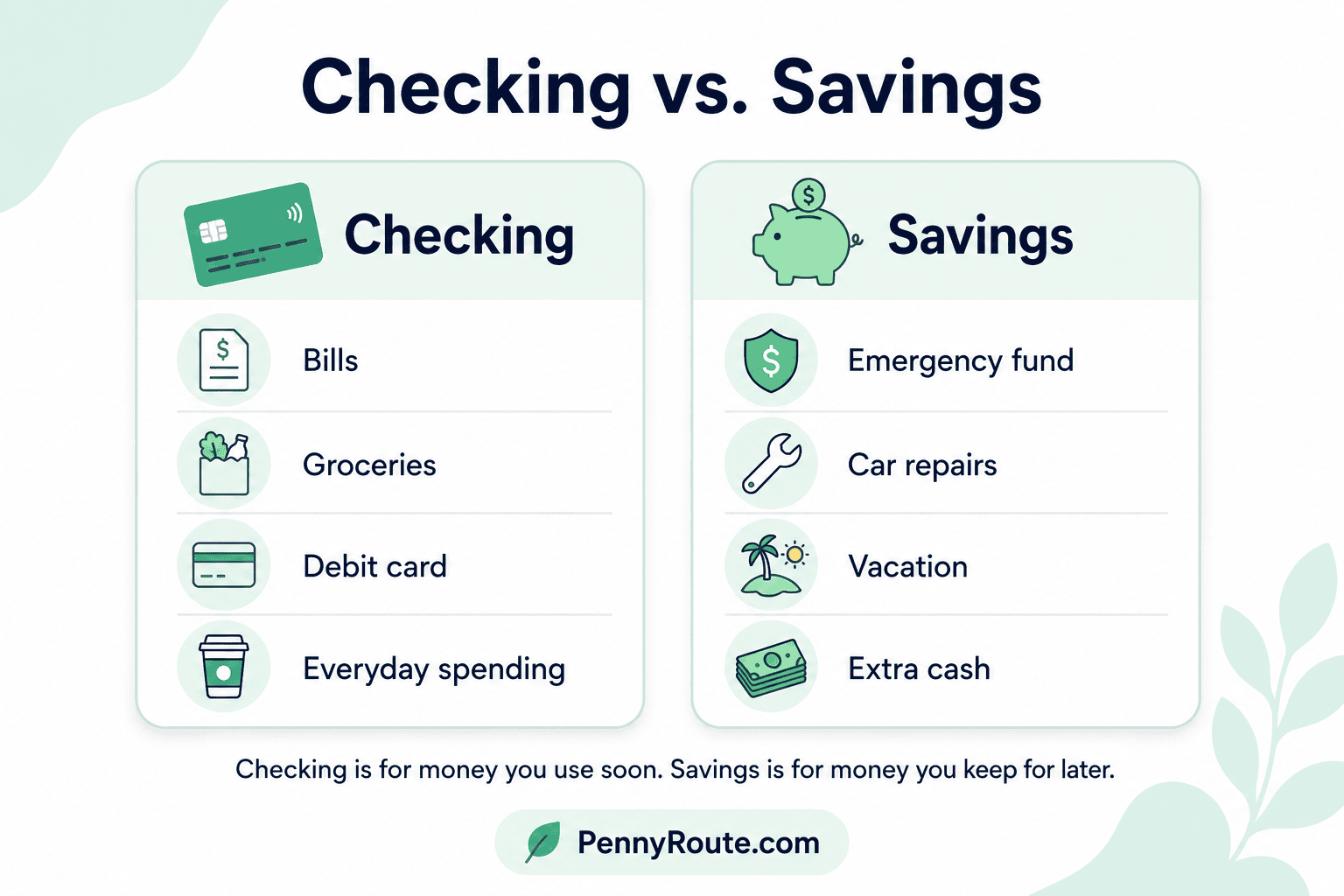
A checking account and a savings account serve different jobs. Checking is built for money you expect to use soon, such as bills, purchases, transfers, and cash withdrawals. Savings is better suited to money you are setting aside for emergencies, planned expenses, or future goals.
A simple way to separate them is: checking holds money expected to move, while savings holds money you have decided not to spend yet. Using both can make it easier to keep everyday spending separate from money reserved for later.
Disclaimer: This content is for informational purposes only and does not constitute financial advice. Account features, fees, interest rates, withdrawal rules, and eligibility requirements vary by financial institution.
Checking vs. Savings Account
Checking and savings accounts are both deposit accounts, but they are built for different types of money use.
| Feature | Checking account | Savings account |
|---|---|---|
| Main purpose | Everyday spending and payments | Money set aside for later |
| Access | Frequent transactions | Less emphasis on everyday spending |
| Debit card access | Common | Less common |
| Interest | Often low or none | Often higher |
| Best for | Bills, purchases, transfers, cash | Emergency savings and planned goals |
| Deposit insurance | Eligible deposits can be federally insured | Eligible deposits can be federally insured |
Access and Payment Options
Checking accounts are designed for regular activity. Debit card purchases, bill payments, transfers, cash withdrawals, and direct deposits are common parts of everyday use.
Savings accounts are usually better for money that does not need to move as often. You can still transfer or withdraw funds, but the account is not typically designed to handle day-to-day spending in the same way.
Interest, Fees, and Minimum Balances
Savings accounts often pay more interest than checking accounts, but the rate alone should not decide where you keep your money.
Fees and balance requirements matter too. A higher APY can lose some of its value if the account charges fees you are likely to pay, while a lower-rate account may still work better if it has fewer costs or easier requirements.
When to Use a Checking Account
A checking account is usually the better place for money you expect to use in the near term.
That can include:
- rent or mortgage payments;
- utilities and other recurring bills;
- groceries and everyday purchases;
- debit card spending;
- cash withdrawals;
- transfers to other accounts.
Keeping near-term spending money in checking makes it easier to handle regular payments without moving money back and forth unnecessarily.
The account itself still needs to fit how you bank. Fees, ATM access, overdraft policies, balance requirements, and digital tools are some of the main things to compare when you choose a checking account.
When to Use a Savings Account
A savings account is usually a better place for money you do not expect to spend right away.
That can include:
- emergency savings;
- annual or irregular expenses;
- travel or holiday spending;
- insurance deductibles;
- a future car purchase;
- other short-term savings goals.
Keeping this money separate from everyday spending can make it easier to see what is actually available for current expenses.
If you prefer to separate goals instead of keeping everything in one balance, using multiple savings accounts can make those categories easier to track.
Should You Have Both Checking and Savings Accounts?
For many households, using both accounts makes everyday money easier to separate.
Checking can hold the money needed for bills and routine spending, while savings can hold money reserved for emergencies, irregular expenses, and short-term goals. That separation can make it easier to see which money is already committed and which money is meant to stay untouched.
Having both is not automatically better, though. If one account adds fees, balance requirements, or extra complexity without serving a clear purpose, a simpler setup may work just as well.
How to Divide Money Between Checking and Savings
There is no single percentage that works for every household. The split depends on what you need checking to cover before the next paycheck or transfer and what money you are intentionally setting aside.
Money That May Stay in Checking
Checking usually needs enough to cover:
- upcoming bills;
- everyday spending;
- scheduled transfers;
- expected cash withdrawals;
- a small cushion for timing differences or variable expenses.
The point is not to keep the balance as low as possible. It is to leave enough available that normal payments do not depend on repeatedly moving money back from savings.
Money That May Move to Savings
Money that does not have a near-term job can be separated for:
- emergency savings;
- annual or irregular expenses;
- planned purchases;
- travel;
- other short-term goals.
Moving reserved money out of checking can also make the spending balance easier to read because money intended for later is no longer mixed with everyday cash flow.
Example
Suppose you have $2,500 available after payday.
You expect $1,700 in bills and everyday spending before the next paycheck and want an extra $200 cushion in checking.
That would leave:
$2,500 − $1,700 − $200 = $600
The $600 could move to savings if it is not needed for another near-term expense.
Review the Split When Your Expenses Change
The amount you keep in each account does not need to stay fixed. A higher utility bill, upcoming insurance payment, change in income, or new savings goal can all change how much needs to remain in checking.
Reviewing the split when those circumstances change is usually more useful than trying to maintain the same checking balance every month.
Which Account Should the Money Go Into?
When you are deciding where a specific amount of money belongs, focus on what that money needs to do next.
Ask:
- Will you need it soon?
Money for upcoming bills, groceries, or other near-term spending usually belongs in checking. - Does it need easy payment access?
If you expect to use a debit card, pay a bill, withdraw cash, or make a transfer soon, checking is usually the more practical place. - Is the money reserved for later?
Emergency savings, annual expenses, and future purchases are usually easier to protect when they are kept in savings. - Would separation help you avoid spending it accidentally?
If money is technically available but not meant for everyday use, moving it to savings can make your checking balance easier to interpret.
The decision does not need to be permanent. Money can move between the two accounts as bills, goals, and timing change.
Should Checking and Savings Be at the Same Bank?
They do not have to be.
Keeping both accounts at the same bank can make transfers and account management simpler. It may also be useful if the bank offers relationship benefits for holding multiple accounts.
Using different institutions can make sense when one offers a stronger checking account and another offers a better savings rate or fewer fees. Keeping savings elsewhere can also create a little more separation between everyday spending and money you are trying not to touch.
The tradeoff is convenience. Transfers between different institutions can take longer, and you may need to manage separate apps, login details, and account rules.
Choose the setup that gives each account a clear job without adding unnecessary cost or friction.