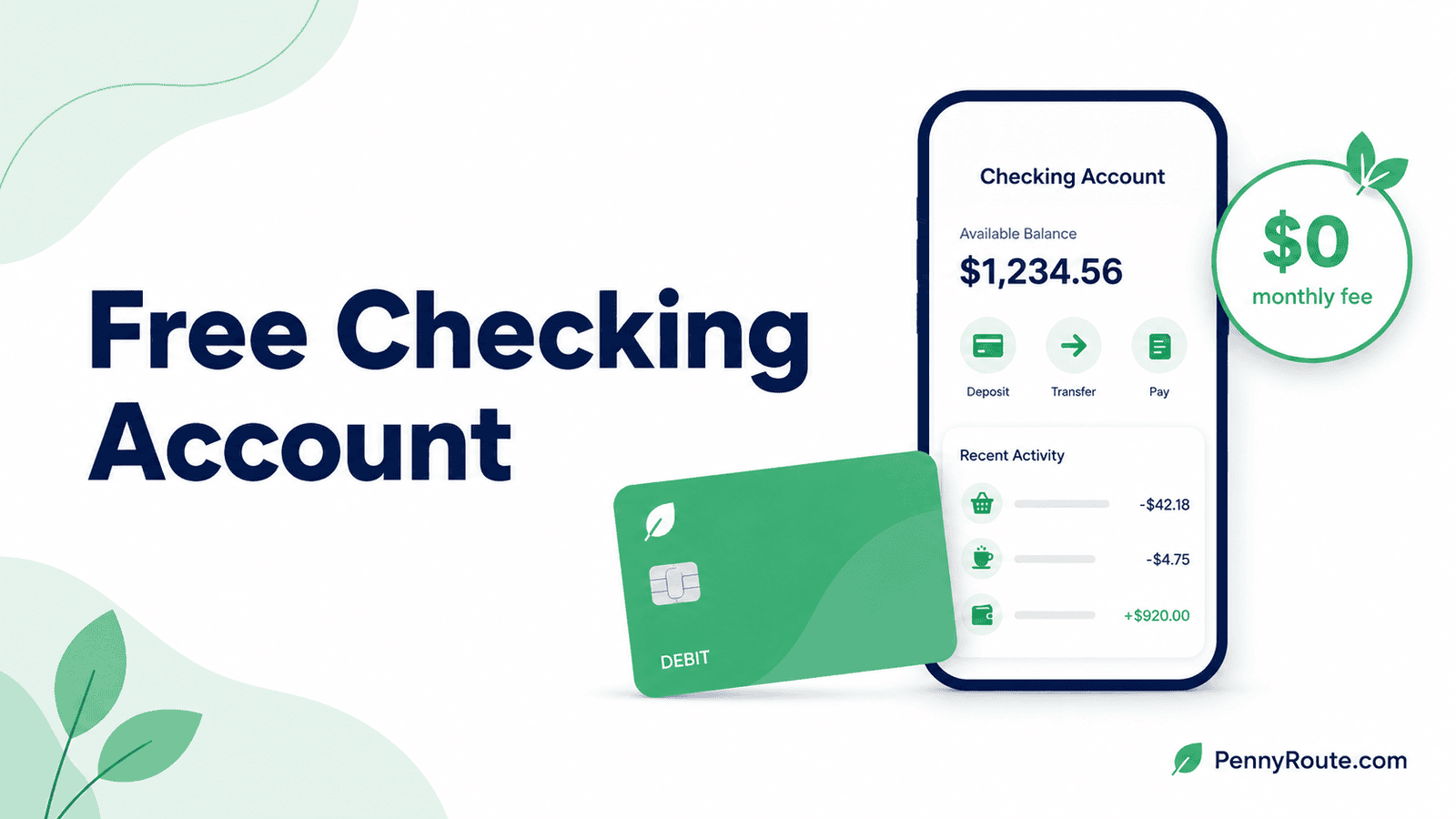
A free checking account does not charge maintenance or activity fees for keeping and routinely using the account. That does not mean every optional service or account event is free.
You may still pay certain fees for things such as out-of-network ATM use, overdrafts, check printing, stop payments, or other services allowed under the account terms.
That distinction matters when comparing accounts. An account advertised as free may still cost you money depending on how you use it, so it is worth checking the full fee schedule before opening the account.
Disclaimer: This content is for informational purposes only and does not constitute financial advice. Checking account fees, features, overdraft policies, and eligibility requirements vary by financial institution.
Quick Overview
- Free checking generally means there is no maintenance or activity fee for keeping and routinely using the account.
- An account that charges a monthly fee unless you meet certain conditions is fee-waivable, not genuinely free.
- Charges for certain services or account events, such as overdrafts, out-of-network ATMs, wires, or checks, may still apply.
- The lowest-cost account depends on which fees and services are relevant to your normal banking habits.
What Does a Free Checking Account Actually Mean?
A free checking account is more specific than simply “a checking account with no monthly fee.”
Under federal Regulation DD, a bank or credit union generally cannot advertise an account as “free” or “no cost” if you must pay maintenance or activity fees to keep or routinely use the account. That includes certain fees tied to minimum-balance requirements or ordinary account activity.
“Free” Does Not Mean Every Service Is Free
A free checking account can still charge for certain optional services or account events. Depending on the institution, that may include:
- out-of-network ATM use;
- overdrafts;
- bounced checks;
- stop-payment requests;
- dormant accounts;
- check printing.
The “free” label tells you something meaningful about the account’s routine maintenance and activity costs, but you still need to check the fee schedule for services you may actually use.
Free Checking vs. Checking With a Waivable Monthly Fee
A genuinely free checking account does not charge maintenance or activity fees for routine account use.
A checking account with a waivable monthly fee works differently. It may charge a monthly fee unless you meet requirements such as receiving qualifying direct deposits or maintaining a specified balance.
For example, an account might charge $12 per month but waive the fee when you receive enough qualifying direct deposits. That can still be a low-cost account if you consistently meet the requirement, but it is not the same as an account with no routine maintenance fee to begin with.
When comparing the two, check whether the fee waiver depends on conditions you can realistically meet every month.
Which Fees Can Still Apply to a Free Checking Account?
A free checking account may still charge for specific services or account activity. These charges are different from a monthly maintenance fee for simply keeping the account open.
| Possible fee | When it may apply |
|---|---|
| Out-of-network ATM fee | You use an ATM outside the institution’s supported network |
| Overdraft fee | The institution covers an eligible transaction that exceeds your available balance |
| Returned-payment fee | A check or electronic payment is returned because the account lacks enough money |
| Stop-payment fee | You ask the institution to prevent an eligible check or payment from being processed |
| Check-related fee | You order paper checks or request certain check services |
| Wire-transfer fee | You send or receive an eligible domestic or international wire |
| Dormant-account fee | The account remains inactive for a specified period, where permitted and disclosed |
| Optional-service fee | You request services such as expedited delivery or a cashier’s check |
Focus on the Fees You Are Likely to Encounter
A long fee schedule does not automatically make an account expensive. What matters is whether it charges for the services you expect to use.
For example:
- Frequent cash withdrawals make ATM access more important.
- Occasional paper checks make check-ordering costs relevant.
- International transfers make wire and foreign-transaction charges worth reviewing.
- A small or unpredictable balance makes overdraft terms more important.
Overdraft fees and related rules vary by transaction type and account setup. Declining overdraft coverage for ATM withdrawals and one-time debit card purchases does not necessarily prevent fees or returned payments involving checks and recurring electronic transactions.
Before opening the account, review the fee schedule and identify the charges connected to your normal banking habits.
Small changes in how you use an account may also help you avoid common bank fees that are not covered by the free-checking label.
Calculate the Account’s Real Annual Cost
A checking account with no monthly maintenance fee is not automatically the cheapest option.
The better comparison is the amount you are realistically likely to pay over a year based on how you use the account.
For example:
Estimated annual account cost = monthly fees + likely ATM fees + likely overdraft or service fees + other expected charges
Calculation
Suppose Account A has no monthly maintenance fee, but you expect to pay:
- $3 in out-of-network ATM fees twice a month;
- one $10 wire fee during the year.
Your estimated annual cost would be:
($3 × 2 × 12) + $10 = $82
Now suppose Account B charges a $5 monthly fee but includes the ATM access and services you normally use:
$5 × 12 = $60
In that situation, the account advertised as “free” would actually cost more based on your expected use.
The numbers will differ from person to person, so use your own banking habits rather than comparing only the advertised monthly fee.
When Free Checking May Be a Good Fit
Free checking may be especially useful if you want predictable account costs without having to meet monthly waiver requirements.
It can be a good fit if you:
- keep a variable balance from month to month;
- have irregular income or inconsistent direct deposits;
- do not want to maintain a minimum balance just to avoid a fee;
- prefer an account that does not require ongoing activity to stay fee-free.
For example, if your income changes from month to month, a fee-waivable account that requires a specific direct-deposit amount may be harder to maintain. A genuinely free account removes that particular concern.
Free checking is still not automatically the best choice. If the account makes it difficult to deposit cash, access ATMs, or use services you rely on, avoiding a monthly fee may not make up for the inconvenience or other costs.
What to Confirm Before Opening a Free Checking Account
Before opening the account, verify that the “free” label holds up under the actual terms.
Check:
- whether there is any maintenance or activity fee;
- whether you must meet conditions to keep the account fee-free;
- whether an opening deposit is required;
- which optional services or account events can still trigger charges.
You do not need to re-evaluate every checking-account feature here. Broader factors such as ATM access, digital tools, transfer rules, and customer support belong in the wider process of choosing a checking account.
The main question for this article is simpler: Will this account remain free based on how you actually plan to use it?
Is a Free Checking Account Safe?
A free checking account is not inherently less safe than an account that charges a monthly fee.
What matters is where the money is held and whether eligible deposits are federally insured. At banks, look for FDIC insurance. At federally insured credit unions, check NCUA share insurance.
If the account is offered through a fintech or another nonbank company, verify which bank actually holds the deposits. The company itself is not FDIC-insured, even if it partners with an insured bank.
You can also review the FDIC’s guidance on banking with third-party apps before relying on an account marketed through a nonbank provider.