Choosing a checking account is easier when you start with how you actually use your money.
An account with attractive features can still be a poor fit if the ATM network is inconvenient, cash deposits are difficult, fee-waiver conditions are unrealistic, or the mobile tools do not match how you bank.
Start by identifying the few features that would affect you most often. Once those priorities are clear, comparing accounts becomes much simpler.
Disclaimer: This content is for informational purposes only and does not constitute financial advice. Checking account features, fees, overdraft rules, and eligibility requirements vary by financial institution.
Quick Overview
- Start with how you receive, spend, deposit, and withdraw money.
- Separate must-have features from extras that would rarely affect you.
- Compare the fees, access limits, and account rules you are realistically likely to encounter.
- Verify federal deposit insurance and review the account terms before opening.
Start With How You Will Use the Account
Before comparing banks or account features, think about how money actually moves through your checking account.
Ask yourself:
- Do you receive income by direct deposit?
- Do you deposit cash regularly?
- How often do you use ATMs?
- Do you need access to a physical branch?
- Do you transfer money between banks?
- Does your balance sometimes run low before payday?
- Do you rely on automatic bill payments?
- Do you prefer to manage everything through a mobile app?
Those answers can quickly rule out accounts that look attractive on paper but would create friction in everyday use.
For example, an online checking account with no monthly fee may work well if you rarely handle cash and are comfortable banking digitally. If you regularly deposit cash or want in-person help, convenient branch or deposit access may matter more than avoiding a small fee.
Separate Must-Haves From Nice-to-Haves
Not every checking-account feature deserves equal weight.
A simple way to narrow your options is to sort features into three groups:
| Priority | What it means |
|---|---|
| Must-have | The account would be difficult to use without it |
| Useful | It would improve the experience but is not essential |
| Unimportant | It is unlikely to affect how you actually bank |
For example, free cash deposits may be a must-have if you handle cash regularly. Early direct deposit may be useful but not essential. Paper checks may be unimportant if you rarely use them.
Try to identify three to five must-haves before comparing accounts. That keeps small perks from distracting you from the features that will affect your everyday banking most.
Compare the Fees You Are Most Likely to Pay
A checking account can have several fees, but not all of them matter equally to every person. Focus first on the charges you are realistically likely to encounter.
That may include:
- monthly maintenance fees;
- out-of-network ATM fees;
- overdraft or returned-payment fees;
- cash-deposit fees;
- wire transfer fees;
- paper statement fees.
A monthly fee is not automatically a deal-breaker if the waiver conditions fit your normal banking habits. The problem is relying on a waiver you are unlikely to meet consistently.
If avoiding a monthly maintenance fee is a priority, compare whether an account is genuinely free checking or simply offers a fee waiver when certain conditions are met.
Focus on the costs you are realistically likely to pay rather than every possible fee listed in the account disclosure.
Check Cash, ATM, and Branch Access
Convenience depends on how you actually move money. An account that works well for someone who banks entirely online can be frustrating if you regularly use cash or need in-person help.
ATM Access
Check the size and location of the ATM network, whether out-of-network fees apply, and whether the bank reimburses any of those charges.
A large network is useful only if the ATMs are convenient for the places you already go.
Cash Deposits
If you receive or handle cash regularly, confirm how deposits work before opening the account.
Some banks accept cash only at branches or certain ATMs, while others use retail deposit networks or charge fees for cash deposits. An account with strong digital features may still be a poor fit if adding cash is inconvenient.
Branch Access
Branch access matters most if you expect to deposit cash, obtain cashier’s checks, handle account problems in person, or prefer face-to-face support.
If you rarely visit a branch, a large branch network should not outweigh features you will use more often.
Review Overdraft and Low-Balance Options
How an account handles a low balance can matter just as much as the monthly fee.
Check whether the institution:
- declines certain transactions when there is not enough money;
- offers optional overdraft coverage;
- transfers money from a linked account;
- charges overdraft or transfer fees;
- provides low-balance alerts;
- offers a grace period or small negative-balance buffer.
For ATM withdrawals and one-time debit card purchases, a bank or credit union generally cannot charge an overdraft fee unless you opted into that coverage. Other transactions, such as checks or recurring payments, can be handled differently.
Overdraft policies vary by institution, so it is worth checking which transactions may be paid, what fees can apply, and how overdraft fees are handled before you open the account.
Compare Deposits, Payments, and Transfer Rules
A feature can look good on a product page and still be frustrating if the limits or timing do not fit how you use the account.
Deposits
Check how the account accepts deposits and whether any limits apply.
For example, a bank may offer mobile check deposit but cap the amount you can deposit per day or month. Cash deposits may be limited to branches, certain ATMs, or participating retail locations.
Payments
Look at how the account handles bill pay, checks, debit card purchases, and recurring payments.
If you rely on scheduled payments, check when funds are withdrawn and whether there are any limits or fees that could affect timing.
Transfers
External transfers can vary in speed, amount limits, and cost.
If you regularly move money between banks, compare:
- daily or monthly transfer limits;
- how long standard transfers usually take;
- whether faster transfers cost extra;
- whether there is a waiting period when linking a new account.
A feature is only useful if the rules behind it fit your normal banking routine.
Test the Mobile and Online Experience
If you expect to manage most of your banking digitally, the app and website should make routine tasks easy to handle.
Check whether you can comfortably:
- review pending and posted transactions;
- set balance and transaction alerts;
- lock or unlock your debit card;
- deposit checks remotely;
- link external accounts;
- find statements and account documents;
- report suspicious activity or contact support.
Do not judge the experience only by screenshots or app-store ratings. A useful mobile app should make the tasks you perform most often easy to find and complete without unnecessary steps.
If digital banking is a must-have, review the available app features and digital tools carefully before moving your regular payments and deposits to the account.
Consider Interest, Rewards, and Promotional Offers
Interest, rewards, and sign-up offers can add value, but they should come after the account’s core costs and everyday usability.
If a checking account pays interest or offers rewards, check:
- the rate or reward amount;
- balance or activity requirements;
- monthly fees;
- caps or exclusions;
- whether the benefit is ongoing or temporary.
A higher APY or attractive reward is less useful if you need to maintain an uncomfortable balance, make transactions you would not normally make, or pay fees that erase much of the benefit.
Promotional bonuses deserve the same scrutiny. Check the qualifying deposit or direct-deposit requirements, how long the money must remain in the account, and whether the account still makes sense after the promotion ends.
Treat interest, rewards, and bonuses as tie-breakers between accounts that already meet your must-haves, not as reasons to overlook a poor fit.
Check Customer Support Before You Need It
Customer support matters most when something goes wrong, so it is worth checking the options before you need help.
Look at:
- phone, chat, secure message, and branch support;
- live-support hours, not just whether a channel exists;
- how fraud, disputes, or locked accounts are handled;
- whether there is a clear escalation path for unresolved problems.
A bank with fewer support channels may still work well if those channels are easy to reach and available when you are likely to need them.
If you prefer in-person help, nearby branch access may matter more. If you bank entirely online, reliable phone or chat support becomes more important.
Confirm Deposit Insurance and Read the Account Agreement
Before opening an account, confirm that your deposits are federally insured and review the terms that could affect how you use the account.
For a bank, you can verify coverage through the FDIC’s deposit insurance information. The standard coverage limit is $250,000 per depositor, per FDIC-insured bank, for each account ownership category.
For a federally insured credit union, the NCUA provides share insurance coverage information. Coverage is generally at least $250,000 per member, with additional coverage possible depending on the ownership category.
Also review the account agreement for details such as:
- monthly fees and waiver requirements;
- minimum balance rules;
- ATM and transfer limits;
- overdraft policies;
- deposit availability;
- account-closing or inactivity rules.
Be more careful when an account is offered through a fintech or another nonbank company. The company itself is not FDIC-insured, even if it works with an insured bank. Funds placed at an FDIC-insured partner bank may qualify for pass-through coverage when the applicable requirements are met. The FDIC’s guidance on banking with third-party apps explains how that protection works.
Verify the institution behind the account and the terms that apply to your deposits rather than relying only on an “FDIC-insured” claim in the marketing.
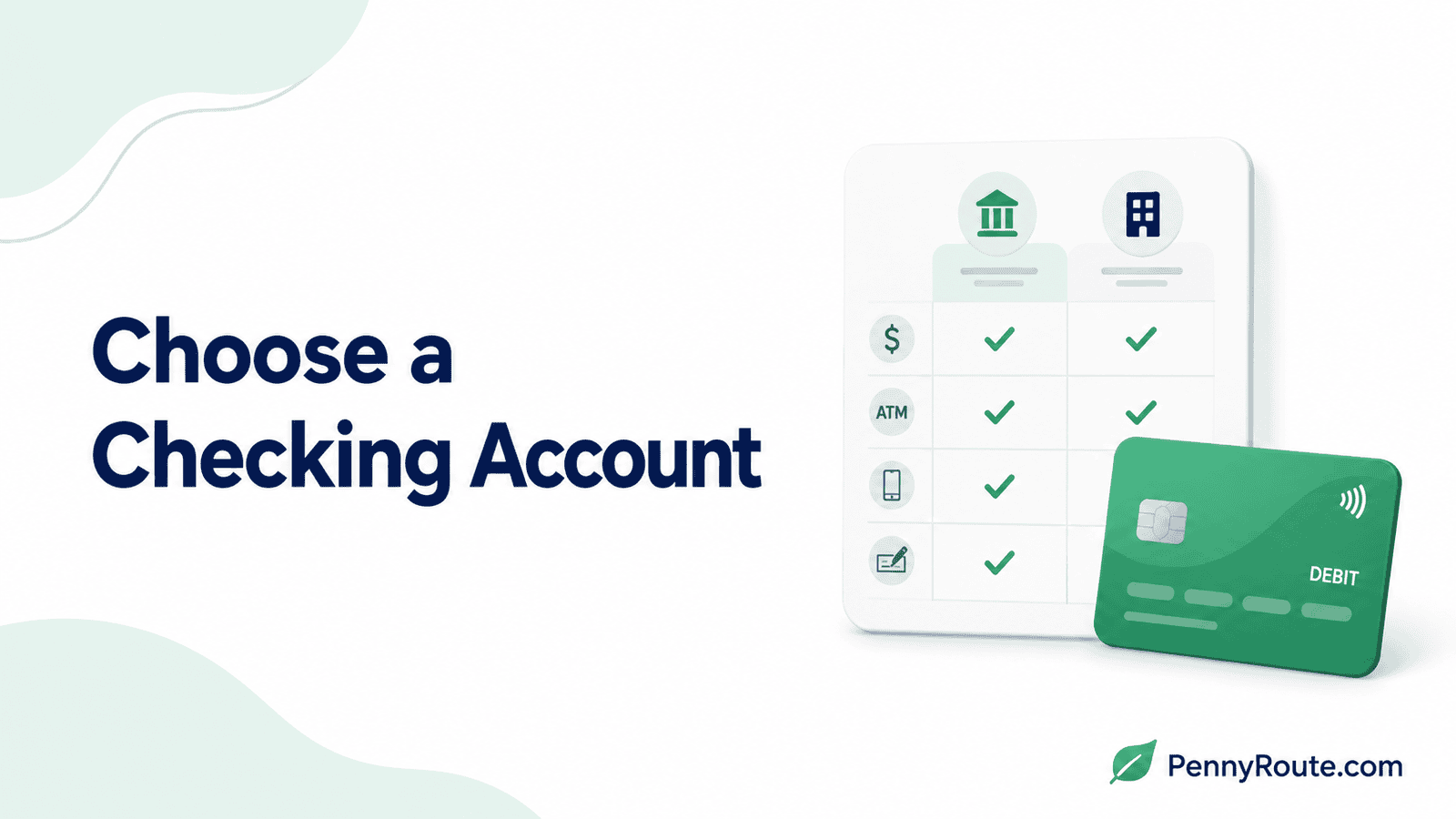
Use a Final Checking Account Comparison
Once you have narrowed your options, compare the accounts side by side using only the factors that would affect you in practice.
| What to Compare | Account A | Account B | Account C |
|---|---|---|---|
| Monthly fee and waiver | |||
| ATM and cash access | |||
| Overdraft and low-balance options | |||
| Deposit and transfer limits | |||
| Mobile and online banking | |||
| Customer support | |||
| Interest, rewards, or bonuses | |||
| Deposit insurance |
Then ask yourself:
- Does this account meet my must-haves?
- Which fees am I realistically likely to pay?
- Can I deposit, withdraw, transfer, and spend money the way I normally do?
- Are there any limits or conditions that could become inconvenient?
- Would I be comfortable using the account after any promotional offer ends?
- Is there another option that gives me the same essentials with fewer compromises?
The best checking account is usually not the one with the longest feature list. It is the one that fits your banking routine with the fewest meaningful compromises.