A checking balance can look reassuring until you remember that some of the money already belongs to rent, utilities, insurance, and other payments that have not left the account yet. What looks available to spend is not always truly available.
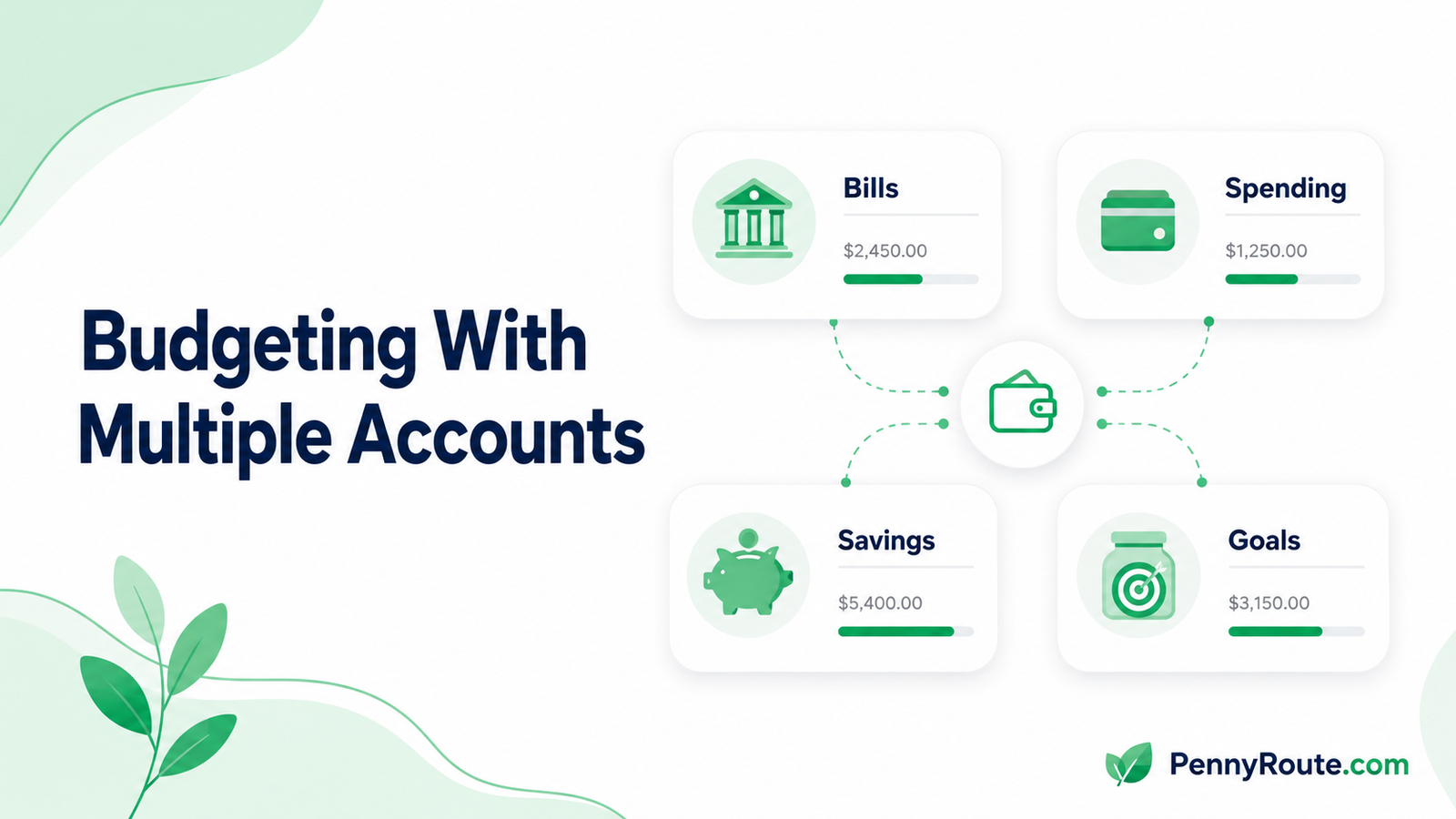
Budgeting with multiple bank accounts can make those boundaries easier to see. Bills can stay separate from everyday spending, while savings sits outside both.
The accounts simply give committed money, everyday spending, and savings clearer boundaries.
Disclaimer: This content is for informational purposes only and does not constitute financial advice. Account fees, features, transfer rules, and requirements vary by financial institution.
Quick Overview
- Give each account a clear job rather than opening extra accounts without a reason.
- Base transfers on your actual budget, not a standard percentage.
- Every account needs the right amount of money at the right time.
- If you constantly move money back and forth, adjust the amounts or simplify the setup.
How Budgeting With Multiple Bank Accounts Works
You do not need a complicated collection of accounts.
For many households, the useful separation comes down to three jobs:
| Account | Main purpose | Typical expenses |
|---|---|---|
| Bills account | Hold money already committed to upcoming payments | Rent or mortgage, utilities, insurance, subscriptions, loan payments |
| Spending account | Cover everyday expenses that change throughout the month | Groceries, gas, transportation, dining, household purchases, personal spending |
| Savings account | Keep money outside routine spending | Emergency savings and other planned goals |
You do not necessarily need three new accounts. Accounts you already have may be enough, and some people only need to separate bills from everyday spending.
Suppose one checking account shows $2,100, but $1,400 needs to cover rent and other payments before your next paycheck. The full $2,100 is visible, but only $700 is really free for other spending.
A separate bills account makes that boundary visible without requiring you to mentally subtract upcoming payments every time you check the balance.
If one checking account already gives you that clarity, adding more accounts may not improve anything.
Bills Account
Money in the bills account is already spoken for, even when the payment is not due for another week.
Housing, insurance, phone service, loan payments, subscriptions, and regular utilities are common examples. The balance is useful because it shows money reserved for commitments rather than money available for today’s purchases.
Spending Account
The spending account covers expenses that happen throughout the pay period.
That can include groceries, gas, public transportation, dining, household purchases, and personal spending.
Some of those costs are essential, so the account is not simply “fun money.” It represents the part of your budget still available for current spending.
Savings Account
Savings stays outside the normal flow of bills and everyday purchases.
That could include your emergency fund or another planned savings goal. You do not need a separate bank account for every goal simply to make this budgeting system work.
Start With Your Budget Before Moving Any Money
The account setup comes after the budget, not before it.
You first need realistic amounts for recurring bills, flexible spending, savings, debt payments, and less-frequent expenses.
Putting $900 into a spending account does not make $900 sufficient if groceries, transportation, household costs, and personal spending regularly total $1,150.
If you are still working out those numbers, a budget for beginners gives you the broader monthly framework. Your budget categories can then help you decide what belongs in bills, everyday spending, savings, and other priorities.
Less-frequent costs also need a place before you start dividing paychecks. Car registration, annual memberships, school costs, and other expenses that are easy to forget when budgeting can leave an otherwise well-funded account unexpectedly short.
Once the budget numbers make sense, the accounts give those numbers somewhere practical to live.
How Much Should You Put in Each Account?
There is no standard percentage that belongs in a bills account or spending account.
Two households can have the same take-home pay and very different housing costs, transportation needs, debt payments, savings goals, and everyday expenses.
Start with your own numbers:
- Add the bills that will come from the bills account.
- Use a realistic amount for bills that change from month to month.
- Include the savings amount already built into your budget.
- Set a realistic amount for groceries, transportation, household purchases, and other current spending.
- Convert the monthly amounts to your actual pay schedule.
For variable bills, avoid using the lowest month as the target.
If electricity normally ranges from $90 to $145, sending only $90 to the bills account each month leaves almost no room when the higher bill arrives.
Once you know the monthly amount, you can convert it into a paycheck contribution:
Monthly amount × 12 ÷ number of paychecks per year = amount to set aside from each paycheck
Paycheck Funding Formula
Someone paid weekly generally receives 52 paychecks in a normal year. Biweekly pay usually produces 26, while twice-monthly pay produces 24.
For an exact annual plan, use the number of paychecks on your actual payroll calendar. Some calendar years can include an additional weekly or biweekly payday.
The formula tells you how much to set aside over the year.
Next, check whether those contributions arrive before the bills do.
Example: A Three-Account Budget Across Two Paychecks
Suppose you take home $3,600 per month and receive two $1,800 paychecks.
Your monthly budget allows:
| Purpose | Monthly amount | Amount from each paycheck |
|---|---|---|
| Bills and committed expenses | $1,950 | $975 |
| Savings | $300 | $150 |
| Everyday spending | $1,350 | $675 |
| Total | $3,600 | $1,800 |
The monthly numbers balance perfectly.
But suppose $1,500 of the month’s bills are due before the second paycheck arrives.
Putting $975 into the bills account from paycheck one leaves a $525 gap:
$1,500 due before the next transfer − $975 arriving from paycheck one = $525 starting cushion
Starting Cushion Calculation
The monthly budget is not wrong. The bills simply arrive before the normal funding schedule has had time to catch up.
You have several ways to handle that:
- build the $525 cushion before relying fully on the new system;
- direct more of the first paycheck toward bills and less of the second;
- change which paycheck funds particular expenses when that fits your cash flow.
A budget calendar makes this much easier to see because paydays and bill due dates sit beside the dollar amounts.
A starting cushion is not an extra monthly expense. It fills the timing gap between when money arrives and when the bills need it.
Match Transfers to Your Paydays and Bill Dates
Once the amounts are clear, decide how the money will reach each account.
Two common options are:
- Deposit first, then transfer: Your paycheck lands in one account, and the planned amounts move to bills, spending, and savings afterward.
- Split direct deposit: Part of the paycheck goes directly into different accounts when your employer supports it.
Some employers let workers split direct deposits between multiple accounts.
Automation can remove a repetitive payday task, but the transfer dates still need to match your real cash flow.
If the first half of the month carries most of your bills, an even 50/50 split between two paychecks may not be the best arrangement. One paycheck can fund more of the bills account while the other contributes less, as long as the full budget still works.
Every account needs two answers:
How much money belongs there?
When does that money need to arrive?
Getting both right is what keeps a mathematically correct budget from becoming a cash-flow problem.
Keep the Bills Account Accurate After Setup
Once the system is running, the bills account needs occasional maintenance.
Update the amount going into it when a recurring cost changes. A rent increase, insurance renewal, subscription price change, new loan payment, or paid-off debt can all change what the account needs.
Try to keep unrelated purchases out of this account as well. Grocery runs, online shopping, and other everyday spending make the balance harder to interpret when the account is supposed to represent committed payments.
Important
Do not assume every dollar showing in the bills account is extra. Scheduled payments or transactions that have not fully posted may still need part of that balance.
The CFPB recommends knowing when prescheduled payments are expected to leave your account. Low-balance alerts can also give you an earlier warning when the bills account is getting tighter than expected.
If the starting cushion you built no longer covers the timing gap because bill dates or amounts changed, recalculate it rather than repeatedly topping up the account at the last minute.
Make the Spending Account a Useful Boundary
The spending account works best when its balance tells you something useful.
Suppose $675 is meant to cover the next half of the month, but only $150 remains after five days. You already know the current pace cannot continue unchanged.
That does not automatically mean you spent irresponsibly. First look at what used the money.
If groceries, transportation, and other necessary costs regularly use more than the amount you planned, the spending target may simply be too low.
If the amount is realistic but most of it disappears early in every pay period, pacing becomes the bigger issue.
The balance should help you answer:
- How much is left until the next planned transfer?
- Are groceries, transportation, and other necessary costs still covered?
- Is optional spending using more than expected?
Credit cards add another wrinkle because spending can happen before your checking balance changes.
Suppose the spending account shows $500 and you put $120 of groceries on a credit card. The checking account still shows $500, but only $380 of the spending budget is truly uncommitted.
Count everyday credit-card purchases against the spending budget when they happen, not when the card payment finally leaves checking.
Otherwise, the bank balance can look healthier than the budget really is.
If Your Multiple-Account Budget Keeps Breaking, Find the Cause
If you have to repair the setup every payday, something in the plan is probably off.
Before moving more money around, identify the pattern.
| What keeps happening | Check this first |
|---|---|
| Bills account is short even though the monthly total is correct | Transfer timing or an inadequate starting cushion |
| Bills account is short because payments cost more than expected | Budget estimates or outdated transfer amounts |
| An annual or occasional cost causes the shortfall | A missing irregular expense |
| Spending account runs out while covering normal essentials | Spending allocation may be too low |
| Spending account looks healthy despite heavy credit-card use | Card purchases may not be counted against the spending budget |
| Money constantly moves between accounts | Account roles may be too narrow or funding amounts may be wrong |
| Managing the setup takes more time than it saves | There may be too many accounts or unnecessary requirements |
Topping up whichever account is short can hide the reason the shortfall keeps happening. The pattern usually points to the part of the setup that needs adjusting.
If You Keep Moving Money Between Accounts
Occasional transfers are normal.
Constant reshuffling is different.
If money repeatedly moves from bills to spending, back to bills, and then somewhere else, either the planned amounts do not match your real expenses or the account boundaries are too narrow.
Before opening another account, simplify the jobs of the accounts you already have.
A bills account does not need separate bank accounts for electricity, phone service, insurance, and every subscription unless that extra separation genuinely helps you manage the money.
If Managing the Accounts Becomes Another Chore
Separate accounts should remove mental work, not create another administrative job.
If fees, balance requirements, logins, and transfers are making the budget harder to follow, the extra separation may no longer be helping. Some accounts also waive maintenance fees only when you meet requirements such as a minimum balance or qualifying direct deposit, so spreading money across several accounts can make those conditions harder to satisfy.
If the budget works but the number of accounts feels harder to manage, check whether each account still has a useful job when deciding how many bank accounts to keep.
Income that changes substantially from month to month also needs a different funding rhythm. Fixed paycheck transfers are less useful when every check is different, so budgeting with irregular income works better when the income plan comes before the account split.
Simplifying from three accounts to two, or from two checking accounts back to one, is not a step backward. It is a better setup when the extra separation no longer helps.
A Multiple-Account Budget Should Make Your Money Easier to Read
A multiple-account budget is working when you can see what is already committed, what remains available to spend, and what is staying in savings without constantly moving money around.
If that clarity disappears, adjust the funding or simplify the setup. The accounts are there to support the budget, not become another budgeting problem.