Paying more than the minimum sounds like the obvious way to reduce debt. The difficult part is finding extra money you can keep paying month after month without leaving yourself short and reaching for credit again.
To pay off debt faster, you need more than a brief burst of motivation. You need every required payment protected, one clear target, and an extra amount that still fits during an ordinary month. When one balance disappears, keeping that total payment in your plan helps the next debt fall faster.
Disclaimer: This content is for general informational purposes and does not constitute financial, legal, tax, or credit advice. Debt terms and repayment options vary, so review your account agreements and seek qualified guidance when appropriate.
Make Sure Faster Payoff Is the Right Step Right Now
Accelerated payoff works best when your basic finances are stable enough to support it.
Before committing extra money, confirm that essential expenses are covered, every required minimum fits, urgent accounts have been addressed, and some money remains available in a normal month.
If a secured loan is past due, an account has legal consequences, or essential bills are at risk, balance size and interest rate should not decide your first move. The more immediate question is which debt you should pay off first based on urgency and consequences.
You also do not need to force an accelerated plan when the budget currently supports only required payments. Stabilizing the accounts and working through what to do when you can only make minimum payments is more useful than choosing an extra payment you cannot sustain.
Put Every Debt in One Place
A payoff plan becomes easier to manage when every account is visible in one list.
Gather the most recent statements and record the information that affects the plan:
| Debt | Balance | APR | Minimum | Status |
|---|---|---|---|---|
| Credit card | $3,800 | 24.99% | $120 | Current |
| Personal loan | $6,400 | 11.50% | $205 | Current |
| Store card | $950 | 18.99% | $45 | Current |
| Medical plan | $1,200 | 0% | $75 | Current |
The figures above are only an example. Your list should reflect the current balance, not the original amount borrowed.
The status column matters because a past-due secured loan or an account facing legal action may need attention before a current unsecured balance, even when its APR is lower.
Record each due date in your calendar or payment system. Add the target order only after urgent obligations and required minimums have been reviewed.
How to Pay Off Debt Faster Without Making the Plan Too Tight
The largest extra payment you could make once is not necessarily the right monthly amount.
A better number is what you could repeat during an ordinary month after accounting for essential expenses, minimum debt payments, predictable irregular costs, and a reasonable amount of breathing room.
Separate your debt money into three buckets:
- Required minimums: Payments needed to keep every account current.
- Repeatable extra payment: Money available in an ordinary month for one target debt.
- Irregular extra money: Bonuses, refunds, overtime, commissions, gifts, or money from sold items.
Suppose your minimum payments total $460 and an ordinary month leaves another $115 after planned expenses.
$460 in required minimums + $115 in repeatable extra money = $575 toward debt each month
Example Calculation
The $115 should be dependable enough that you are not counting on a tax refund, a bonus that has not arrived, or a month with unusually low expenses.
A consistent $115 is more useful than committing $300, running short two weeks later, and putting groceries back on a credit card.
Give the Extra Payment One Clear Target
Continue making the required payment on every debt, then send the repeatable extra amount to one target account.
Concentrating the extra money gives that balance a clear reason to fall faster. Dividing an extra $100 among four accounts reduces each balance slightly, but it delays the point when one required payment disappears.
Your target order could be based on:
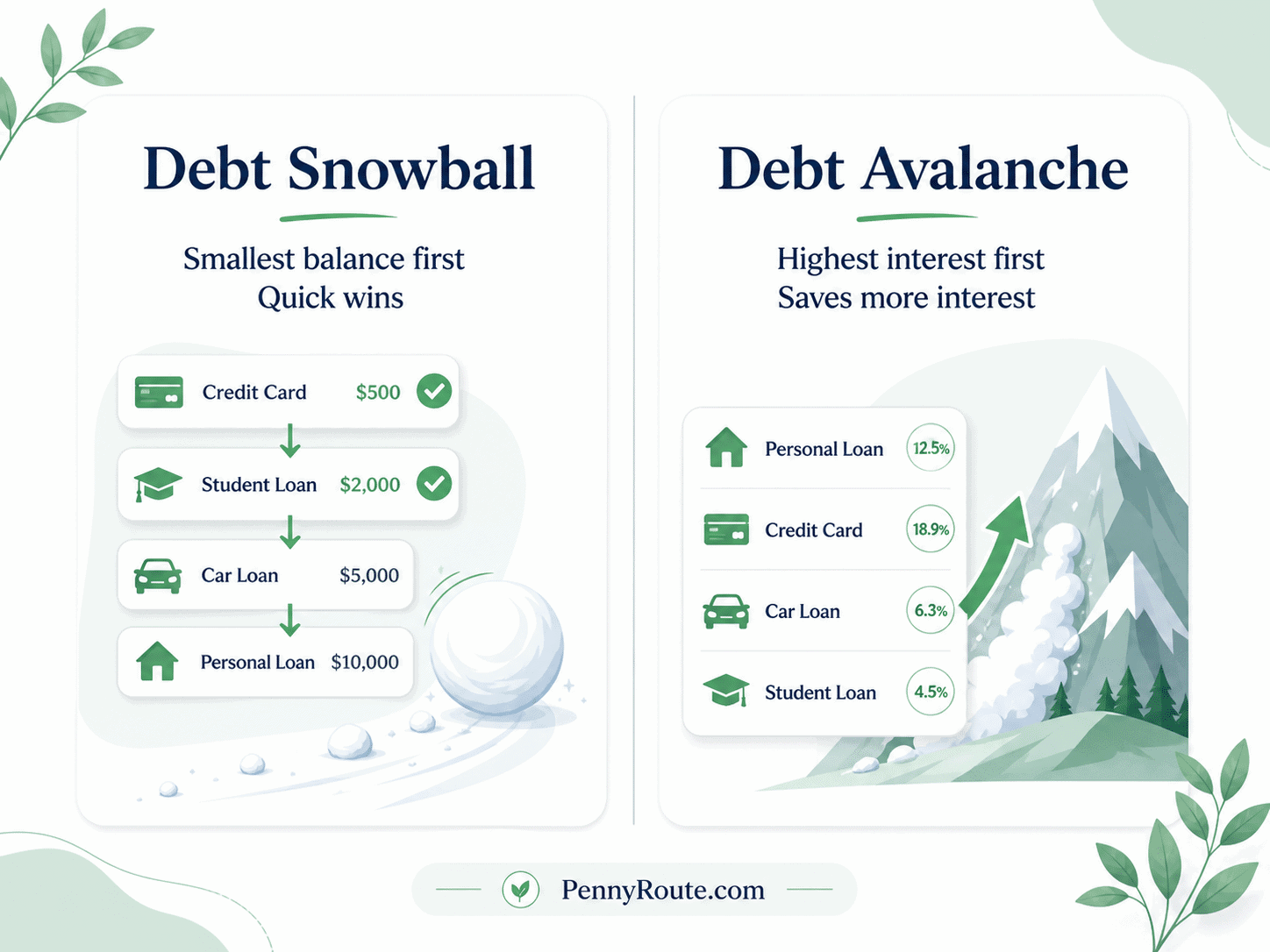
- the smallest balance
- the highest interest rate
- or another documented reason connected to the account terms
Urgent or past-due accounts should be evaluated before this payoff order is set.
The debt snowball vs. debt avalanche comparison explains when an early account payoff may be worth prioritizing and when reducing interest should carry more weight.
Once you choose the first target, avoid changing it because another balance looks frustrating that week. Revisit the order when an account is cleared or something material changes, such as an APR, promotional deadline, minimum payment, or account status.
Keep the Total Payment When One Debt Is Gone
Paying off one account creates an important choice.
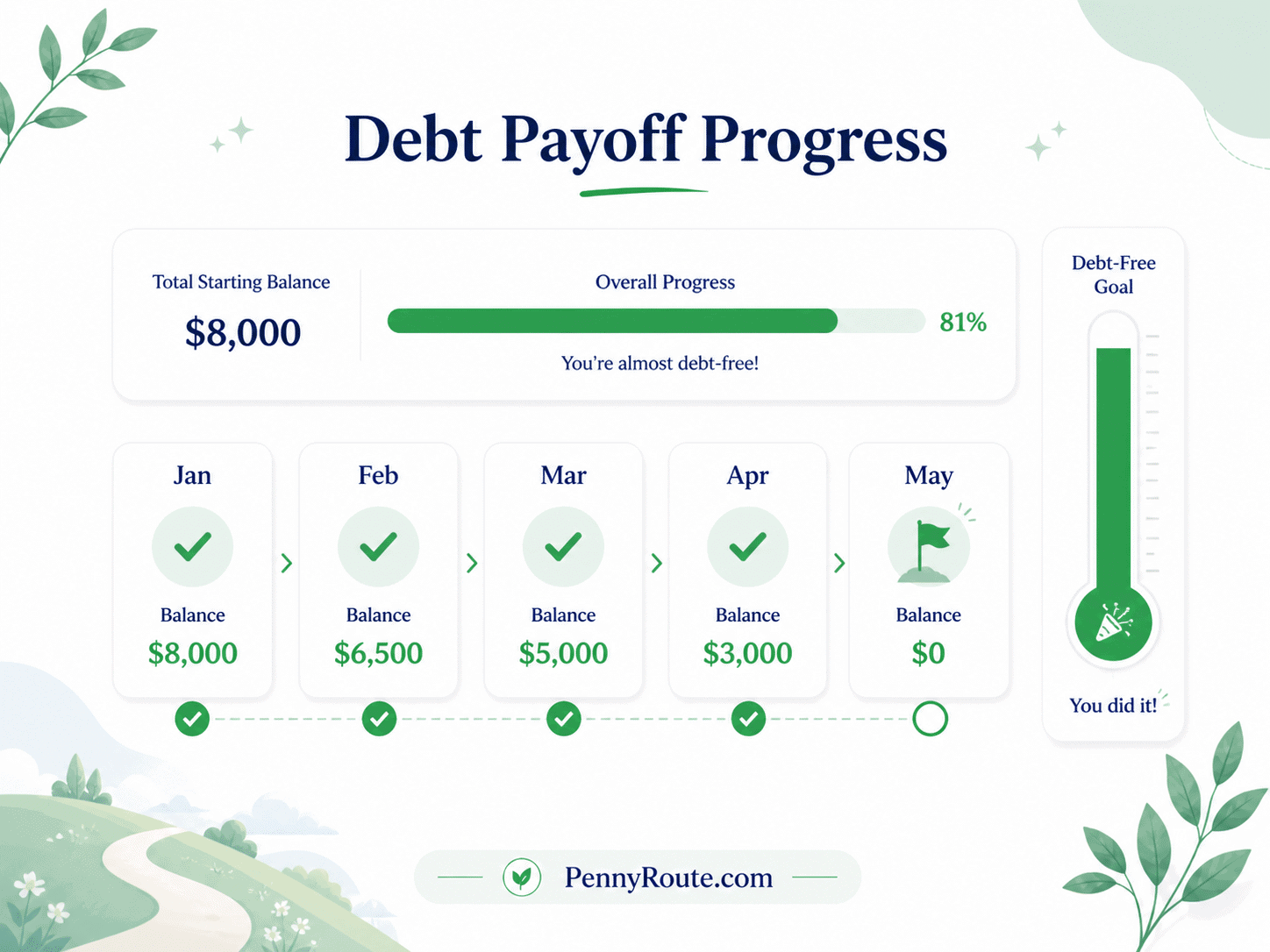
You could let its old payment return to general spending. Or you could move that amount to the next target and keep the household’s total debt payment unchanged.
Example: Rolling a Cleared Payment Forward
Suppose your first target receives a $65 minimum payment plus a $115 monthly extra payment, for a total of $180.
Once that debt is gone, move the full $180 to the next target. If the next debt already has a $90 minimum payment, it will now receive $270 per month.
This rollover is what allows the plan to build speed. The amount leaving your budget stays the same, but more of it reaches the current target as earlier payments are freed.
Treat the cleared payment as already committed unless your income or essential expenses have genuinely changed. Otherwise, it can quietly disappear into routine spending before the next payoff begins.
Use Irregular Money Without Depending on It
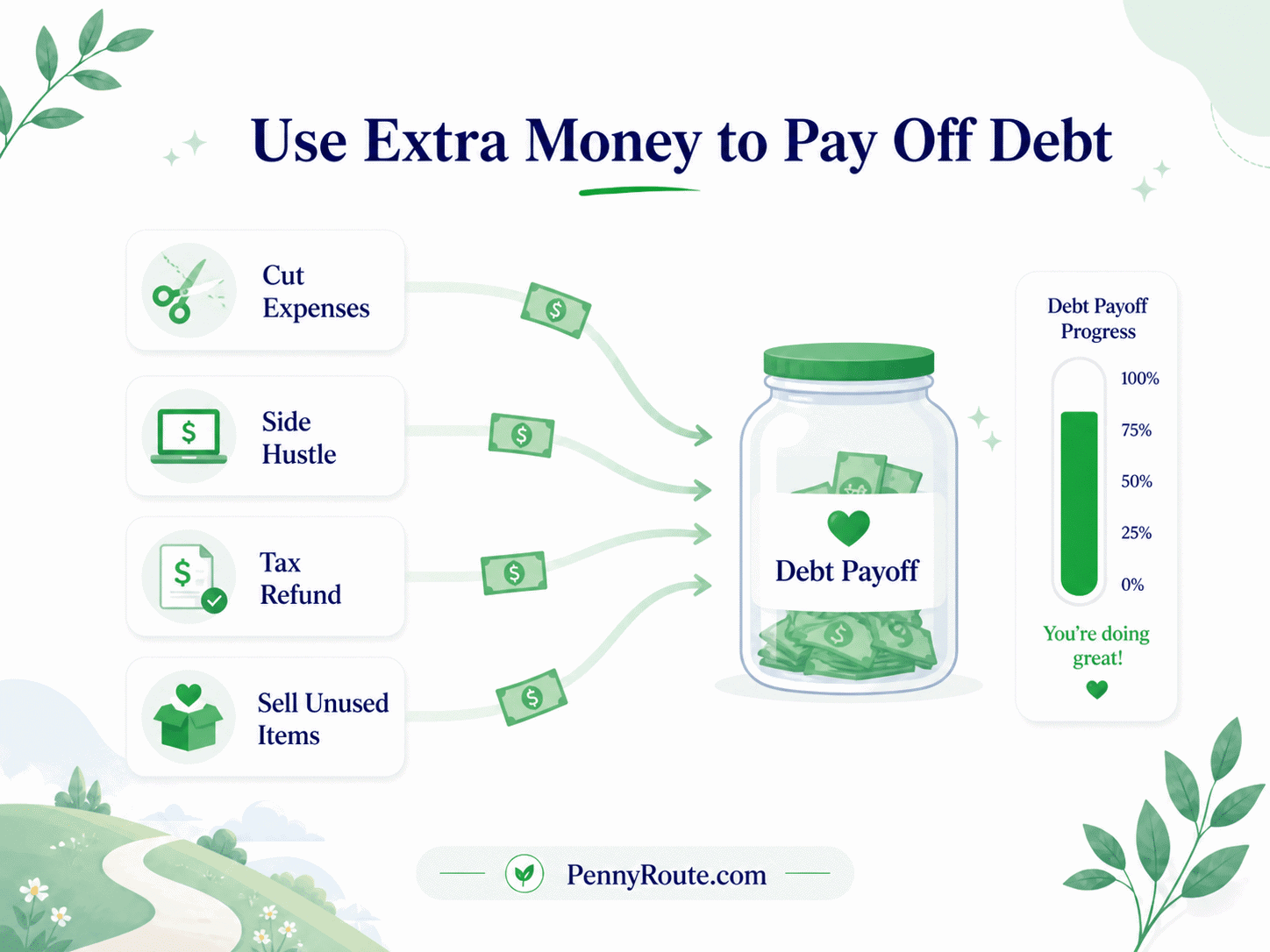
A bonus or tax refund can shorten a payoff timeline, but uncertain money should not hold the regular plan together.
Decide in advance how you will handle irregular income. You might choose a percentage for debt after covering known expenses and any taxes connected with the income.
For example, you could send 60% to the target debt, reserve 20% for an upcoming expense, and use the remaining 20% for another current priority. Those percentages are only illustrative. The useful part is deciding your rule before the money arrives.
For variable income, build the repeatable payment around a conservative month. Higher-income months can produce additional payments without creating an obligation that becomes unaffordable when work slows down.
Send the planned debt portion soon after receiving it. Leaving windfall money in a general spending account for several weeks gives it plenty of opportunities to find other jobs.
Set Up a Payment Routine You Can Maintain
A payoff strategy is easier to sustain when payments do not depend on remembering several separate decisions each month.
Protect Every Required Payment
Autopay may help keep minimum payments current, provided the linked account reliably has enough money before each withdrawal.
Review the dates rather than assuming all payments fit simply because the monthly total works. Four withdrawals arriving before payday can create a cash-flow problem even when the budget balances across the full month.
Where autopay is not suitable, set calendar reminders several days before each due date. The priority is a reliable system, not a particular payment feature.
Schedule the Extra Payment
Schedule the target payment shortly after dependable income arrives.
Waiting until the end of the month to send “whatever is left” often produces an inconsistent result because other spending claims the money first.
If income arrives twice a month, the extra payment could also be divided across those paychecks. The exact timing matters less than knowing the amount and sending it before it becomes available for unrelated spending.
Review the account after making the first additional payment. Confirm that it reduced the intended balance and check whether the lender applied it toward principal or simply advanced the next payment due date.
Review the Plan Once a Month
A monthly check is usually enough. Constantly rebuilding the plan makes normal balance changes look more important than they are.
Ask:
- Did every required payment clear?
- Did the planned extra payment reach the target?
- Was any new balance added?
- Did an APR, minimum, or account status change?
- Is next month’s extra amount still realistic?
If the answers remain stable, the plan probably does not need a new strategy. It needs another month of consistent payments.
Stop New Balances From Replacing the Progress
A debt payment does not create lasting progress when the same amount returns as new borrowing.
Suppose you send an extra $200 to a credit card, then charge $180 of groceries and household supplies because the checking account is too low. The old balance fell, but the underlying shortage remained.
Look at what created the new charge.
A genuine emergency may justify a temporary change. A car repair, urgent medical cost, or sudden income interruption is different from an annual insurance bill that arrives every year but was not included in the plan.
When new charges keep appearing:
- identify the expense behind them;
- add predictable irregular costs to the monthly plan;
- reduce the extra debt payment if it is too aggressive;
- and keep a limited cash buffer for expenses that do not arrive every month.
Lowering a planned payment from $200 to $140 is not failure when it prevents $100 from returning to the card. The plan is stronger when the balance moves in one direction, even at a slightly slower pace.
If credit cards are covering routine purchases while you repay old balances, the practical steps for stopping credit card use during debt payoff can help separate current spending from the repayment plan.
Would a Lower Interest Rate Actually Speed Things Up?
Reducing an interest rate gives more of each payment a chance to reach principal. That does not mean every refinancing, consolidation, or promotional offer improves the payoff.
Compare the complete change:
- the new APR;
- transfer or origination fees;
- the repayment term;
- the total projected cost;
- the required monthly payment;
- and what happens to the old credit accounts.
A lower monthly payment is not the same as a faster payoff.
A smaller required payment may come from extending the debt across more years. That can ease immediate pressure while increasing the repayment time or total cost.
The offer is more likely to support faster payoff when it lowers the complete cost and you continue paying at least as much as before.
For example, replacing a $350 payment with a $250 payment will not accelerate the debt if you begin paying only $250. Keeping the payment near $350 is what allows more of the rate savings to shorten the timeline.
Changing the debt structure also does not solve the spending or cash-flow issue that created the balances. If paid-off credit cards fill up again, the household may end up with both the new loan and new revolving debt.
What to Do When the Plan Stalls
A slow month does not automatically mean the method is wrong. First identify what changed.
| What changed | Sensible adjustment |
|---|---|
| One unusually expensive month | Temporarily reduce or pause the extra payment |
| Income fell for several months | Reset the repeatable extra amount |
| APR or minimum changed | Update the payoff estimate |
| An expected windfall did not arrive | Continue with the ordinary-month plan |
| Minimums no longer fit | Shift from acceleration to stabilization or qualified help |
| Progress is steady but slow | Model a larger payment before changing methods |
One difficult month calls for a temporary response. Repeated shortfalls mean the regular plan needs a more permanent adjustment.
Avoid switching payoff methods simply because interest made the balance fall more slowly than expected. Review the statement, confirm that no new charges were added, and compare the actual change with the projection.
A debt payoff calculator can show whether adding another $25 or $50 meaningfully changes the completion date. That is more useful than increasing the payment based on guesswork.
When Faster Payoff Is No Longer a DIY Problem
An accelerated payoff plan assumes the minimum payments are manageable and the balances have a realistic path to zero.
Extra support deserves consideration when:
- minimums remain unaffordable after reasonable adjustments;
- essential expenses are repeatedly being missed;
- one debt is being used to pay another;
- accounts are in collections or legal action;
- interest and fees are growing faster than the balances can be reduced;
- or current income does not support a credible repayment path.
A nonprofit credit counselor may help review the complete situation and explain available options. Credit counseling and debt settlement are not the same service, so understand how credit counseling differs from debt settlement and consolidation before agreeing to a program.
Caution
Be cautious with companies that guarantee they can eliminate debt, tell you to stop communicating with creditors, or charge fees before settling a debt. These are common warning signs of risky debt-relief companies . A difficult debt situation does not mean you should trust an offer that sounds too simple.
Legal concerns, lawsuits, tax debts, foreclosure, repossession, or possible bankruptcy may require advice from an appropriately qualified professional rather than a general payoff plan.
Build Speed Through Repetition, Not Pressure
A faster debt payoff plan does not need to take every available dollar. It needs a realistic payment that keeps reaching the same target without creating new shortfalls elsewhere.
List the accounts, protect the minimums, choose one target, and set an amount that works during an ordinary month. When a balance disappears, keep the payment in the plan and move it forward. That steady rollover creates more lasting speed than a few aggressive payments followed by months of recovery.