
Clothing purchases do not always seem expensive in the moment. A discounted top here, a pair of shoes there, and a few “just in case” outfits may gradually take up more of your monthly budget than expected.
A capsule wardrobe may help you spend less by making better use of the clothes you already own. Instead of constantly adding new pieces, you build a smaller collection of items that fit your routine, work well together, and get worn regularly.
You do not need to replace your entire wardrobe or follow a strict minimalist rule. The most budget-friendly approach is to start with what you already have, identify genuine gaps, and make future purchases more intentionally.
Disclaimer: This content is for informational purposes only and does not constitute financial advice. Please consult a qualified professional before making financial decisions.
Can a Capsule Wardrobe Save You Money?
A capsule wardrobe may help you save money by reducing unnecessary purchases and helping you wear more of what you already own. The savings usually come from better planning, not from owning the smallest possible number of clothes.
Here are the main ways it may reduce clothing costs:
- Fewer impulse purchases: A clear wardrobe plan makes it easier to skip items that do not match your needs.
- Fewer duplicate pieces: You are less likely to buy another black sweater or similar pair of jeans without realizing you already own one.
- Lower cost per wear: Clothes that work with several outfits are more likely to be worn regularly.
- Less trend-driven spending: A wardrobe built around your routine may reduce the pressure to replace clothes whenever styles change.
- More intentional replacements: You buy when an item is worn out or when a genuine wardrobe gap appears.
A capsule wardrobe does not guarantee savings. You may still spend more if you replace everything at once, shop without a budget, or treat the process as an excuse to buy a completely new collection. Starting with your current wardrobe is usually the least expensive approach.
Understanding Cost per Wear
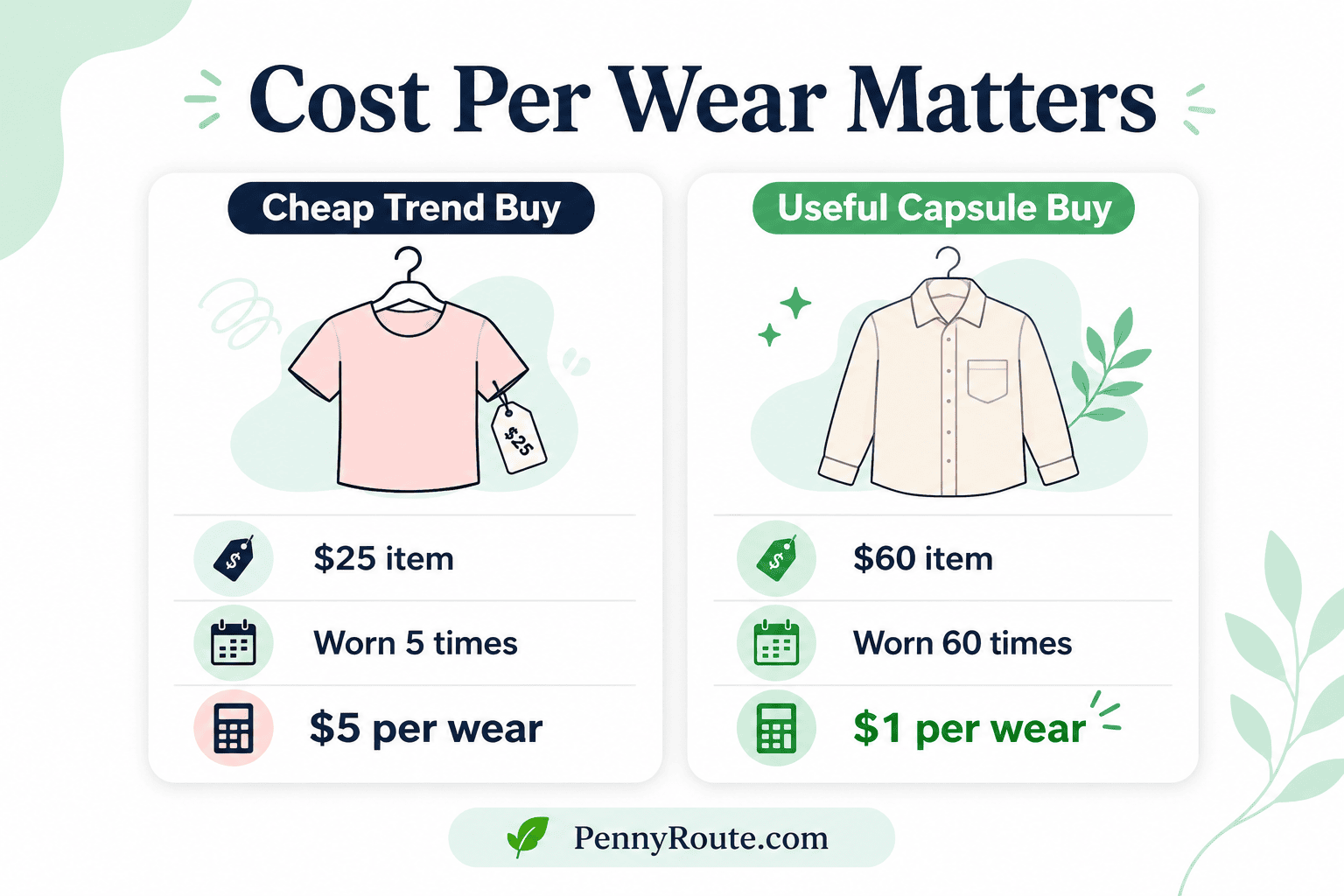
Cost per wear helps you compare the purchase price of an item with how often you actually use it.
Cost per wear = Purchase price ÷ Number of times worn
Cost Per Wear
For example:
| Item | Purchase price | Times worn | Cost per wear |
|---|---|---|---|
| Trendy top | $25 | 5 | $5.00 |
| Versatile sweater | $60 | 60 | $1.00 |
The $60 sweater costs more upfront, but it provides better value in this example because it is worn far more often.
This does not mean you should automatically buy expensive clothes. A higher price does not guarantee better quality, comfort, or durability. Cost per wear is most useful when you consider price, expected use, fit, and how well the item works with the rest of your wardrobe.
What Is a Capsule Wardrobe?
A capsule wardrobe is a smaller collection of clothes that work well together and suit your everyday routine. The focus is not on owning as little as possible. It is on keeping useful pieces that you wear regularly and may combine into multiple outfits.
A capsule wardrobe often includes:
- Everyday tops and bottoms
- A few layering pieces
- Shoes that match your usual activities
- Seasonal clothing
- Workwear, if needed
- A small number of special-occasion items
There is no required number of pieces. Your wardrobe may be larger or smaller depending on your climate, job, laundry schedule, personal style, and whether you include shoes, outerwear, or accessories.
You may also keep separate mini-capsules for different parts of your life, such as work, exercise, travel, or formal events. What matters is that each item has a clear purpose and fits comfortably into the way you actually live.
How Much Could a Capsule Wardrobe Save?
The amount you save depends on your current clothing habits, budget, and how often you shop. Looking back at recent transactions or tracking your expenses may help you calculate your current monthly clothing spending.
A capsule wardrobe may then help you lower that amount by reducing duplicate, unplanned, or rarely used purchases.
According to the U.S. Bureau of Labor Statistics, the average U.S. consumer unit spent $2,001 on apparel and related services in 2024. Your own spending may be much lower or higher, but tracking it gives you a useful starting point.
Consider this hypothetical example:
| Clothing spending | Monthly amount | Annual amount |
|---|---|---|
| Before creating a capsule wardrobe | $150 | $1,800 |
| After planning purchases | $65 | $780 |
| Potential difference | $85 | $1,020 |
In this example, the savings come from buying fewer duplicate items, skipping unplanned purchases, and replacing clothes only when necessary. It is not a guaranteed result, but it shows how small monthly changes may add up over a year.
Clothing purchases often fall under discretionary spending, which means you may adjust the amount when your budget needs more room.
Build a Clothing Budget Before You Shop
An annual clothing budget may be easier to manage than making purchase decisions one at a time.
You may estimate it with this simple formula:
Annual clothing budget = planned replacements + seasonal needs + special occasions + repairs + buffer
Formula
For example:
| Clothing expense | Annual amount |
|---|---|
| Planned replacements | $300 |
| Seasonal items | $150 |
| Special occasions | $100 |
| Repairs or tailoring | $75 |
| Small buffer | $75 |
| Total annual clothing budget | $700 |
You do not need to spend the full amount. The budget simply gives you a limit and helps you prepare for genuine clothing needs without relying on last-minute purchases.
Signs a Capsule Wardrobe May Help You Spend Less
A capsule wardrobe may be useful if clothing purchases are becoming difficult to track or your closet contains more items than you regularly wear.
Common signs include:
- You own unworn clothes or items with tags attached. This may point to impulse purchases or clothes bought for situations that rarely happen.
- You keep buying similar pieces. Repeatedly purchasing nearly identical tops, shoes, or jeans may increase spending without adding much variety.
- You shop without a clear plan. Sales, boredom, stress, or emotional spending may lead to purchases that do not fit your budget or routine.
- You struggle to build outfits from what you own. The problem may be a lack of compatible pieces rather than a lack of clothes.
You do not need to relate to every point. Even one repeated pattern may be enough reason to review your wardrobe before buying anything new.
How to Build a Capsule Wardrobe on a Budget
1. Audit What You Already Own
Start by reviewing the clothes you already have before buying anything new.
Take everything out by category, then separate items into four groups:
- Wear regularly
- Wear occasionally
- Need repair or alteration
- Rarely or never wear
Pay attention to repeated items, uncomfortable fits, and clothes that no longer match your routine. You may discover that you already have enough basics but are missing one or two pieces that would make more outfits work.
Avoid donating or selling uncertain items immediately. Place them in a separate box for 30 days instead. If you need something during that time, return it to your wardrobe. This may prevent regret and unnecessary replacement purchases.
2. Match Your Wardrobe to Your Routine
Your capsule wardrobe should reflect how you spend most of your time.
List the activities that shape a typical week, such as:
- Work or school
- Errands
- Exercise
- Social plans
- Time at home
- Religious or community events
Then compare those needs with the clothes you currently own. A wardrobe built mostly around office wear may not be practical if you work from home, while a large collection of casual clothes may not help if your job requires formal outfits.
Focus first on the categories you use most often. This helps prevent spending on clothes that suit an occasional or imagined lifestyle rather than your actual routine.
3. Choose Colors That Work Together
A limited color palette may make it easier to combine more of your clothes into complete outfits.
Start with two or three neutral colors you already wear, such as:
- Black
- Navy
- Gray
- Beige
- Brown
- White
Then add one or two accent colors you enjoy wearing. You do not need to remove every item outside the palette. Use it as a guide for future purchases so new clothes work with more of what you already own.
Before buying an item, check whether it matches at least three pieces in your wardrobe. This simple test may help you avoid clothes that look appealing on their own but are difficult to wear regularly.
4. Identify Genuine Wardrobe Gaps
After reviewing your routine and color palette, make a short list of what is actually missing.
A genuine gap is an item that would help you use more of the clothes you already own. For example, one versatile jacket may complete several outfits, while another similar top may add little value.
Keep your list specific:
- One pair of work shoes
- One lightweight layering piece
- Two everyday tops
- One replacement pair of jeans
Avoid broad notes such as “more casual clothes” or “new workwear.” Specific gaps are easier to budget for and less likely to lead to extra purchases.
Before adding an item to the list, ask whether you already own something that serves the same purpose. This helps separate real needs from temporary wants.
5. Set a Spending Limit
Decide how much you may spend before looking for replacement items or filling wardrobe gaps.
You could use a monthly limit, a seasonal budget, or a separate sinking fund for clothing expenses. Choose the method that fits your income and shopping habits.
For example, if your annual clothing budget is $600, you might set aside $50 per month. That money may cover replacements, seasonal needs, repairs, and occasional purchases without disrupting the rest of your budget.
Keep a simple list of:
- What you plan to buy
- Your maximum price for each item
- What you actually spend
- How much remains in the budget
A spending limit works best when it is set before shopping, not after you find something you like.
6. Test Your Capsule Before Removing Clothes
You do not need to sell or donate everything outside your capsule immediately.
Choose the clothes you expect to wear most often, then store uncertain items separately for 30 days. During the trial, notice which pieces you miss, which outfits are difficult to complete, and which clothes remain unused.
At the end of the month:
- Return useful items to your wardrobe
- Repair or alter clothes that still serve a purpose
- Sell items with resale value
- Donate wearable pieces you no longer need
- Recycle textiles that are too damaged to use
A trial period gives you time to adjust the wardrobe without creating replacement costs later.
7. Replace Clothes Slowly and Intentionally
Fill wardrobe gaps one item at a time instead of buying everything at once.
Start with the piece that would solve the most immediate problem or complete the greatest number of outfits. Then compare options based on fit, comfort, versatility, care requirements, ongoing care costs, and price.
Before buying, check:
- Whether the item fills a documented gap
- How many outfits you may create with it
- Whether you already own something similar
- Whether it fits your current budget
- Whether you would still want it at full price
Waiting a few days before purchasing may also help separate a useful addition from a temporary impulse.
The aim is not to finish your capsule wardrobe quickly. It is to build it without creating another round of unnecessary spending.
Simple Capsule Wardrobe Example
Your capsule wardrobe should reflect your climate, routine, and personal style. The example below is only a starting point, not a required formula.
| Category | Example pieces |
|---|---|
| Tops | 5 everyday tops, 2 dressier tops |
| Bottoms | 2 pairs of jeans, 2 trousers, 1 skirt or alternative |
| Layers | 2 sweaters, 1 cardigan, 1 jacket |
| Shoes | 1 everyday pair, 1 work or dress pair, 1 seasonal pair |
| Outerwear | 1 weather-appropriate coat |
| Special-use items | Exercise clothes, formal wear, or uniforms as needed |
This example includes enough variety for different outfits without requiring a large collection. You may need more or fewer items depending on laundry frequency, weather changes, dress codes, and how often you repeat outfits.
Shoes, accessories, sleepwear, underwear, and workout clothes may be included in your total or tracked separately. Consistency matters less than whether each category supports your actual routine.
Questions to Ask Before Buying Clothes
A short checklist may help you avoid purchases that do not fit your wardrobe or budget.
Before buying, ask:
- Does this fill a documented wardrobe gap?
- Can I wear it with at least three items I already own?
- Do I already own something that serves the same purpose?
- Will I wear it often enough to justify the price?
- Does it fit comfortably and suit my current routine?
- Is it within my clothing budget?
A sale price should not replace these questions. An item is not a bargain if it remains unworn or leads to more purchases just to make it work.
A waiting period and a clear purchase list may also make it easier to stop overspending when sales or online shopping create extra temptation.
Is a Capsule Wardrobe Right for You?
A capsule wardrobe may work well if you want to simplify clothing decisions, reduce unplanned purchases, and make better use of what you already own.
It may be a good fit if:
- You prefer a smaller, more coordinated wardrobe
- You often buy clothes that are difficult to combine
- You want clearer limits for clothing spending
- You are comfortable repeating outfits
- You would rather replace items slowly than shop frequently
It may be less practical if your work, climate, hobbies, or cultural needs require a wider range of clothing. You also do not need to apply the idea to your entire closet.
A partial capsule may be enough. You could create one for work, travel, a particular season, or everyday casual wear while keeping other clothing categories separate. The best approach is the one that supports your routine without creating unnecessary restrictions.
Start With the Clothes You Already Own
A capsule wardrobe does not need to begin with a shopping trip. Review what you already wear, identify the pieces that work well together, and make a short list of genuine gaps.
Set a realistic clothing budget and replace items gradually. A few deliberate changes may help you spend less and get more use from the clothes already in your closet.
Frequently Asked Questions
How many clothes should be in a capsule wardrobe?
There is no required number. Some capsule wardrobes include around 25 to 40 items, but your total may be higher or lower depending on your climate, work requirements, laundry schedule, and whether you include shoes, outerwear, or accessories.
How much does a capsule wardrobe cost?
A capsule wardrobe does not need a large startup budget. The lowest-cost approach is to begin with clothes you already own and spend only when you identify a genuine gap or need to replace a worn-out item.
How do you build a capsule wardrobe on a budget?
Start by auditing your current clothes, matching them to your routine, and listing only the pieces that are genuinely missing. Set a spending limit, test the wardrobe before removing items, and replace clothes gradually rather than buying a new collection at once.
Can a capsule wardrobe save you money?
It may help you spend less by reducing impulse purchases, duplicate items, and clothes that are rarely worn. The amount you save depends on your current shopping habits and whether you follow a clear clothing budget.
What should be included in a capsule wardrobe?
A capsule wardrobe usually includes everyday tops, bottoms, layering pieces, shoes, and seasonal clothing that work well together. You may also include workwear, exercise clothes, outerwear, or special-occasion items based on your routine.