

You do not need identical money habits before marriage, but you should understand what each person is bringing into the relationship and where your expectations may be different.
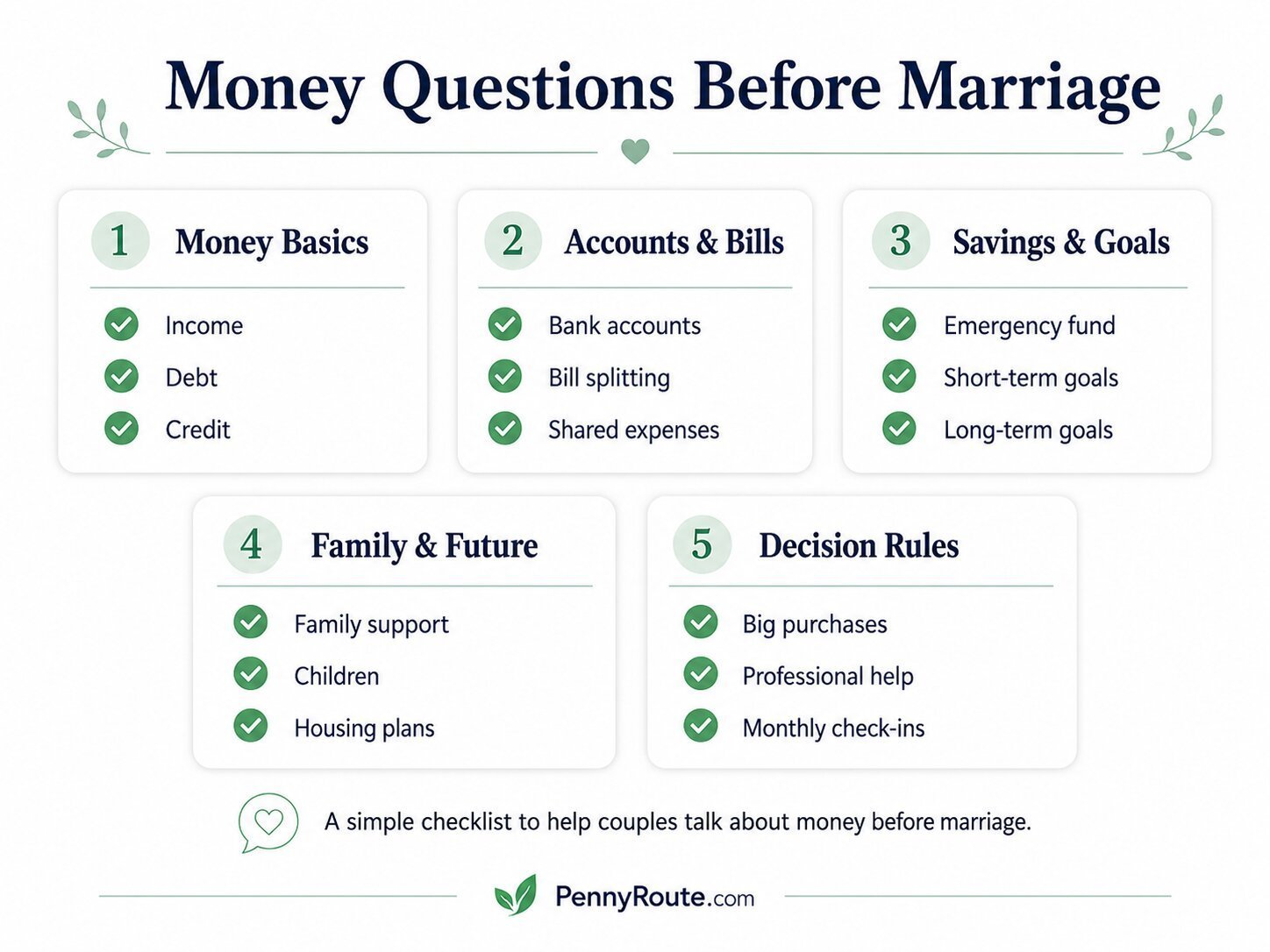
Some money conversations are about facts, such as income, debt, credit, and existing financial obligations. Others are about expectations, including how much to save, how to handle family support, or what financial security means to each of you. A few require an actual decision before you begin sharing more of your financial life.
Having those conversations early can make it easier to spot differences while you still have time to talk through them calmly. The purpose is not to agree on every detail. It is to know where things stand, what still needs a decision, and whether there are any financial surprises that could affect your plans together.
Disclaimer: This content is for informational purposes only and does not constitute financial, legal, or tax advice. Marriage can affect taxes, debt responsibility, and other financial matters differently depending on your situation and state laws, so consider consulting a qualified professional when needed.
Quick Overview
- Start with the facts: income, debt, credit, savings, accounts, and existing financial obligations.
- Talk through expectations around spending, saving, family support, and financial security.
- Make clear decisions about shared bills, account structure, large purchases, and financial responsibilities.
- You do not need identical money habits, but you do need enough transparency to plan together.
- Some differences can be worked through over time, while others need a clearer agreement before finances are combined.
What Should Couples Know About Each Other’s Finances Before Marriage?
Before you can make shared financial decisions, you need a reasonably clear picture of three things: what already exists, what each of you expects, and what still needs to be decided together.
| Before marriage, understand | What that includes |
|---|---|
| What already exists | Income, debt, credit history, savings, accounts, and ongoing financial obligations |
| What each person expects | Spending, saving, lifestyle, family support, and what financial security looks like |
| What you will decide together | Shared bills, account structure, large purchases, financial goals, and who handles which responsibilities |
These conversations do not require you to have every future detail settled. They are meant to uncover the information and expectations that could affect how your finances work once you are married.
A difference in preferences is not automatically a problem. What is harder to plan around is discovering important debt, obligations, or financial expectations only after you have already started making major decisions together.
How to Talk About Money Before Marriage
Money conversations tend to go better when you are both working from the same facts instead of assumptions.
Start with one topic at a time and use actual numbers where they matter. Saying “I have some debt” is very different from sharing the balance, minimum payment, and whether the account is current. The same applies to income, savings, and financial obligations.
It also helps to separate questions from accusations. “How do you usually decide what to spend on?” opens a conversation. “Why do you spend so much?” usually closes one.
Not every topic has to be settled in a single sitting. If something needs more thought, write it down and come back to it. The important part is that the conversation stays specific enough to reveal what you know, what you still need to decide, and where expectations do not yet match.
15 Money Questions to Ask Before Marriage
1. What Income Do We Each Actually Have Available?
Start with the income each of you can realistically count on, not just the number on a job offer or an annual salary.
That may include:
- take-home pay
- overtime and bonuses
- freelance income and commissions
- or other income that changes from month to month.
If some of it is irregular, talk about what is dependable and what is not.
It also helps to be clear about money that is already committed before it reaches the household, such as payroll deductions, support payments, or other recurring obligations.
You do not need to combine income to have this conversation. You just need a realistic picture of the income each of you can actually plan around.
2. What Debts and Required Payments Do We Each Have?
Debt matters before marriage because the balance is only part of the picture. Monthly payments, interest rates, account status, and how long the obligation may last can all affect future household decisions.
Talk openly about debts such as:
- credit cards
- student loans
- auto loans
- personal loans
- medical debt
- accounts that are past due or in collections
It is also worth discussing expectations. Will each person continue handling their own debt, or do you expect shared income to help pay some of it down? There is no single right arrangement, but it is better to make that clear before it starts affecting shared cash flow.
Getting married does not automatically make you jointly responsible for every debt your spouse already has. Responsibility can depend on whose name is on the debt, whether you later borrow jointly, and applicable state law.
3. Is There Anything Important in Our Credit Histories We Should Know?
Getting married does not combine your credit scores. Each person keeps an individual credit history, although both credit profiles can matter when you apply for a loan together.
Talk about anything that could matter for future borrowing, such as:
- missed or late payments
- collections
- high credit card balances
- limited credit history
- recent credit problems
The purpose is not to judge each other’s score. It is to understand whether either credit history could affect plans such as renting a home, financing a car, or applying jointly for a mortgage.
4. What Savings, Assets, and Financial Accounts Do We Each Have?
You should both have a basic picture of the financial resources already in place, not just the debts and monthly payments.
That can include:
- checking and savings accounts
- retirement accounts
- investment accounts
- cash savings
- other assets that are relevant to your shared plans
You do not need to combine everything or give up individual accounts just because you are getting married.
Talk about what each account or asset is for and whether any of it is already intended for a specific purpose. One person may see savings as available for a shared goal while the other considers that money personal or already committed elsewhere.
5. Do Either of Us Have Financial Obligations Beyond Ordinary Bills?
Not every recurring financial commitment shows up as debt. One of you may already be supporting a parent, helping another family member, paying child support, or covering ongoing caregiving or medical costs.
These obligations matter because they can affect how much income is actually available for shared expenses and future goals.
Talk about what is already being paid, whether the amount is likely to continue, and whether either of you expects that support to increase later.
The conversation is about knowing how much income is already committed before you begin making shared plans around it.
6. Have Either of Us Had Tax Problems or Unpaid Taxes?
Tax issues are worth discussing before marriage because they can affect future filing choices, refunds, and the way you plan around household income.
Talk about any unpaid federal or state taxes, unfiled returns, payment plans, or other tax problems that are still unresolved. It is also useful to know whether either person has a situation that regularly makes taxes more complicated, such as self-employment or significant freelance income.
If you later file a joint federal tax return, both spouses are generally responsible for the tax liability on that return under the IRS rules for joint and several liability
You do not need to sort out every tax detail now. You do need to know whether an unresolved issue could affect future filing or deserves professional advice before you file together.
7. How Does Each of Us Normally Spend and Save?
Money habits can look very different even when two people earn similar amounts. One person may spend more freely on everyday wants, while the other prefers to keep a larger cushion in savings.
Talk about the patterns that actually affect shared finances, such as how often you save, how comfortable you are with discretionary spending, and whether you tend to plan purchases or decide in the moment.
Different habits are not automatically a problem. The trouble usually starts when shared money is being handled under two different assumptions.
A difference in spending or saving habits can be manageable when both people know it exists and agree on how shared money will be handled.
8. What Does Financial Security Look Like to Each of Us?
Two people can look at the same bank balance and feel very differently about whether it is enough.
For one person, financial security might mean having a large emergency cushion. For another, it might mean low debt, steady income, enough room for travel, or being able to help family without putting other bills at risk.
Talk about the conditions that would make each of you consider the household financially stable. That can reveal differences that would not show up from income or savings numbers alone.
You do not need identical definitions. You do need to understand what each person is trying to protect or build, especially when those priorities will shape shared saving, spending, and long-term decisions.
9. Will We Use Joint Accounts, Separate Accounts, or Both?
There is no single account setup that works best for every couple.
Some couples combine most of their money. Others keep separate accounts and use one joint account for shared expenses. Some keep everything separate and simply agree on who pays what.
Talk about which setup seems easiest for both of you to manage and what each account would be used for. It also helps to decide how shared bills, savings, and personal spending would fit into that structure.
The account setup matters less than whether both of you understand how shared expenses will be covered and what money remains individual.
10. How Will We Divide Shared Expenses?
Shared expenses do not have to be split 50/50 to be fair.
If your incomes are different, one option is to divide certain costs in proportion to what each person earns. A split-bills-by-income approach can make that easier to compare without assuming both people should contribute the same dollar amount.
Talk about which expenses will count as shared, how contributions will be calculated, and what happens when income changes.
The arrangement should be clear enough that neither person has to guess what they are responsible for each month.
11. How Much Can Either of Us Spend Without Checking First?
You do not need permission for every purchase, but it helps to agree on when a spending decision becomes something you should discuss together.
That threshold can be different for every couple. For some, it may apply only to large purchases. For others, it may also include new subscriptions, financing, or any expense that affects shared savings or upcoming bills.
Talk about the kinds of purchases that should trigger a conversation and whether the same rule applies to both of you.
Agreeing on the threshold now makes it clearer when a purchase is personal and when it affects both of you.
12. What Financial Goals Are We Planning for Together?
Shared goals can affect how much you save, what you are willing to spend now, and which larger financial decisions make sense later.
Talk about the goals that could shape your finances as a couple, such as:
- buying a home
- traveling
- building retirement savings
- going back to school
- starting a business
- preparing for a major move.
You do not need every goal fully planned before marriage. It is enough to know which ones matter to each of you, which goals you already share, and where your timelines or priorities are different.
When you are ready to turn a shared priority into a specific target, setting a financial goal with a clear amount, timeline, and realistic contribution can make the next step easier.
13. How Will We Handle Financial Support for Family?
Even if neither of you is supporting family now, one of you may expect to help a parent, sibling, or other relative financially in the future.
Talk about whether either of you expects to provide financial help in the future, what kinds of situations would justify it, and whether there should be a limit or a conversation before shared money is used.
It also helps to separate occasional help from an ongoing commitment. Covering an emergency once is different from regularly contributing to another household’s expenses.
You do not need to predict every family situation in advance. You do need a shared understanding of when financial support becomes a joint decision rather than an individual one.
14. How Might Children or Caregiving Change Our Finances?
Children and caregiving can change both expenses and income, sometimes at the same time.
Talk about what you expect around:
- childcare
- parental leave
- reduced work hours
- education costs
- supporting an aging parent or another family member.
You do not need exact numbers for every possibility, but it helps to know where your expectations differ.
For example, one person may assume both partners will keep working full time, while the other expects to step back from work for a period. That difference can affect housing choices, savings goals, and how much flexibility you want in the budget.
These are easier decisions to plan for before a change in income or caregiving responsibilities makes them urgent.
15. Who Will Handle Which Financial Responsibilities?
Someone will need to keep track of bills, tax documents, insurance paperwork, account updates, and other routine financial tasks. Those jobs do not have to be split evenly, but both of you should understand how they are being handled.
Talk about who is most likely to take care of which responsibilities and what the other person still needs to know. One partner may prefer managing bill payments, while the other handles insurance or tax records.
Dividing the work can make money management easier, but it should not leave one person completely disconnected from the household finances.
However you divide the tasks, both of you should still know where key accounts, bills, and documents stand. Dividing the work should make things easier, not leave one person completely dependent on the other for basic financial information.
You Do Not Need to Agree on Every Money Preference
Different money preferences do not automatically mean you are financially incompatible.
One of you may prefer keeping a larger savings cushion while the other wants more room for travel or everyday spending. You may also disagree about joint accounts, personal spending, or how financial tasks should be divided. Those are choices you can discuss and negotiate.
A hidden debt, undisclosed account, or financial obligation is different. In those situations, one person is making plans without information that could materially affect them.
You do not have to reach the same opinion on every money decision before marriage. But both of you should know the financial facts that could change the decisions you are making together.
Which Money Differences Need a Plan Before Marriage?
Some differences can stay flexible. Others affect shared cash flow, borrowing, or day-to-day responsibilities enough that they are easier to handle with a clear plan.
| If you disagree about | Decide before marriage |
|---|---|
| Joint vs. separate accounts | How shared bills will actually be paid |
| Different incomes | How household expenses will be divided |
| Existing debt | Whether shared money will help pay it down |
| Family support | When support becomes a joint decision |
| Large purchases | What spending amount should trigger a conversation |
| Long-term goals | Which goals will affect near-term saving and borrowing |
You do not need to predict every future situation. Focus on the differences that will directly affect shared bills, borrowing, savings, or financial responsibilities. Those are the areas where a clear plan now can prevent both of you from operating under different assumptions later.
Clear Money Conversations Give You a Better Starting Point
Talking about money before marriage will not settle every financial decision you will make together. It does give both of you a clearer picture of the income, obligations, accounts, and priorities that will shape those decisions.
Knowing the numbers is only part of that preparation. You also know which choices have already been discussed, where you still need an agreement, and which financial issues may require more time or professional guidance.
You will keep making money decisions as your circumstances change. Starting those conversations before marriage gives you something useful to build from instead of discovering the important details only when a decision is already in front of you.