

“Save more money” sounds like a goal, but it does not tell you how much you need, when you want to reach it, or what the plan will require from your current finances.
A useful financial goal gives you a clear target and a realistic way to work toward it. That might mean saving for a car repair, building a larger cash buffer, paying down debt, or putting money toward a longer-term goal.
The important part is not making the goal sound ambitious. It is making sure the amount, deadline, and contribution actually fit together well enough that you can follow the plan in real life.
Disclaimer: This content is for informational purposes only and does not constitute financial advice. Consider your own financial situation, priorities, and timeline when setting money goals, and consult a qualified professional when needed.
Quick Overview
- A financial goal works best when it has a clear amount, purpose, and timeframe.
- The monthly contribution needs to fit your actual budget, not just the deadline you want.
- You can have several goals at once without giving each one the same priority.
- If the numbers do not work, adjust the target, deadline, or funding source.
- Financial goals can change when your income, expenses, or priorities change.
What Are Financial Goals?
A financial goal is a specific money outcome you want to reach within a certain timeframe.
It turns a general intention into something you can actually plan around. “Save more” is vague. “Save $1,200 for car repairs over the next 12 months” gives you a target, a purpose, and a deadline.
Financial goals can be small or large. You might want to build a bill buffer, pay off a balance, save for a move, replace a car, or put more toward retirement. The size of the goal matters less than whether the numbers behind it are clear enough to guide your next steps.
A well-defined goal should help you answer three basic questions:
- What am I working toward?
- How much will I need?
- When do I want to reach it?
Those answers give you something concrete to work with before you decide how much to set aside each month or how the goal should fit alongside your other financial priorities.
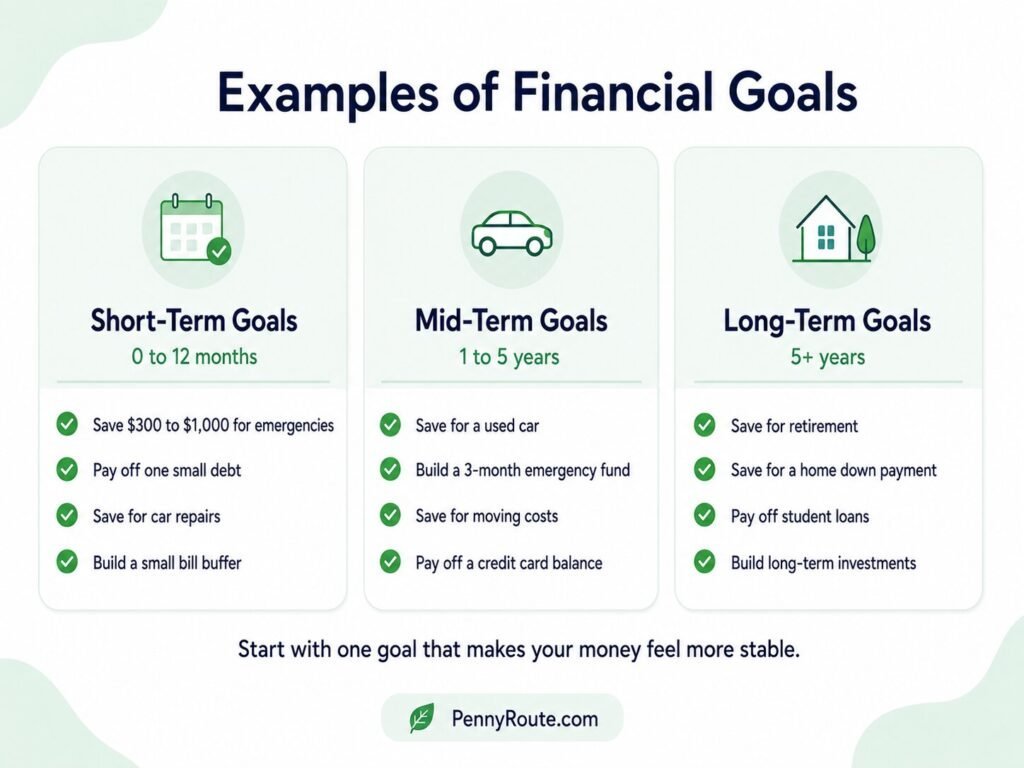
Short-Term, Medium-Term, and Long-Term Financial Goals
Financial goals usually fall into different timeframes, and that timeframe affects how much room you have to save, adjust, and respond if something changes.
| Timeframe | Financial Goal Examples |
|---|---|
| Short term | Build a $600 car-repair fund; save for an annual bill |
| Medium term | Save $5,000 for moving costs; save toward a replacement car |
| Long term | Save toward retirement or a future home purchase |
There is no single cutoff that every source uses for short-, medium-, and long-term goals, so the exact labels matter less than the timeline itself.
A shorter deadline usually means the monthly amount has to be higher. A longer deadline gives you more time to spread the target out, but it can also mean more changes in income, expenses, or priorities along the way.
That is why the timeframe should come from the goal itself, not from a category label. The next step is making sure the target and deadline work together in a way that fits your actual finances.
SMART Financial Goals: Useful, but Not the Whole Plan
The SMART framework can help turn a vague money goal into something more concrete. A SMART goal is:
- Specific: You know exactly what you are working toward.
- Measurable: You can track progress with a number.
- Achievable: The target is realistic for your situation.
- Relevant: The goal matters to you and fits your priorities.
- Time-bound: You have a deadline or target date.
The CFPB’s SMART goals tool uses the same framework to help turn broad goals into specific, measurable, achievable, relevant, and time-bound ones.
For example, “I want to save more” is too open-ended to plan around. “I want to save $1,800 for moving costs within 12 months” gives you a clearer target.
The SMART framework is useful for defining the goal, but it does not answer the most important practical question on its own:
Does the amount you need to contribute actually fit your finances?
A goal can look perfectly clear on paper and still be difficult to follow if the deadline requires more money each month than you realistically have available. That is why the next step is to look at the numbers behind the goal, not just the wording.
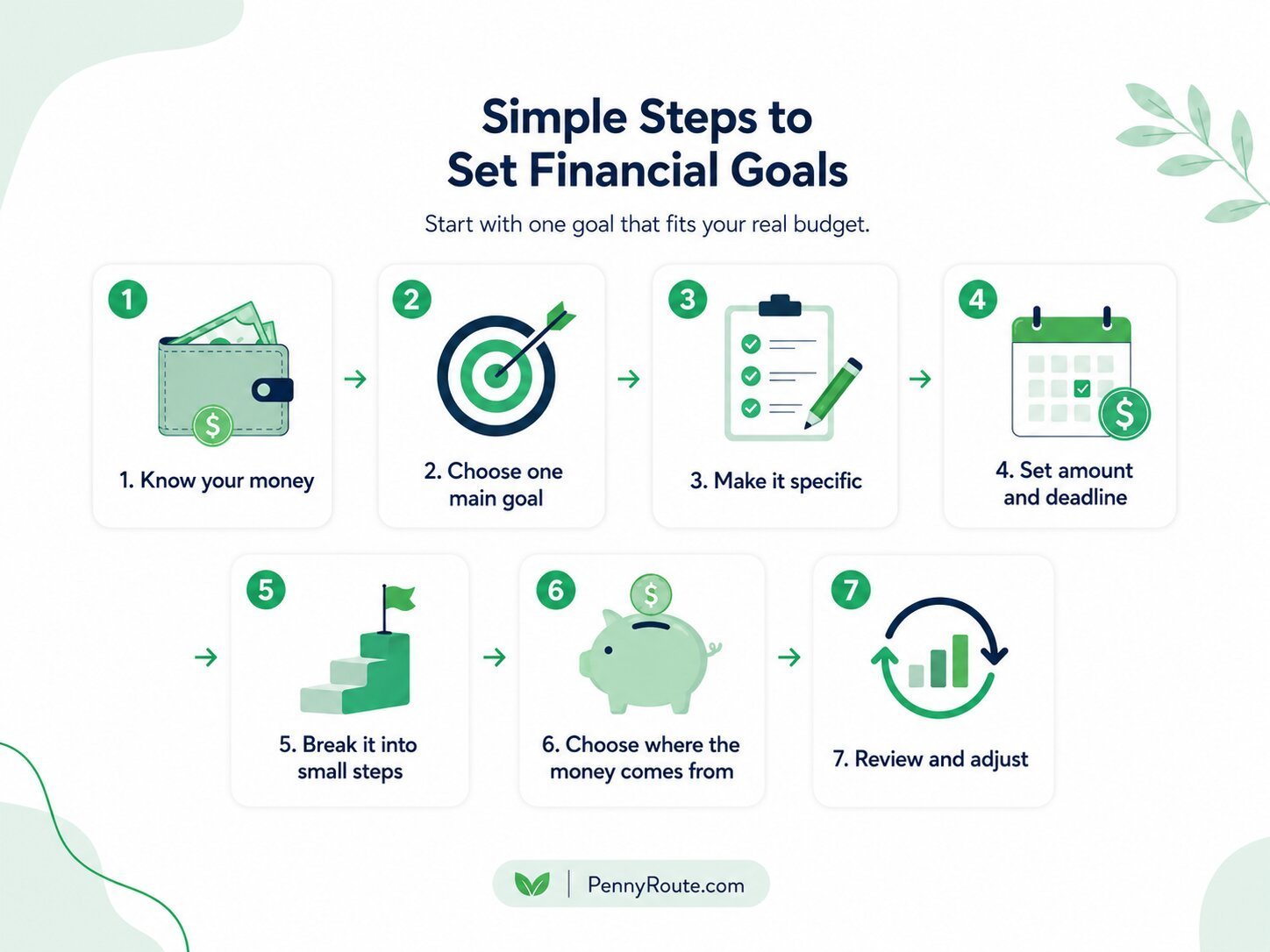
How to Set Financial Goals in 7 Realistic Steps
1. Start With Your Current Money Picture
Before you commit to a target, look at the money you are already working with.
You do not need a full financial plan. A simple snapshot of your income, regular expenses, debt payments, current savings, and any known upcoming costs is enough to show how much room you realistically have.
If your financial information is scattered across several accounts, bills, and notes, getting it into a simple system first can make this step easier.
The point is not to wait until everything is perfectly organized. You just need enough visibility to avoid setting a goal based on money that is already spoken for.
2. Choose the Goal That Matters Most Right Now
You can have more than one financial goal at the same time. The harder part is deciding which one should get the most attention first.
Start with the goal that is most important to your current situation, especially if it has a real deadline or solves a problem you are likely to face soon. A car repair fund, upcoming move, or overdue balance may deserve more attention than a goal with no immediate pressure.
That does not mean every other goal has to stop. You can keep smaller contributions going elsewhere if they still fit. The main priority simply gets the larger share of the money you have available.
This approach is usually more realistic than trying to fund every goal equally. It gives you a clear focus without pretending the rest of your financial life has disappeared.
3. Give the Goal a Specific Target
Once you know which goal deserves priority, give it a number.
“Build emergency savings” is useful as a direction, but it is still hard to plan around. “Save $1,500 for emergency expenses” gives you something concrete to measure.
Your target should reflect the actual purpose of the goal. If you are saving for a known expense, use the best estimate you have. If the amount is less certain, choose a reasonable target for now rather than waiting for a perfect number.
A specific target also makes later decisions easier. You can work out how much is still needed, what the deadline will require, and whether the plan fits the money you have available.
4. Set a Deadline That Fits the Goal
A deadline gives the target a timeline, but it should come from the goal rather than from pressure to finish as quickly as possible.
If the expense has a fixed date, such as a move, annual insurance payment, or planned trip, the deadline is already partly decided for you. If the timing is flexible, choose a date that gives you enough room to make steady progress without forcing an unrealistic monthly amount.
For example, saving $2,400 over 12 months requires a very different contribution than saving the same amount over six months.
A useful deadline should make the plan clearer, not tighter than your finances can reasonably handle. The next step is to turn that deadline into an actual monthly number.
5. Calculate What the Goal Requires From You
Once you have a target and a deadline, turn them into a monthly number.
Start with the amount you still need, then divide it by the number of months left:
Amount still needed ÷ months remaining = monthly contribution
Calculation
For example, suppose your goal is $3,000, you already have $500, and you want to reach the target in 10 months.
$2,500 ÷ 10 = $250 per month
Example
That $250 is the number you need to test against your actual finances. If it fits comfortably, the plan is starting from a workable place. If it does not, the next step is not to force the contribution. It is to adjust the plan before you rely on it.
6. Check Whether the Contribution Fits Your Real Budget
Now compare the monthly contribution with the money you actually have available after regular expenses and existing commitments.
Using the earlier example, the goal requires $250 per month. If your budget only leaves about $140 available, the plan does not fit as written. That does not mean the goal is bad. It means one part of the plan needs to change.
You could:
- extend the deadline
- lower the target
- use a different realistic funding source
- reduce the monthly contribution and accept slower progress
A simple budget can help you see what is genuinely available before you commit to a number.
This step is where a financial goal becomes practical. The amount on paper has to work with the rest of your finances, not compete with money that is already needed somewhere else.
7. Decide How the Goal Will Be Funded and Reviewed
Once the monthly amount fits, decide how the money will actually move toward the goal.
That might mean setting up an automatic transfer after payday, moving a set amount manually each month, or using part of irregular income when it arrives. Choose a method that moves the money consistently without creating problems elsewhere in your budget.
It also helps to check the goal often enough to catch changes before they throw the plan off. A short weekly money check-in can help you notice whether the contribution still fits, whether the deadline needs adjusting, or whether another expense has become more urgent.
You do not need to review the goal every day. A simple routine that keeps the numbers current is usually enough to show whether the plan is still working or needs a small change.
What If You Have Several Financial Goals at Once?
You can work toward more than one financial goal at a time, but they do not all need the same amount of money or attention.
Start by separating required commitments from goals you have more flexibility to pace. Bills, minimum debt payments, and expenses with firm deadlines still need to be covered. Goals such as travel, a future car purchase, or a larger savings target may give you more room to adjust the timing.
A simple comparison can help you decide where your available money should go first:
| Question | Why it matters | Example |
|---|---|---|
| Which goal has the closest real deadline? | Less flexible goals may need more money now. | Moving costs due in 6 months |
| Which goal solves the most immediate problem? | Some goals can protect your finances sooner. | Building a car-repair fund |
| Which goals can move more slowly? | Not every goal needs equal funding. | Vacation or future purchase |
| How much can you realistically divide between them? | The split still has to fit your budget. | $300 available across 3 goals |
Suppose you have $300 a month available for a car-repair fund, a vacation, and a future down payment. You do not have to divide it into $100 for each. If the repair fund is the most immediate need, you could direct most of the $300 there for now and increase the other contributions later.
Priorities can change as deadlines, income, and expenses change. Your contributions can change with them. Several goals can still move forward even when one of them needs most of your attention for a while.
Is Your Financial Goal Actually Realistic?
Once the target, deadline, monthly contribution, and funding plan are in place, check where the plan is most likely to break down.
Different problems call for different adjustments:
| If this is the problem | Consider changing |
|---|---|
| The monthly contribution is too high | Extend the deadline or lower the target |
| The deadline cannot move | Reduce the target or find another realistic funding source |
| Your income changes from month to month | Use a flexible contribution instead of one fixed amount |
| Several goals are competing for the same money | Give one goal temporary priority |
| The goal no longer matters as much as it did | Reduce it, pause it, or replace it |
A realistic goal can still require effort, but it should not depend on ignoring bills, borrowing to keep up, or using money that already has another job.
What to Do When a Financial Goal Stops Fitting
A financial goal that worked six months ago may not fit the same way after a change in income, expenses, or priorities.
That does not mean you need to abandon it immediately. First, look at what changed. The contribution may be too high now, the deadline may be less important, or another expense may need attention first.
Depending on the situation, you can:
- Slow it down by contributing less for a while.
- Extend the deadline so the monthly amount becomes easier to manage.
- Resize the target if the original amount no longer makes sense.
- Pause the goal while you deal with something more urgent.
- Replace it if your priorities have changed completely.
For example, if you were saving $250 a month toward a future purchase and a new recurring expense takes up $100 of that room, continuing the same contribution may no longer be realistic. Reducing it to $150 or extending the deadline can keep the goal moving without putting unnecessary pressure on the rest of your budget.
Financial goals are plans, not contracts. Changing one because your circumstances changed can be a practical adjustment, especially when the alternative is forcing a number that no longer fits.
A Good Financial Goal Gives You a Plan You Can Use
A financial goal becomes much easier to work with once you know the target, the timeline, and what the plan asks from your monthly budget.
You do not need the most ambitious target or the fastest deadline. A smaller goal that fits your actual finances gives you a clearer path than a bigger one that only works on paper.
Set the numbers, check that they fit, and adjust when your circumstances require it. That gives the goal enough structure to guide your money without making the plan unnecessarily rigid.