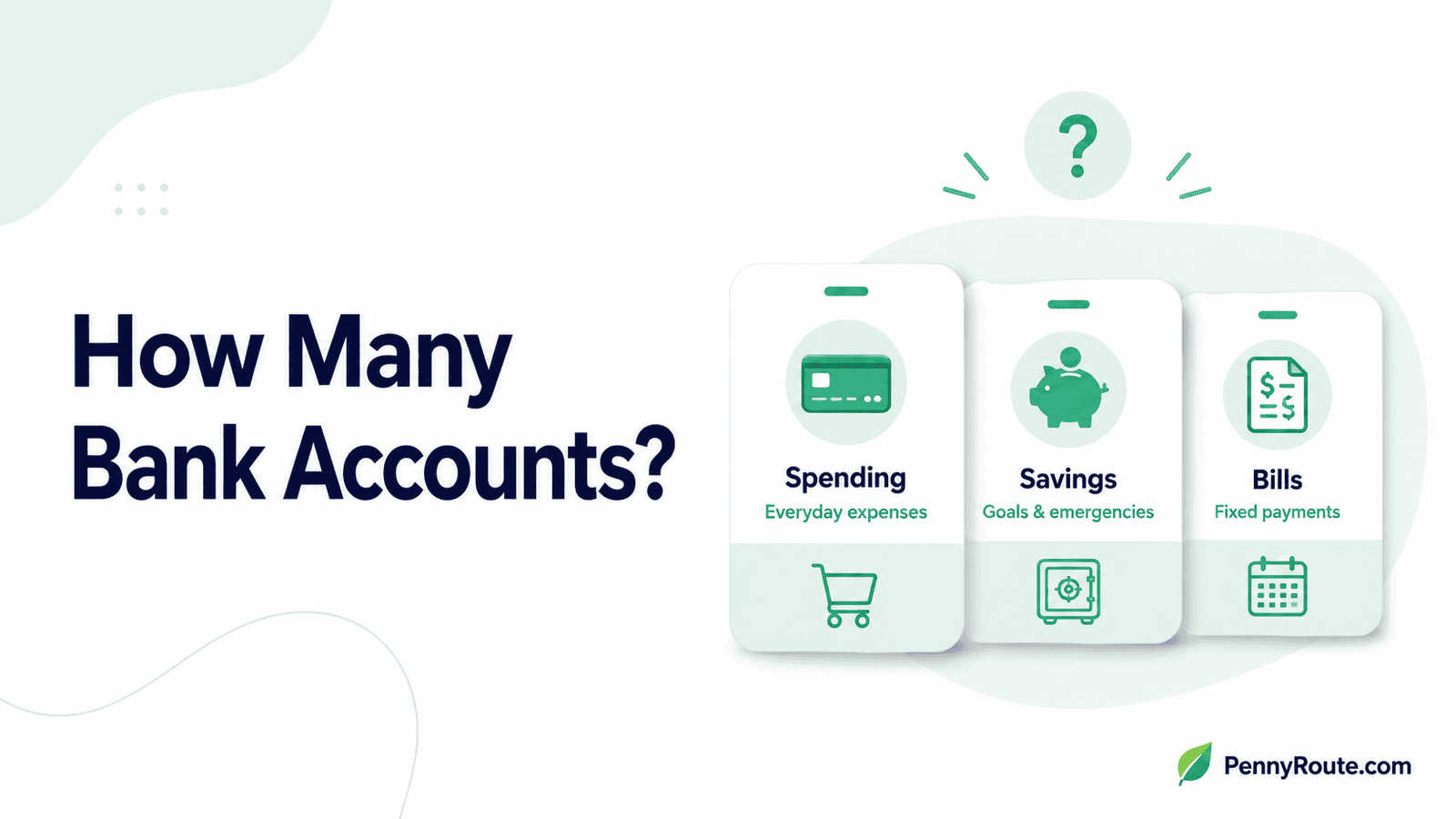
There is no perfect number of bank accounts. One checking account and one savings account may be enough when your finances are simple. Another person may need a separate place for bills, shared expenses, irregular income, or a major savings goal.
The useful test is not how many accounts you have. It is whether each one makes your money easier to understand. An extra account can add clarity, but it can also mean more fees, transfers, balances, and logins to keep track of.
The best setup is usually the smallest number of accounts that gives your money clear jobs without making the system harder to manage.
Disclaimer: This content is for informational purposes only and does not constitute financial advice. Account fees, features, ownership rules, and eligibility requirements vary by financial institution and individual circumstances.
Is There a Limit to How Many Bank Accounts You Can Have?
There is no general limit on the number of checking or savings accounts you can hold. You can also keep accounts at more than one financial institution.
The Consumer Financial Protection Bureau explains that you can have checking or savings accounts with more than one bank or credit union.
Individual banks and credit unions can still set their own account-opening requirements, product limits, fees, and eligibility policies.
The practical limit is usually how many accounts you can manage without losing track of balances, transactions, fees, or what each account is meant to do.
Start With the Jobs Your Money Needs
Instead of choosing a number first, list what your money needs to do.
Common jobs include:
- Receiving income
- Paying bills
- Covering everyday spending
- Holding emergency savings
- Saving for short-term goals
- Managing shared expenses
- Setting aside taxes from freelance or irregular income
Not every job needs its own account.
For example, income, bills, and everyday spending may all flow through one checking account when the balance is easy to track. Emergency savings and a short-term goal may also share one savings account if your bank provides buckets, labels, or goal tools.
A separate account becomes more useful when mixing the money creates a real problem. Bill money may need stronger protection from everyday spending. Shared household costs may need their own space. Irregular income may need to sit separately until taxes and monthly expenses are covered.
Start with the jobs, then decide which ones can comfortably share an account.
A Simple Account Setup for Most Beginners
A simple starting point is one checking account and one savings account.
The checking account handles money that moves regularly, such as income, bills, debit card spending, and transfers. The savings account keeps money that is meant to stay available for emergencies or short-term goals.
For example, if you bring home $3,000 per month, your paycheck may land in checking while an automatic transfer moves part of it into savings. The rest stays available for rent, utilities, groceries, transportation, and other monthly costs.
This setup works well when you can clearly see:
- What is available to spend
- What is already committed to bills
- What is being saved
You do not need a separate account for every category. If your bank offers savings buckets, account labels, or goal tracking, one savings account may be enough for more than one purpose.
The point is to keep the system easy to understand. More accounts are only useful when they solve a problem that the basic setup cannot.
When a Third Account May Add Real Value
A third account makes sense when the basic checking-and-savings setup is no longer keeping an important part of your money clear.
The extra account should solve one specific problem. It should not exist simply because a more complicated setup looks more organized.
Bill Money Needs Stronger Separation
If everyday spending regularly cuts into money meant for rent, utilities, or other fixed expenses, a second checking account may help.
One account can hold bill money while the other handles groceries, transportation, and flexible spending. The separation creates a clearer boundary between money that is already committed and money that is still available.
Shared Expenses Need Their Own Space
A separate account can make shared household costs easier to manage when two people contribute to the same bills.
Each person can transfer an agreed amount for rent, utilities, groceries, or childcare while keeping personal spending separate. This works best when both account holders understand who deposits money, which expenses belong there, and how overdrafts will be handled.
Irregular Income Needs a Holding Account
Freelance, side-hustle, or seasonal income does not always arrive on a predictable schedule.
A separate account can hold that income before you move money toward taxes, savings, and monthly spending. This creates a buffer between what you earn and what is actually available to use.
A Major Savings Goal Needs Clearer Separation
Keeping a large goal in the same account as emergency savings can make progress harder to track.
A separate savings account may help when the goal has a clear target, such as a car, home repair, or upcoming move. However, another account is not always necessary if your current bank already offers useful savings buckets or goal labels.
The third account should make one decision easier: what the money is for, whether it can be spent, or when it should be used.
Sample Bank Account Setups by Situation
There is no single setup that works for everyone. The examples below show how account roles can change with different financial needs.
| Situation | Possible setup | Why it may work |
|---|---|---|
| You are starting with simple finances | 1 checking account + 1 savings account | Keeps bills, spending, and basic savings easy to see |
| Bills keep getting mixed with everyday spending | 2 checking accounts + 1 savings account | Separates committed money from flexible spending |
| You share selected household costs with a partner | Personal accounts + 1 shared checking account | Keeps shared expenses visible without combining everything |
| Your income is irregular | 1 income account + 1 main checking account + savings for taxes or emergencies | Creates a buffer between unpredictable income and monthly spending |
| You have several savings goals | 1 checking account + 1 savings account with buckets, or separate savings accounts | Keeps goals visible without adding more accounts than you can manage |
These are examples, not targets.
A three-account setup is not automatically better than a two-account setup. The better choice is the one that helps you see what is available, what is committed, and what should remain untouched.
Start with the simplest structure that works. Add another account only when you can explain exactly what problem it will solve.
Do You Need a Separate Account for Every Goal?
No. Separate accounts can help, but they are not the only way to keep savings goals organized.
One savings account may be enough when your bank lets you create buckets, labels, or named goals. You can keep emergency savings, a travel fund, and money for home repairs in one place while tracking each amount separately.
A budgeting app, spreadsheet, or savings tracker can also create that separation without adding another account.
A new account becomes more useful when the money needs a stronger boundary. You may want one when:
- The goal has a large balance that should not be mixed with emergency savings.
- You are tempted to spend the money when it sits beside other savings.
- More than one person contributes to the goal.
- The money needs different access, ownership, or withdrawal rules.
- Your current bank does not provide a clear way to track separate goals.
Before opening another savings account, ask whether the problem is truly the account structure or simply the way the goal is being tracked.
Separate accounts may still be useful when major goals need clearer boundaries, and having multiple savings accounts can make progress easier to track when each account has a specific purpose.
How to Tell When You Have Too Many Bank Accounts
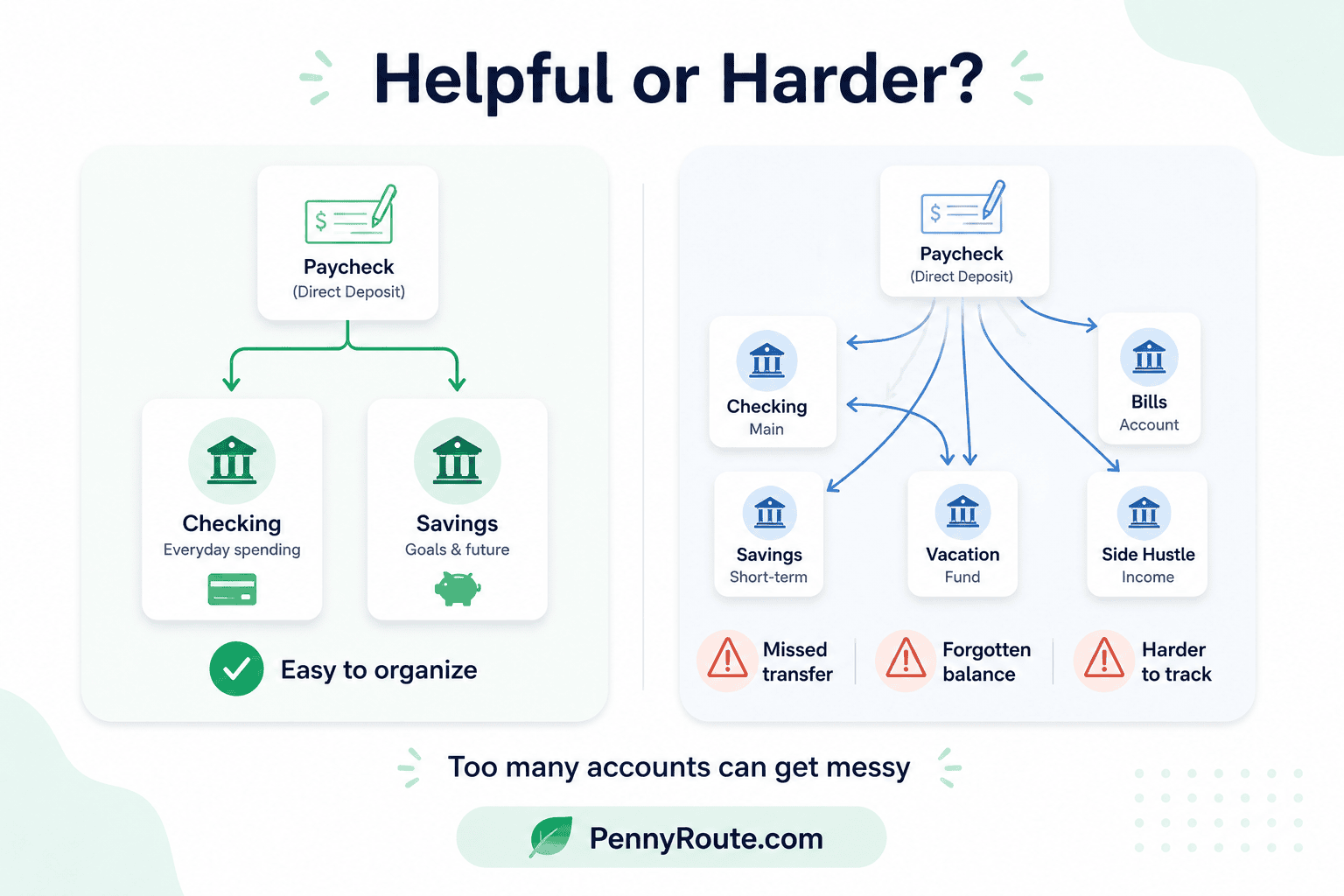
The number becomes too high when the setup starts hiding what is happening with your money instead of making it easier to understand.
You Cannot Explain What Each Account Is For
Every account should have a clear job.
If two or three accounts all hold “extra money” without a specific purpose, they may be creating clutter rather than useful separation.
A simple test is to name each account in one short phrase, such as “Monthly Bills,” “Emergency Fund,” or “Shared Expenses.” If that is difficult, the account may not be adding much value.
You Keep Moving Money to Prevent Shortfalls
Frequent transfers can be a sign that the accounts are divided too narrowly.
Moving money occasionally is normal. Moving it several times a week because one account is short while another has excess cash usually means the setup is working against you.
Fees and Balance Rules Are Harder to Meet
Several accounts can create several monthly fees, minimum-balance requirements, or direct-deposit conditions.
An account that saves $10 in one area but causes a $12 monthly fee somewhere else is not improving the system.
You Miss Activity or Automatic Payments
Too many accounts can make it easier to overlook:
- A subscription charged to an old account
- A debit card purchase that has not cleared
- A direct deposit sent to the wrong place
- A low-balance alert
- A fee on an account you rarely use
The setup is too complex when checking every account starts to feel like detective work.
Several Accounts Do the Same Job
Two savings accounts for clearly different goals may be useful. Four accounts holding unassigned savings may not be.
When several accounts serve the same purpose, combining them may make your total balance, progress, and available cash easier to see.
The right number is not based on how many accounts you can open. It is based on how many you can use confidently without losing track of fees, balances, or account purpose.
How to Simplify an Overcomplicated Setup
If your accounts have started to blur together, do not rush to close everything at once. Simplifying works better when you decide where each job will go before moving money around.
List Every Account and Its Purpose
Write down each checking and savings account, then note:
- What the account is used for
- Its current balance
- Any monthly fee or minimum requirement
- Which deposits go into it
- Which payments come out of it
This often makes the problem obvious. You may find two accounts doing the same job or one account that no longer has a real purpose.
Choose the Accounts You Want to Keep
Keep the accounts that are useful, affordable, and easy to manage.
When two accounts serve the same purpose, compare their fees, features, access, and balance requirements. The better option is usually the one that handles the job with less cost or friction.
Reassign Deposits and Payments
Before closing anything, decide where each direct deposit, automatic payment, transfer, and subscription will move.
Update them gradually and keep a simple checklist. A forgotten gym membership or annual renewal can still hit an old account weeks later.
Leave Time for Pending Activity
Keep enough money in the old account to cover outstanding checks, debit card transactions, and fees that have not posted yet.
Do not assume a zero balance means the account is ready to close. Review recent activity and wait until pending items have cleared.
Close Only After the New Setup Is Working
Once deposits and payments are reaching the right places, confirm that the old account has no remaining balance or activity.
Ask the bank for confirmation that the account is closed, then keep that record with your financial documents.
The aim is not to end up with the fewest accounts possible. It is to remove accounts that no longer make your financial life clearer.
Review Your Account Setup When Life Changes
The right number of accounts can change as your finances become simpler or more complex.
A setup that worked well a year ago may stop fitting after you:
- Move in with a partner
- Start freelance or side-hustle work
- Add a major savings goal
- Pay off debt
- Change jobs or income patterns
- Switch banks
- Stop using an account for its original purpose
For example, a separate account for debt payments may no longer be useful after the balance is paid off. A shared checking account may become helpful when household expenses begin coming from two incomes. Irregular work may create a need for a separate place to hold tax money.
Reviewing your accounts does not mean changing them constantly. It means checking whether each one still has a clear job and whether the full setup remains easy to follow.
When an account no longer serves a useful purpose, simplify carefully rather than keeping it open out of habit.
Keep Your Account Setup Simple
The best number of bank accounts is not two, three, or five. It is the smallest number that helps you see what is available, what is already committed, and what should remain untouched.
Start simple. Give each account a clear job. Add another only when it makes the system easier to use, and simplify when the setup starts creating more work than clarity.