A fun weekend on a budget does not have to mean choosing the cheapest option every time. What matters more is deciding how much you are comfortable spending before the weekend starts, then using that money on the parts you actually care about.
Weekend costs often grow through the extras rather than one big purchase. A ticket becomes parking, snacks, coffee, and dinner afterward. A quick meal turns into delivery fees and another stop on the way home. None of those choices are necessarily a problem, but together they can push the total much higher than you expected.
A better approach is to give the weekend a clear spending limit, choose one or two things that are worth paying for, and let the rest of your plans fit around them.
Disclaimer: This content is for informational purposes only and does not constitute financial advice. Choose spending and saving decisions that fit your own financial situation.
Quick Overview
- Choose your weekend spending limit before deciding what to do.
- Spend more on the part of the weekend you care about most instead of spreading the money across several small extras.
- Count the full cost of an outing, including food, parking, transportation, and fees.
- Use free or low-cost plans around one paid activity to stretch the weekend without making it feel restrictive.
- If a plan costs more than your limit, adjust the activity or the extras before increasing the budget.
How to Plan a Fun Weekend on a Budget
Start with the amount you can comfortably use for weekend fun after your required expenses and other priorities are covered. That amount does not need to match anyone else’s.
For one person, $30 might be enough for a meal and a low-cost activity. Someone else may have $75 available and prefer to use most of it on one outing. The useful number is the one that fits your current cash flow without creating pressure elsewhere.
Weekend spending is usually discretionary spending, which means you have more flexibility over whether, when, and how much to spend. That makes it easier to adjust the plan before the money is gone.
Once you know the amount, split the decision into three parts:
- what you most want to pay for
- what other costs come with it
- which parts of the weekend can stay free or low-cost
This keeps the weekend enjoyable without expecting every activity to be cheap.
Decide What Is Worth Spending Money On
A limited weekend budget works better when you choose what matters most before the smaller extras start competing for the same money.
Choose One Main Paid Plan
You do not need several paid activities to make the weekend enjoyable.
If there is one thing you genuinely want to do, let that be the main paid plan and build the rest of the weekend around it. That could be a meal out, a movie, a class, a museum visit, or another activity that feels worth the cost to you.
The rest of the weekend can stay simpler without making the paid part less enjoyable.
Spend More on What You Actually Care About
There is no single “right” way to divide weekend spending.
Someone who enjoys restaurants may prefer to spend most of the budget on one good meal and keep entertainment free. Someone else may cook at home and use the same amount for an activity instead.
The better choice is the one that matches what you value, rather than spreading the money across several purchases that do not add much to the weekend.
Leave Room for the Extras
The main activity is not always the full cost of the plan.
Parking, transportation, food, drinks, booking fees, or small add-ons can quickly use the money you thought was still available.
Leaving part of the budget unassigned gives you some flexibility without forcing you to increase the total later.
Budget for the Whole Outing, Not Just the Ticket
The price you first see is often only part of what the plan will cost.
A $25 ticket can turn into a much more expensive outing once you add parking, transportation, food, drinks, or booking fees. Looking at the full cost before you commit makes it easier to decide whether the activity still fits your weekend budget.
| Cost to include | Examples |
|---|---|
| Main activity | Tickets, admission, rental |
| Getting there | Gas, transit, parking |
| Food and drinks | Meal, coffee, snacks |
| Add-ons | Booking fees, equipment, extras |
| Buffer | Small unexpected cost |
Example
Suppose two tickets cost $48. Add $12 for parking, $16 for snacks, and $6 in booking fees, and the outing now costs $82.
If your weekend budget is $60, you could eat beforehand, skip the snacks, find cheaper parking, or choose a different activity rather than quietly letting the total climb.
The useful number is the total you are likely to spend from leaving home to getting back, not just the advertised price of the activity.
Combine Paid and Free Plans
A limited weekend budget goes further when one paid activity does not have to carry the whole weekend.
You might pay for brunch, a movie, a class, or another outing you really want, then build the rest of the weekend around things that do not require additional spending.
For example:
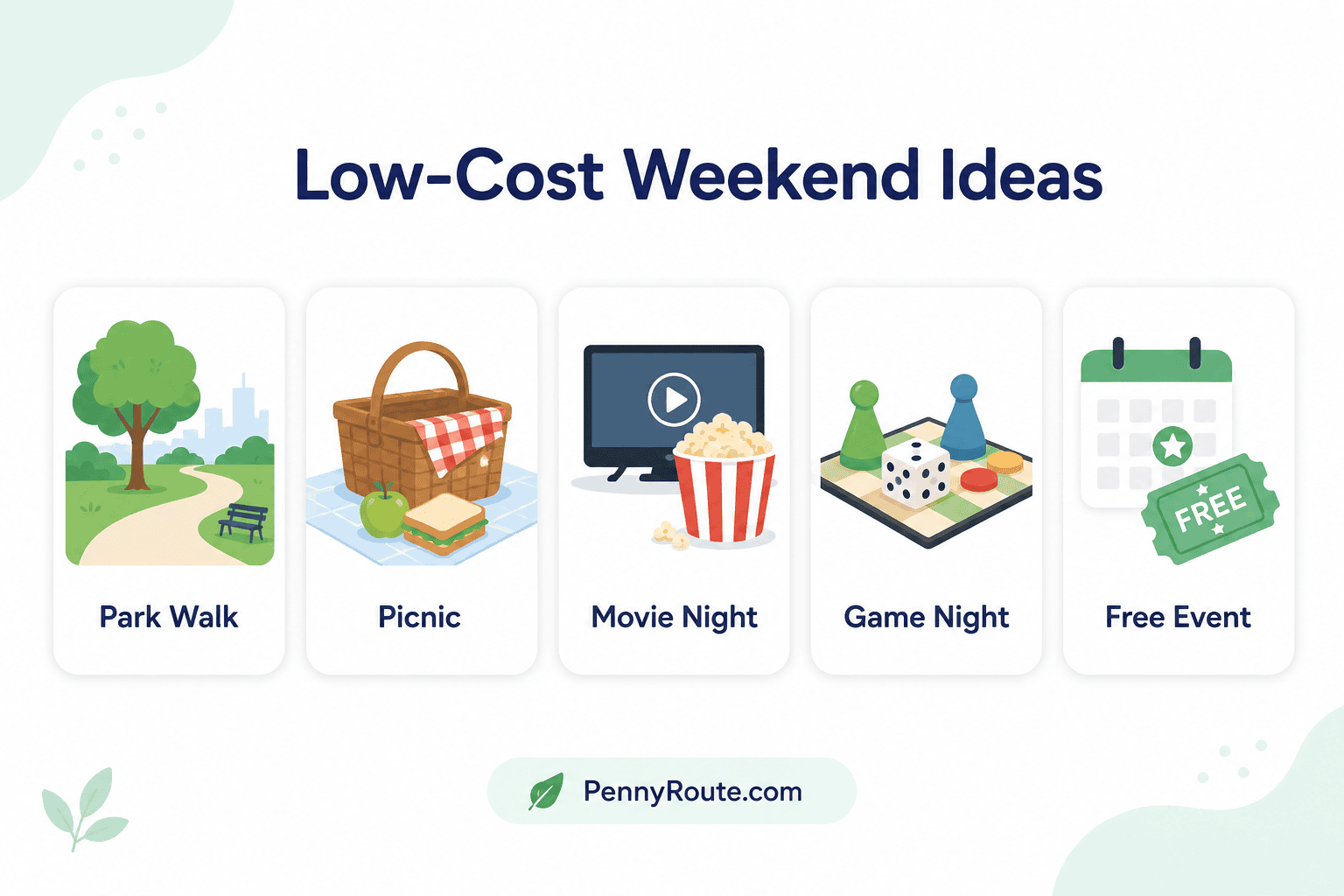
- brunch out, followed by a walk or park visit
- a paid museum visit with lunch brought from home
- a movie followed by dinner at home
- one paid class with a free evening activity
- a restaurant meal paired with a free local event
This approach gives you room to spend where it matters without turning every part of the weekend into another purchase.
If you want the rest of the weekend to stay completely free, no-spend weekend ideas can help fill those gaps with activities that do not require new discretionary spending.
Weekend Budget Examples With Real Numbers
A weekend budget is easier to use when you can see how the money might be divided. These examples are only illustrations, not recommended spending targets.
Example: $25 Weekend for One Person
Suppose you use about $15 for one small paid plan and keep the remaining $10 available for transportation, food, or another minor expense.
The rest of the weekend could be built around free plans such as a walk, library visit, or time at home.
Example: $50 Weekend for Two
Suppose you want one paid activity together.
You might spend $30 on the activity, $15 on food or drinks, and leave $5 as a buffer. If parking or transportation would push the total higher, you could adjust the food plan or choose a nearby activity instead.
Example: $75 Family Weekend
A family might use $40 for one shared activity, $20 for food, and $15 for transportation, parking, or another practical cost.
If the paid activity already takes most of the budget, keeping the rest of the weekend simple can make the total easier to manage without turning every family plan into another expense.
The useful part is not matching these numbers. It is deciding how much of your own weekend amount should go toward the main plan, the costs around it, and a little breathing room.
What to Do When the Plan Costs More Than Your Limit
Sometimes the activity you want simply costs more than the amount you set aside for the weekend.
Before increasing the budget, look at what is pushing the total higher. The main activity may still fit once you remove or reduce extras such as food, parking, add-ons, or a second paid plan.
If the activity itself is the problem, you have a few practical options:
- choose a lower-cost alternative
- do one paid activity instead of two
- move the plan to another weekend and save for it
- increase the spending amount only if the rest of your finances still support it
Changing the budget is not automatically a bad decision. What matters is knowing what that extra spending replaces or delays elsewhere.
If adding another $30 means using money already meant for a bill, savings goal, or another priority, the better choice may be to adjust the weekend instead.
When a $0 Weekend Makes More Sense
There are weekends when even a small entertainment budget does not fit comfortably.
That might happen because other expenses are unusually high, you have already used most of your discretionary money for the month, or you simply want a temporary break from spending.
In that situation, forcing a paid plan usually adds more pressure than enjoyment. A $0 weekend can still include time outside, plans with friends or family, or a quiet day at home without adding new discretionary purchases.
The choice does not have to be permanent. Some weekends can include a paid activity, while others work better with no new spending at all.
Spend on the Parts You Will Actually Enjoy
A weekend budget works best when it reflects what you genuinely want to do, not when every dollar is spread across as many activities as possible.
Choose the part of the weekend that matters most, account for the full cost, and let the rest of the plans stay simple. That gives you room to enjoy the money you decided to spend without letting a few unplanned extras take over the total.