Saving money gets harder when every piece of advice sounds equally important. Cancel a subscription. Stop buying coffee. Use coupons. Cook more. Switch providers. After a while, it becomes difficult to tell which changes will actually make a noticeable difference.
A better starting point is to look for the places where your money has the most room to move. That might mean removing a recurring cost you barely use, lowering a bill that comes back every month, or changing one spending habit that quietly adds up.
There is one more step that matters just as much: keeping the money you free up. Spending $80 less this month does not automatically mean your savings increased by $80. The difference needs somewhere to go, whether that is an emergency fund, a future expense, or another savings goal.
Disclaimer: This content is for informational purposes only and does not constitute financial advice. Your best saving approach depends on your income, expenses, priorities, and overall financial situation.
Quick Overview
- Saving starts by creating a gap between the money coming in and the money going out.
- Start with changes that free up meaningful money without putting essential expenses at risk.
- Recurring costs often deserve more attention than isolated small purchases because one change can help month after month.
- Money you free up only becomes savings when you give it a clear destination.
- If essentials already use most of your income, the right approach is different from simply cutting more.
How Saving Money Actually Works
Saving money sounds simple: spend less than you earn and keep the difference. In practice, the important part is what happens to that difference after it appears.
Create Room in Your Cash Flow
You create room to save when your income is higher than your spending. That extra room might come from lowering an expense, avoiding a purchase, earning more, or simply having money left after your regular costs are covered.
You do not need to cut everything at once. What matters is finding money that does not need to be spent right now and deciding how much of it you can realistically keep.
Spending Less Is Not the Same as Saving More
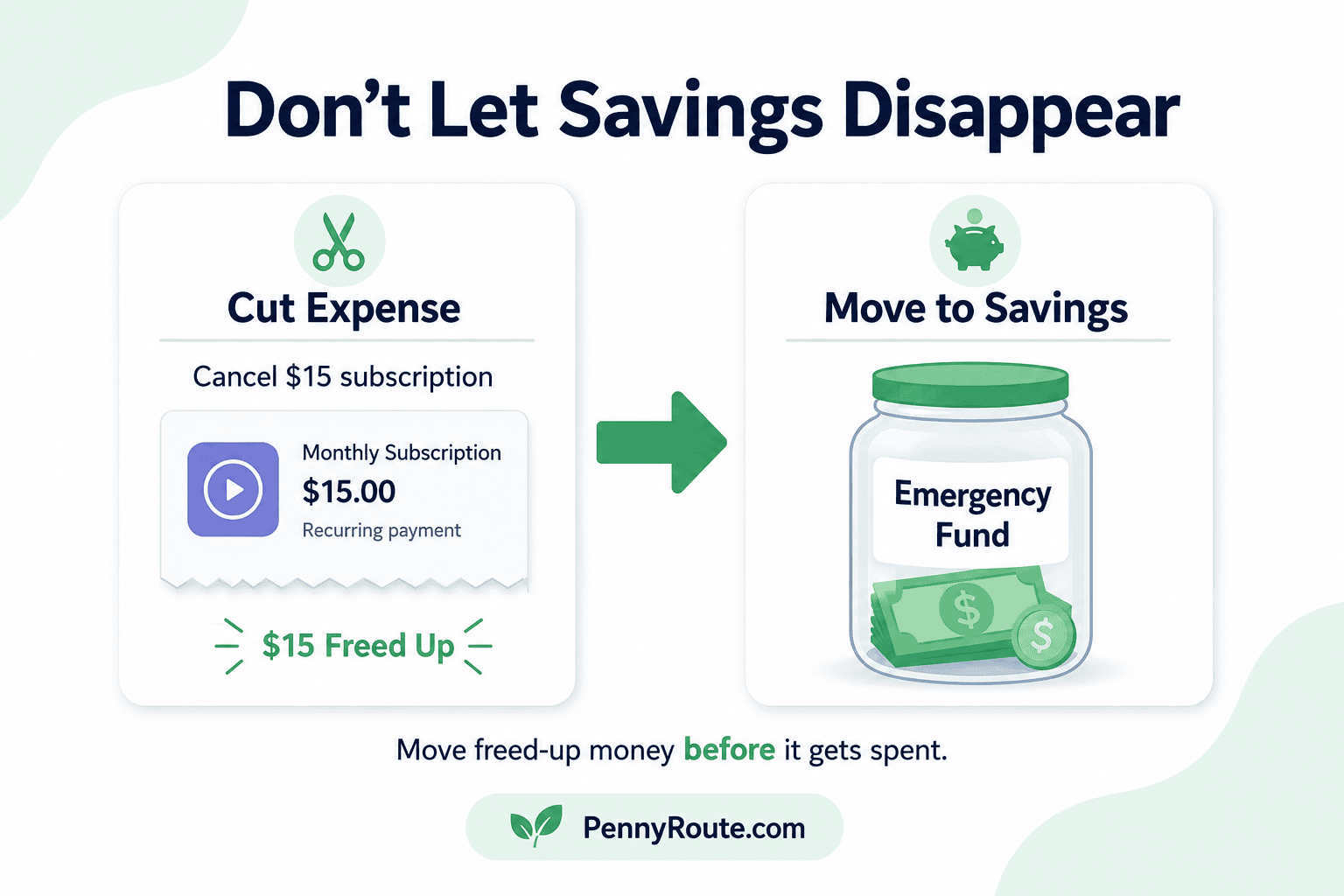
If you cancel a $20 subscription and then spend that $20 elsewhere, your monthly expenses changed, but your savings did not increase.
The money becomes savings when you deliberately set it aside for something you want or need later.
That gives a saving plan two separate jobs:
- Create room: Find money that does not need to be spent right now.
- Keep the difference: Move or assign some of that money before it blends back into everyday spending.
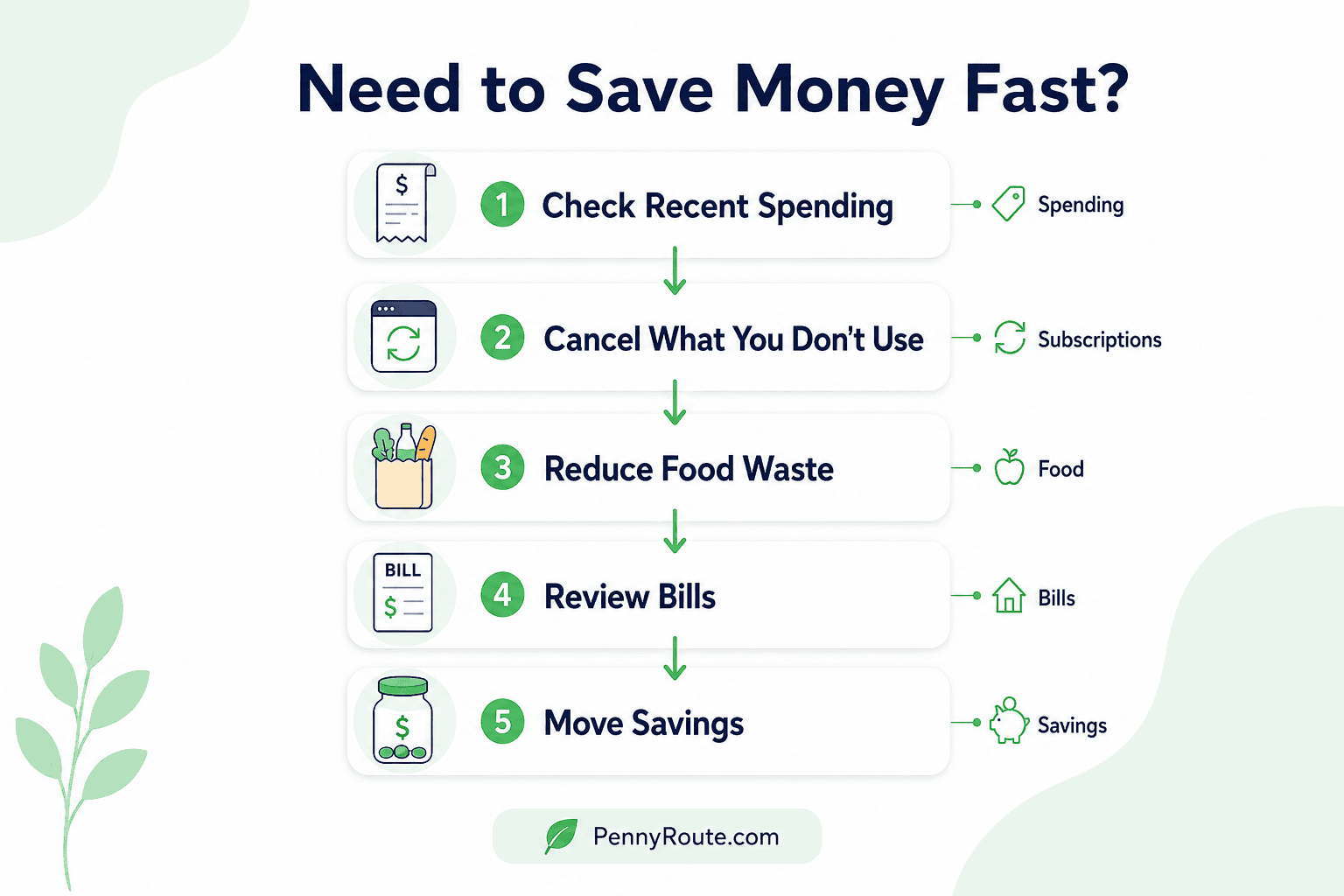
If you are unsure where that room exists, reviewing recent transactions can help you see which expenses are fixed, which repeat regularly, and which change from month to month.
A full budget becomes useful when you need to balance income, bills, everyday spending, saving, and other priorities across the whole month. Learning how to make a budget gives that broader structure without turning this saving plan into a full budgeting exercise.
Choose What the Money Needs to Do
Saving gets easier to plan when the money has a job. A $500 cushion for an unexpected car repair is different from $500 you are setting aside for a trip next summer, even though both amounts sit in savings.
The purpose affects how quickly you need the money, how often you expect to use it, and how much flexibility you have with the target.
| If you are saving for… | A useful approach |
|---|---|
| Unexpected expenses | Build an emergency fund |
| A known future expense | Use a sinking fund |
| A goal with a specific amount and deadline | Set a target and saving timeline |
| More general financial breathing room | Start with a modest cash buffer |
An emergency fund is designed for expenses you did not plan for, while a sinking fund is money set aside gradually for something you already expect to pay for. Keeping those purposes separate helps you avoid using emergency savings for predictable costs.
For a specific goal, the calculation is usually more straightforward. If you want to save $1,200 over 12 months, that works out to $100 per month before accounting for any money you already have set aside.
You do not need a separate account for every small goal. What matters more is being able to tell how much belongs to each priority so one expense does not quietly consume money intended for something else.
If you have several goals at once, urgency matters. A basic emergency cushion or an expense with a firm deadline will often need attention before a flexible goal that can simply be pushed back.
Find the Savings That Will Make the Biggest Difference
Not every expense deserves the same amount of attention. Saving $5 once is useful, but reducing a recurring cost by $25 can free up $300 over a year.
A practical place to start is with changes that offer a meaningful payoff without creating problems elsewhere.
| Look here first | Examples | Why it matters |
|---|---|---|
| Low-value recurring costs | Unused subscriptions, memberships, duplicate services | One decision can reduce spending every month |
| Bills that may be adjustable | Phone, internet, insurance, utilities | A lower recurring bill keeps creating room over time |
| Repeated flexible spending | Takeout, shopping, convenience purchases | Small choices can add up when they happen often |
| Larger fixed costs | Housing, transportation, childcare | The potential savings are bigger, but changes are usually harder |
Remove Spending You No Longer Value
Recurring charges are often worth checking first because they keep taking money whether you are thinking about them or not.
That does not mean canceling every subscription or membership. The better question is whether you would choose to pay for it again today at its current price.
A service you use every week may be worth keeping. One you barely notice until the charge appears on your statement is a stronger candidate.
Review Bills That Repeat Every Month
Some expenses are necessary but not completely fixed. Phone plans, internet service, insurance premiums, and utility costs can change over time, especially when introductory pricing ends or your needs change.
Even a modest reduction matters when it repeats. Lowering a bill by $25 per month creates $300 of annual room without requiring you to make the same saving decision every day.
That does not mean every provider will offer a better price. It means recurring bills deserve occasional attention because the payoff can continue long after the initial comparison. There are also more specific ways to save on utility bills and save money on car insurance when those costs are taking up more of your budget.
Change One Spending Pattern That Keeps Adding Up
Flexible spending is harder to reduce because it is usually tied to routines rather than one monthly charge.
You might notice that delivery becomes the default on busy evenings, small online purchases happen several times a week, or convenience-store stops cost more over a month than expected. The useful question is not whether every purchase was unnecessary. It is whether one repeated pattern is using more money than you want it to.
Changing one pattern is often more realistic than trying to become cheaper in every category at once.
If food spending is taking up more room than you expected, grocery shopping on a budget can help you lower the cost while still keeping meals practical and realistic.
Look at Bigger Costs When Small Changes Are Not Enough
Small reductions work best when there is already some flexibility in your finances. They are much less helpful when one or two large expenses are creating most of the pressure.
Housing, transportation, childcare, and other major costs often offer the biggest potential difference, but they are also the hardest to change. Moving, replacing a vehicle, or changing childcare arrangements can carry financial, practical, and personal tradeoffs that make a quick decision unrealistic.
The point is not to make a drastic change just to save money. It is to recognize when optimizing a handful of small purchases will not solve a much larger monthly gap.
In that situation, it makes more sense to identify the expense creating the pressure and evaluate realistic alternatives over time rather than constantly cutting smaller things around it.
Turn the Money You Free Up Into Actual Savings
Once you know how much money is available to save, decide where it should go and when you will move it.
That might mean moving it to savings, assigning it to a specific goal, or leaving a small portion in checking if your monthly cash flow needs more breathing room.
You do not have to transfer every dollar you save on an expense. If lowering several bills frees up $120 per month but moving the full amount would leave your checking account uncomfortably tight, saving $80 consistently may work better than setting an aggressive target you keep reversing.
When Your Cash Flow Is Predictable
If your paychecks and regular expenses are fairly consistent, an automatic transfer can make saving easier to maintain. The Consumer Financial Protection Bureau also identifies automatic transfers as one way to make saving more consistent.
You might schedule the transfer shortly after payday, once you know the money needed for upcoming bills is covered. The amount does not have to be large. What matters is choosing a level that fits your normal month rather than relying on whatever happens to be left at the end.
If you are deciding between a fixed dollar amount and a percentage of each paycheck, how much you save from each paycheck depends on your income, essential expenses, and other priorities.
Example
Suppose you cancel an $18 subscription, lower your phone bill by $32, and spend about $60 less on delivery each month. That creates roughly $110 of additional room.
If transferring the full $110 would make your checking balance too tight, you might move $80 to savings and leave $30 as extra monthly breathing room. You are still saving more without making the rest of your finances harder to manage.
When Your Income or Expenses Change
A fixed automatic transfer is not always the best fit when income varies or expenses change significantly from one month to the next.
In that situation, a flexible transfer can make more sense. You might save after each paycheck based on what came in, or wait until essential bills are accounted for and then move a reasonable amount.
The important part is having a consistent decision rather than a rigid number. A strong month may allow a larger transfer. A tighter month may call for less. Adjusting the amount is not the same as abandoning the saving habit.
How to Save Money Faster When Your Timeline Is Short
A short deadline changes what matters. Instead of trying to improve every part of your spending, focus on actions that can put money toward the goal soon enough to make a difference.
Start With Money You Can Redirect Quickly
One-time money can have an immediate effect because you do not have to wait several months for the savings to build.
That could include part of a bonus or refund, money from returning an eligible purchase, or proceeds from selling something you genuinely no longer use.
Recurring reductions still help, but the deadline matters. Saving $40 per month adds $120 over three months. If your goal is due in two weeks, the same change will have much less time to help.
Looking at both the amount saved and the time remaining makes it easier to choose actions that are actually relevant to your target.
Use Temporary Cuts for a Temporary Push
Some spending changes do not need to become permanent.
If you are trying to reach a near-term goal, you might temporarily scale back optional purchases, restaurant spending, entertainment, or another flexible category for a few weeks.
A no-spend challenge can also create a defined short-term pause in selected spending without treating the restriction as a permanent lifestyle.
Temporary cuts work best when they have a clear purpose and end point. Otherwise, an overly restrictive plan is harder to maintain and easier to abandon.
Know When Cutting More Will Not Close the Gap
Sometimes the numbers simply do not work.
If you need $1,500 in two months but your realistic spending changes would free up only $300, pushing harder on small expenses will not solve the remaining $1,200 gap.
At that point, the more useful options are to reconsider the timeline, adjust the target where possible, or look for additional income rather than trying to squeeze increasingly small amounts from essential or already-limited spending.
Important
Saving faster should not come at the expense of essential bills, minimum required payments, necessary insurance, medication, or other costs that protect your financial and personal well-being.
What If There Is Almost Nothing Left to Save?
A saving plan looks different when essential expenses already use nearly all of your income. In that situation, an aggressive target can create more pressure rather than more progress.
Protect the Money You Need First
Housing, food, utilities, transportation, minimum required payments, and other essentials come before an arbitrary savings percentage.
If only a small amount remains after those costs, it is reasonable for your saving amount to be small as well. Setting aside $20 or $30 consistently is still useful if that is what your current cash flow supports.
Your contribution can also change from month to month. A month with lower expenses or slightly higher income might allow you to save more, while a tighter month may leave little or nothing available.
What matters is avoiding a target that repeatedly forces you to pull money back out of savings just to cover normal expenses.
Focus on the Gap, Not Just Smaller Purchases
When there is very little left after essentials, the biggest issue is often the difference between income and necessary costs rather than a handful of optional purchases.
There may still be opportunities to reduce an avoidable fee, adjust a recurring service, or use extra income when it appears. But those changes have limits.
Saving money on a low income often requires more flexible targets and a closer look at costs that are difficult to reduce, rather than applying a standard savings rule.
A modest cash buffer still matters. Even a small amount set aside can make an unexpected expense easier to handle without pretending that every month has room for a large transfer.
Make Saving Easier to Continue
Saving is easier to maintain when the plan changes with your life instead of expecting every month to look the same.
Review Your Saving Amount After Major Changes
You do not need to rethink your savings every few weeks. It is more useful to review the amount after a meaningful change in your finances, such as a raise, rent increase, new childcare cost, paid-off loan, or change in household income.
An increase in available cash does not have to go entirely to savings. You might save part of it and keep part for current priorities. Likewise, a tighter period may call for a temporary reduction rather than stopping altogether.
Rebuild Money You Had a Reason to Use
Savings are not supposed to remain untouched forever.
If you use an emergency fund for an unexpected expense or spend money that was set aside for a planned cost, the next decision is whether that balance needs to be rebuilt.
Returning to regular contributions after the expense passes helps restore the cushion without treating the withdrawal as a setback.
Start With One Change That Matters
You don’t need to fix every expense at once. Start with one change that makes a meaningful difference, give the money a clear purpose, and build from there. A savings plan becomes much easier to maintain when each improvement fits the rest of your finances.
Frequently Asked Questions About Saving Money
How much money should I save each month?
There is no single amount that works for everyone. A realistic target depends on your income, essential expenses, current obligations, and savings goals. If a percentage feels too aggressive, start with a smaller fixed amount and adjust it over time.
Where should I keep the money I save?
That depends on when you expect to use it. Money for everyday bills usually belongs in checking, while short-term savings are often easier to manage in a separate savings account.
Keeping savings separate can also make it less likely that the money blends into routine spending. The roles become clearer when you compare checking and savings accounts.
Should I save money or pay off debt first?
You do not always have to choose one or the other. Some accessible savings can help cover unexpected expenses, while high-interest debt can make it harder to make progress elsewhere. Keep required minimum payments current, then decide how any extra money should be divided between building a cash cushion and reducing debt.