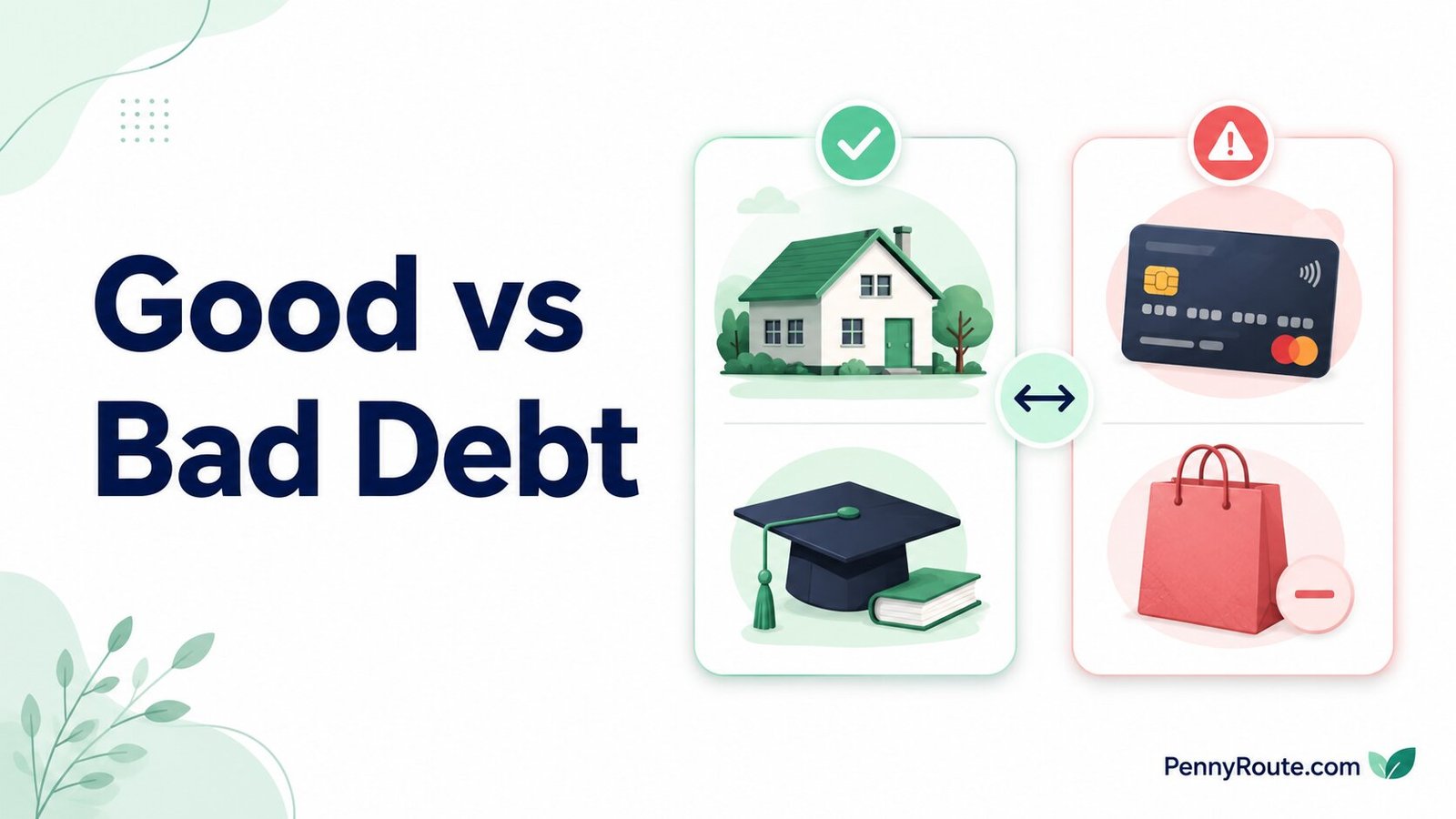
Calling debt “good” or “bad” is convenient, but those labels can hide the details that matter most. A mortgage may support stable housing, a student loan may pay for valuable training, and a car loan may protect your ability to get to work. None of those outcomes automatically makes the financing affordable.
The difference between good debt vs. bad debt depends on more than what you borrowed for. The complete cost, monthly payment, repayment terms, downside risk, and value you actually receive all affect whether the debt helps or puts your finances under pressure.
Disclaimer: This content is for general informational purposes and does not constitute financial advice. Loan costs, terms, and risks vary, so review the agreement and your financial situation before borrowing.
Quick Overview
- Good debt supports a meaningful purpose at a cost and payment you can reasonably manage.
- Bad debt creates more cost, pressure, or risk than the value it provides.
- The type of loan alone does not determine whether the borrowing is sensible.
- A low monthly payment can still hide a high total cost or an excessively long repayment term.
- Debt that started with a useful purpose can become harmful when your circumstances or the loan terms change.
Good Debt vs. Bad Debt: What the Labels Actually Mean
Good debt usually refers to borrowing that supports a useful long-term purpose and remains manageable after interest, fees, monthly payments, and risk are considered.
Examples often include borrowing for:
- a reasonably priced home;
- education or training with realistic career value;
- essential transportation;
- or equipment that helps a business earn revenue.
The expected benefit matters, but so does the financing. A useful purchase funded through an unaffordable loan is not suddenly a good decision because the item itself has value.
Bad debt usually refers to borrowing that is too expensive, difficult to repay, or used for something that provides little lasting value. High-interest revolving balances, repeated payday loans, and several overlapping buy now, pay later plans often fall into this category.
Still, the label is not permanent. A loan that was manageable when you signed it can become a serious problem after an income drop, rate increase, unexpected expense, or change in the value you receive.
The better question is not simply, “Is this a good type of debt?” It is:
Does the expected benefit justify the complete cost and the repayment obligation?
Why the Type of Debt Does Not Decide the Answer
A home, degree, vehicle, or piece of business equipment may provide value. The loan is the contract used to pay for it.
That contract determines:
- how much interest you pay;
- how long the obligation lasts;
- whether the rate can change;
- whether an asset serves as collateral;
- and what happens if you cannot make the payments.
This distinction matters because a worthwhile purchase can be paired with poor financing.
A mortgage, for example, may provide long-term housing and a way to build equity. But the complete monthly cost can include property taxes, homeowners insurance, mortgage insurance, and other expenses beyond principal and interest.
Approval does not settle the question either. A lender decides whether an application meets its requirements. You still need to decide whether the payment fits your life after groceries, utilities, transportation, savings, child care, medical costs, and irregular expenses.
The same distinction applies to credit cards. Using a card for convenience and paying the statement balance in full is not the same as carrying long-term credit card debt. If you regularly pay in full, you can generally avoid paying interest on a credit card when an active purchase grace period applies. A revolving balance at a high APR is a different financial commitment.
Common Examples of Good and Bad Debt
The same category of debt can produce different outcomes. What matters is why you borrowed, what the financing costs, and whether the payments remain manageable.
| Debt type | Potential value | What can make it harmful |
|---|---|---|
| Mortgage | Provides stable housing and a path to building equity | The full housing cost strains cash flow or the loan terms create added risk |
| Student loan | Pays for education or training with realistic career value | Borrowing is high compared with likely earnings and repayment capacity |
| Car loan | Provides transportation needed for work and daily life | The vehicle is too expensive, the APR is high, or the term creates negative equity |
| Credit card borrowing | Offers short-term flexibility for a planned expense | A high-interest balance rolls over while new charges continue |
| Business loan | Funds a specific purchase or expansion supported by business cash flow | Repayment depends on optimistic revenue or puts personal assets at risk |
| Buy now, pay later | Spreads out a planned purchase that already fits the budget | Several plans overlap or missed payments lead to fees and collections |
| Payday loan | Provides fast access to a small amount of cash | High fees, lump-sum repayment, and rollovers make the debt difficult to escape |
Credit card use is not automatically credit card debt
A credit card can function as a payment method rather than long-term borrowing. If you charge $300 and pay the full statement balance by the due date, you have used credit without necessarily paying interest.
The situation changes when part of the balance carries into the next billing cycle. Interest is often calculated daily, and continuing to add purchases makes the balance harder to reduce.
Buy now, pay later can create hidden payment pressure
A single BNPL plan may look manageable. Problems often begin when several plans overlap and their automatic withdrawals fall on different dates.
Missed BNPL payments can lead to late fees, frozen purchasing access, debt collection, and possible credit reporting. Automatic withdrawals may also trigger overdraft or nonsufficient-funds fees when the linked account does not have enough money.
Payday loans are structured around a difficult deadline
A payday loan may appear to solve an immediate cash shortage, but the full amount and fees are often due in one lump sum. If the borrower cannot repay it, renewing or rolling over the loan adds another fee without meaningfully reducing the original amount owed.
Six Questions to Ask Before Taking on Debt
A familiar label tells you very little about whether the actual loan fits your situation. These six questions provide a more reliable test.
1. What Is This Debt Supposed to Accomplish?
Start with the purpose, but make it specific.
“Paying for education” is too broad. A more useful question is whether the program has a reasonable cost, a credible path to completion, and realistic value in the type of work you plan to pursue.
Before borrowing for college or career training, compare the program’s net cost, graduation information, typical debt, and post-enrollment earnings rather than relying only on the amount of aid offered.
The same thinking applies elsewhere:
- Will a car protect reliable access to work?
- Will a home fit your expected location and household needs?
- Will business equipment generate enough cash flow to support its payment?
- Will the purchase still matter after the debt is repaid?
A useful purpose strengthens the case for borrowing. It does not guarantee that the price or loan terms are reasonable.
2. What Is the Complete Cost?
The monthly payment is only one number.
Look at:
- the amount financed;
- APR;
- origination, transfer, or transaction fees;
- repayment term;
- required insurance;
- closing costs;
- and any expense that comes with owning or maintaining the purchase.
A smaller monthly payment can result from stretching the loan across more years. That may help today’s budget while increasing the total amount repaid.
With a mortgage, the quoted principal-and-interest payment may not reflect property taxes, homeowners insurance, mortgage insurance, homeowners association fees, repairs, or closing costs.
With a car, the budget also needs room for insurance, fuel, registration, tires, maintenance, and repairs.
A low rate helps, but it does not rescue an overpriced purchase or an excessive loan amount.
3. Does the Payment Fit Your Real Cash Flow?
A payment is not affordable simply because it fits under a lender’s approval limit.
Start with take-home income rather than gross income. Then account for:
- essential bills;
- existing debt payments;
- irregular expenses;
- basic savings;
- and the normal costs that do not appear every month.
Your debt-to-income ratio offers one view of how much monthly debt you carry, although it does not show how much take-home pay remains after taxes and household expenses.
You can use PennyRoute’s debt-to-income ratio calculator to estimate yours.
A loan payment that technically fits your DTI can still leave your checking account stretched before the end of each month.
4. What Happens If the Plan Does Not Work Perfectly?
A borrowing decision should not depend on every assumption going right.
Ask what would happen if:
- income fell for several months;
- the expected raise took longer to arrive;
- business sales were below forecast;
- the car needed a major repair;
- the degree did not lead to the expected salary;
- an adjustable rate increased;
- or another essential expense appeared.
This is not about planning for every possible disaster. It is about checking whether the debt still works when life is somewhat less predictable than the sales pitch or spreadsheet assumes.
A loan that only remains affordable under ideal conditions leaves little room for ordinary setbacks.
5. How Much Flexibility Are You Giving Up?
Every required payment claims part of your future income.
A new loan may reduce your ability to:
- change jobs;
- relocate;
- handle an emergency;
- reduce work hours;
- save for another priority;
- or leave a purchase that no longer suits you.
Secured debt creates another layer of risk because the lender may have a claim on the asset. A long auto loan can also leave you owing more than the car is worth, making it costly to sell or trade before the balance is cleared.
Variable rates deserve extra care because the payment or borrowing cost can rise later. Personal guarantees and co-signers can extend the consequences beyond the person or business receiving the immediate benefit.
The longer and less flexible the commitment, the stronger the underlying reason for borrowing should be.
6. What Is the Repayment Path?
A repayment plan should be more specific than “I will make the monthly payment.”
You should know:
- where the payment will come from;
- how long the balance will remain;
- whether the debt should decline predictably;
- what could cause the cost to rise;
- and what you would change if the payment became difficult.
Business borrowing offers a clear example. The repayment plan should be supported by realistic cash flow, not simply enthusiasm for the idea. If expected revenue is delayed or lower than forecast, the payment still has to come from somewhere.
When repayment depends on a future event, such as a bonus, tax refund, property sale, business launch, or salary increase, ask what happens if that event is smaller or later than expected.
Example: The Same Need, Two Very Different Car Loans
Both options below provide reliable transportation. The purpose is the same, but the financing produces very different costs.
Illustrative Car Loan Comparison
Option A: You finance $22,000 at a fixed 6.5% APR for 48 months. The estimated payment is about $521.73 per month, and total interest is approximately $3,042.99.
Option B: You finance $30,000 at a fixed 8.5% APR for 72 months. The estimated payment is about $533.35 per month, and total interest is approximately $8,401.31.
Option B costs only about $11.62 more each month, which can make the vehicles appear similarly affordable. But the larger loan and longer term produce roughly $13,358 more in total payments.
These estimates assume fixed monthly payments and exclude taxes, registration, optional products, insurance, maintenance, and other ownership expenses.
The lower-looking payment difference does not tell the full story. Option B commits the borrower for two additional years, costs substantially more, and creates more time for the vehicle to lose value while the loan remains outstanding.
Longer loan terms generally lower the monthly payment but increase total interest and the risk of negative equity, where the amount owed exceeds the vehicle’s value.
Option A is not automatically the right choice. A $521 payment could still be unaffordable after insurance, fuel, repairs, and other obligations. The example shows why the purpose and monthly payment cannot settle the decision on their own.
Signs a Debt Is No Longer Working for You
Debt that began with a reasonable purpose can become harmful as the balance, terms, or your circumstances change.
Warning signs include:
- You are using another credit card or loan to make the payment.
- Essential bills are being delayed to keep the account current.
- The balance is not declining as expected.
- A variable rate or changing expense has pushed the payment beyond your budget.
- The education, asset, or business investment has not provided the expected value.
- One routine setback would cause an immediate missed payment.
- The debt leaves no room for basic savings or necessary expenses.
These signs do not erase the value the debt may have provided. They show that the current obligation now needs a different level of attention.
When several balances are competing for limited money, deciding which debt you should pay off first should begin with urgency, cost, and consequences rather than the original “good” or “bad” label.
Should You Pay Off “Good Debt” Early?
A debt can be reasonable to take on and still be worth paying off ahead of schedule.
Extra payments may make sense when they:
- save meaningful interest;
- reduce a large fixed monthly obligation;
- lower the risk attached to a variable rate;
- remove debt before retirement or another income change;
- or provide valuable peace of mind without weakening your cash reserves.
Early payoff is not automatically the best use of every extra dollar. High-cost or overdue debts may deserve attention first. A limited emergency fund could also be more urgent than accelerating a low-rate loan, particularly when paying extra would leave you relying on credit after the next unexpected expense.
Review the loan terms before sending a large additional payment. Confirm that extra money will reduce principal and whether any prepayment condition applies.
The original label should not control the decision. Compare the interest saved, the flexibility gained, and what the money would otherwise accomplish.
Look Beyond the Label Before You Borrow
Good debt is not a promise that borrowing will improve your finances, and bad debt is not defined by one particular product. The outcome depends on the purpose, complete cost, payment burden, risks, and repayment path working together.
Before signing, ask whether the debt still makes sense if income is lower, costs are higher, or the expected benefit takes longer to arrive. A sensible borrowing decision should leave room for real life, not require everything to go exactly as planned.