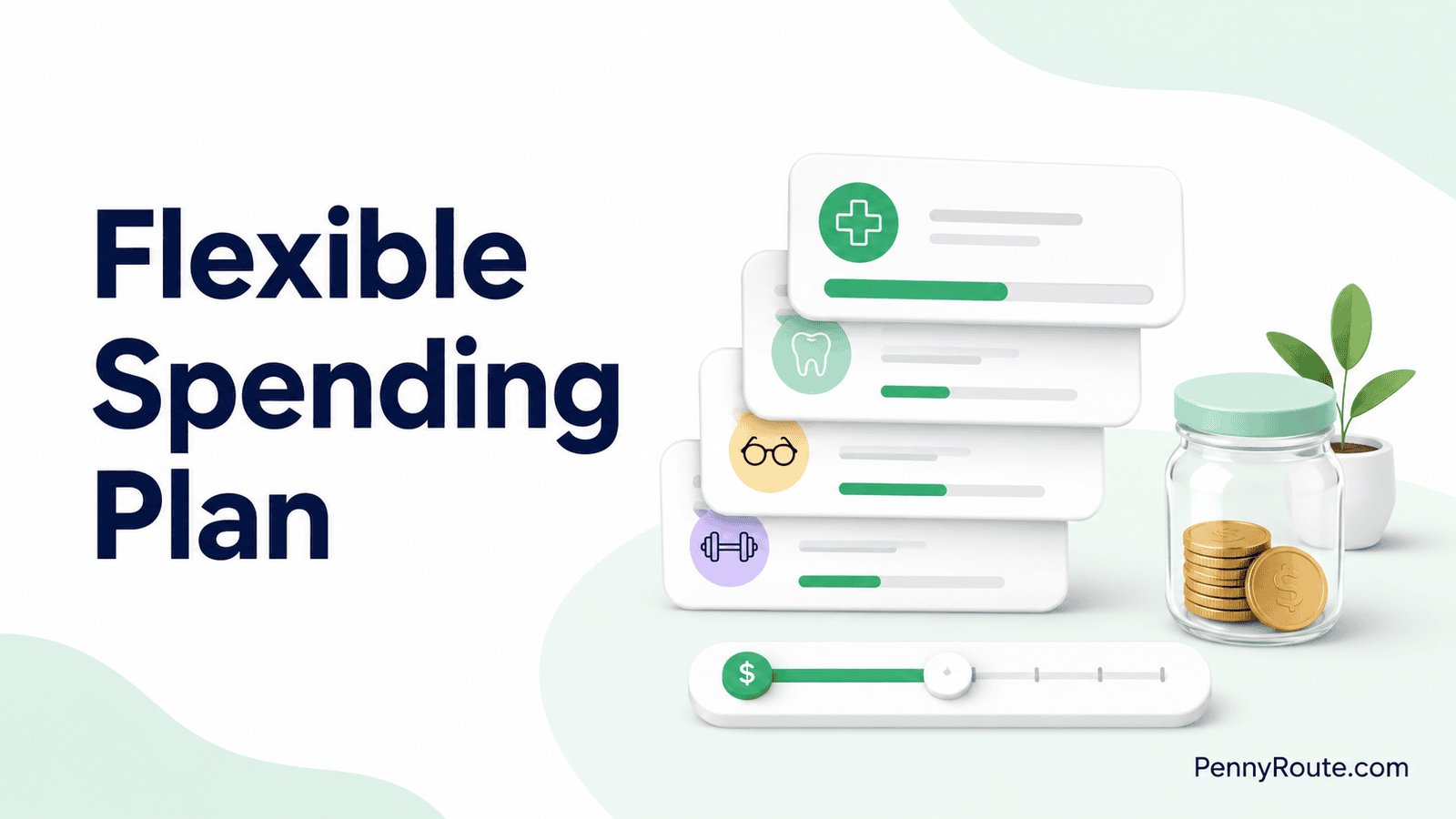
Some expenses never feel optional. Medical bills, prescriptions, or childcare costs tend to show up no matter how carefully you plan your budget.
A flexible spending plan is designed to help with exactly that. It allows you to set aside part of your paycheck before taxes, so those same expenses feel easier to handle when they come up.
Once you understand how it fits into your monthly money flow, it becomes easier to see if it is something worth paying attention to.
Disclaimer: This content is for informational purposes only and does not constitute financial advice. Please consult a qualified professional before making financial decisions.
What Is a Flexible Spending Plan?
A flexible spending plan is an employer-provided benefit that lets you set aside money from your paycheck before taxes to pay for certain expenses. These usually include healthcare costs or dependent care, such as childcare.
In most cases, this plan is offered through a Flexible Spending Account. You choose how much to contribute during your employer’s enrollment period, and that amount is taken from your paycheck before taxes are applied.
Here’s a simple way to think about it. Instead of paying for eligible expenses with fully taxed income, you set that money aside in advance. This can make those costs feel easier to manage when they come up.
How a Flexible Spending Plan Works
A flexible spending plan follows a simple structure. You decide how much to set aside, and that money is used later for eligible expenses.
How contributions are made
You choose a contribution amount during your employer’s enrollment period. This is usually done once a year. The amount you select is divided across your paychecks and deducted before taxes.
For example, if you decide to set aside $1,200 for the year, about $100 is taken from your paycheck each month before taxes are applied.
How you use the money
The money in your plan is used for approved expenses. Most employers provide a debit card linked to your account, or you can pay out of pocket and request reimbursement.
Common uses include:
- Doctor visits
- Prescriptions
- Dental or vision care
- Childcare expenses (if it is a dependent care plan)
What happens to unused money
This is one part that often causes confusion. Flexible spending plans usually follow a “use-it-or-lose-it” rule.
If you do not use the full amount by the end of the plan year, the remaining money may not carry over. Some employers allow a small portion to roll over or offer a short grace period, but this depends on the plan.
Understanding this part early helps you choose a contribution amount that feels comfortable and realistic.
FSA Contribution Limits (Updated for 2026)
The amount you can set aside in a flexible spending plan is limited each year. These limits are set by the IRS and may change over time.
Health FSA limit
For 2026, you can contribute up to $3,400 per year to a health flexible spending plan.
This limit applies per person. If both you and your partner have access to a plan through your employers, each of you can contribute up to the maximum.
Carryover rules
Some plans allow you to carry over a portion of unused money into the next year. For 2026, up to $680 may be carried over if your employer offers this option.
Other plans use a short grace period instead. This gives you a little extra time to spend the remaining balance after the plan year ends.
Since employers choose which option to offer, it helps to check the details of your specific plan.
Dependent care FSA limit
If your plan covers dependent care expenses, the limits are different.
For 2026:
- $7,500 per year per household
- $3,750 if married filing separately
This can apply to expenses like daycare or after-school programs.
Because these limits are higher than in previous years, they can make a noticeable difference for households with regular childcare costs.
What Expenses Can You Use It For?
A flexible spending plan is designed for specific types of everyday costs. Unlike discretionary spending, which can change from month to month, these expenses tend to show up regularly. The plan simply changes how you pay for them.
Health-related expenses
Most people use this plan for medical costs that are not fully covered by insurance.
Common examples include:
- Doctor visits
- Prescription medications
- Dental treatments
- Vision care such as eye exams or glasses
These are the kinds of expenses that tend to show up throughout the year, which makes them easier to plan for in advance.
Dependent care expenses
If your plan includes dependent care, it can also help cover costs related to taking care of others while you work.
This may include:
- Daycare services
- After-school programs
- In-home care for children or older family members
These expenses are often consistent each month, which makes them easier to estimate when choosing your contribution amount.
Knowing what qualifies helps you avoid setting aside money for expenses that cannot be reimbursed later.
Benefits of a Flexible Spending Plan
A flexible spending plan can make certain expenses feel easier to handle, especially when those costs show up regularly throughout the year.
One of the main benefits is that your contributions are made before taxes. This means your taxable income is lower, which can leave you with more usable money for the same expenses you were already planning to pay.
It can also help you plan ahead for predictable costs. If you already expect to spend money on doctor visits, prescriptions, or childcare, setting that amount aside in advance can reduce the pressure on your monthly budget.
Another benefit is access to funds when you need them. For health-related plans, the full yearly contribution is often available early in the year, even though it is deducted from your paycheck over time. This can make larger expenses easier to manage without waiting to save up first.
Overall, it works as a structured way to handle certain expenses with more clarity, especially when those costs are already part of your routine.
Things to Consider Before Using a Flexible Spending Plan
A flexible spending plan can be helpful, but it works best when you understand a few key details ahead of time.
One thing to be aware of is the use-it-or-lose-it rule. If you set aside more money than you end up using, the remaining amount may not carry over. Some plans allow a small rollover or a short grace period, but that depends on your employer.
It is also important to choose your contribution carefully. Since you decide the amount in advance, estimating your expected expenses makes a big difference. If your medical or childcare costs change during the year, it can affect how useful the plan feels.
Another point to keep in mind is that each employer plan can be slightly different. Rules around carryover, deadlines, and eligible expenses may vary, so it helps to review your plan details before enrolling.
When you keep these factors in mind, it becomes easier to use the plan in a way that fits your situation without adding unnecessary pressure.
Flexible Spending Plan vs HSA (Quick Comparison)
A flexible spending plan and a Health Savings Account are often mentioned together. They both help you pay for medical expenses using pre-tax money, but they work in different ways.
A flexible spending plan is usually tied to your employer. The money you set aside is meant to be used within the plan year, with limited carryover depending on your employer’s rules.
A Health Savings Account, on the other hand, is not tied to a single employer in the same way. The money stays with you and can roll over year after year if it is not used.
Another difference is eligibility. A Health Savings Account is only available if you have a qualifying high-deductible health plan, while a flexible spending plan is based on what your employer offers.
In simple terms, a flexible spending plan is designed for short-term, predictable expenses, while an HSA can be used as a longer-term savings option for healthcare costs.
When People Typically Use a Flexible Spending Plan
A flexible spending plan is often used for expenses that show up regularly and are easier to estimate ahead of time.
Many people use it when they expect routine medical costs during the year. This can include doctor visits, ongoing prescriptions, or planned dental and vision care. When those expenses are predictable, setting aside money in advance can make them feel more manageable.
It is also common for families to use it for childcare expenses. Costs like daycare or after-school programs tend to follow a steady monthly pattern, which makes it easier to choose a contribution amount with some confidence.
Some people also use it simply because their employer offers it as part of their benefits package. When it is available, it can be one of the simpler ways to handle specific expenses with a bit more structure.
The more predictable your expenses are, the easier it becomes to decide if this type of plan fits into your overall money setup.
For unexpected costs, having an emergency fund can still play an important role alongside this.
Simple Example: How a Flexible Spending Plan Works in Real Life
It often helps to see how a flexible spending plan fits into a real situation.
Imagine you earn $3,000 a month and expect to spend around $1,200 over the year on medical expenses like doctor visits, prescriptions, and a dental checkup.
You decide to set aside $1,200 through your plan. That means about $100 is taken from your paycheck each month before taxes.
Now, when those expenses come up during the year, you use that pre-tax money instead of paying fully out of pocket.
If you end up spending the full $1,200, the plan works as expected. If your expenses are lower, what happens to the remaining amount depends on your employer’s rules.
Seeing it this way makes it easier to understand how the plan fits into your monthly income and spending without changing your overall budget structure.
Final Thoughts
A flexible spending plan is simply a different way to handle expenses you are likely to have anyway. It does not change what you spend, but it can change how that money is set aside and used.
For many people, it works best when expenses are predictable and easy to estimate. When those costs are less certain, it may take a bit more planning to make the most of it.
You do not need to figure everything out at once. A small, realistic contribution can be enough to see how it fits into your routine. Over time, that clarity can make your monthly expenses feel easier to manage.
Common Questions About Flexible Spending Plans
Can you withdraw money from a flexible spending plan as cash?
No. The money can only be used for eligible expenses. You cannot withdraw it for general use like you would from a regular bank account.
What happens if you leave your job?
In most cases, access to your flexible spending plan ends when your employment ends. You may still be able to submit claims for expenses made while you were employed, depending on your plan’s rules.
Can both spouses have a flexible spending plan?
Yes, if both of you have access through your employers. Each person can contribute up to the allowed limit for their own plan.
Is a flexible spending plan useful for small expenses?
It can be. Even smaller, recurring costs like prescriptions or routine checkups can add up over time. Setting aside money for them in advance can make those expenses feel easier to handle.
Can you change your contribution during the year?
Usually, no. Your contribution amount is set during enrollment and stays the same for the year. Changes are typically only allowed if you have a qualifying life event, such as a change in family or employment situation.

PennyRoute Editorial creates beginner-friendly guides on budgeting, saving, expense tracking, cashback apps, side income, and everyday money habits. Our goal is to make personal finance easier to understand with clear explanations, realistic examples, and practical steps.