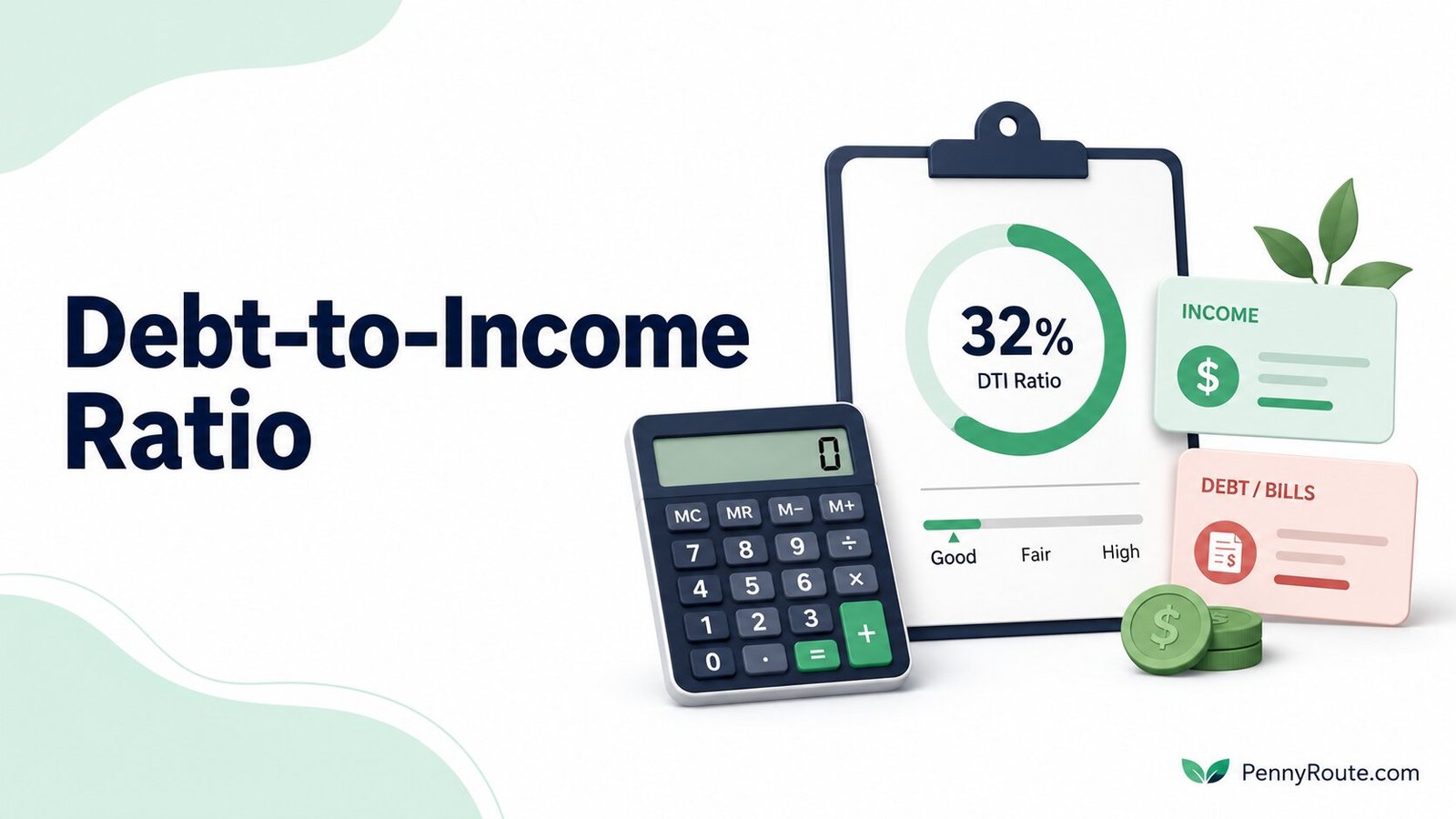
Your debt-to-income ratio shows how much of your gross monthly income is already committed to required debt payments.
That number can help you see the effect of a current debt load or estimate what could happen after adding a car loan, mortgage, personal loan, or another monthly payment. Lenders also use DTI when reviewing some applications, although each lender can calculate and evaluate it differently.
Use the calculator below to estimate your current DTI and compare it with your ratio after a proposed payment. The result is a starting point for review, not a prediction of approval or proof that a new payment fits your budget.
Disclaimer: This content is for informational purposes only and does not constitute financial advice. Debt-to-income calculations, lending criteria, and affordability decisions vary by lender and personal circumstances.
Debt-to-Income Ratio Calculator
PennyRoute Calculator
Debt-to-Income Ratio Calculator
Enter your gross monthly income and monthly debt payments to estimate your DTI.
Total monthly debt payments
$0Current estimated DTI
0%Estimated DTI after new payment
0%Calculator note: This tool provides an estimate based on the numbers you enter. It does not determine loan approval, credit eligibility, or affordability. Lenders can calculate DTI differently based on verified income, credit reports, loan type, and other factors.
For the most useful estimate, include regular monthly debt payments such as credit card minimum payments, auto loans, student loans, personal loans, and housing payments. Do not include everyday spending like groceries, gas, utilities, or subscriptions in the debt fields.
You can also use the optional “new monthly payment” field if you want to see how a new loan, car payment, or debt consolidation payment could change your DTI.
What Is Debt-to-Income Ratio?
Debt-to-income ratio, or DTI, is the percentage of your gross monthly income that goes toward required monthly debt payments.
Lenders use DTI as one part of deciding whether you can reasonably take on another payment. A lower ratio means less of your income is already committed to debt, while a higher ratio means more of it is tied to existing obligations.
DTI does not show your full financial picture. It usually leaves out everyday costs such as groceries, utilities, childcare, and savings, so it should not be treated as proof that a new payment is affordable.
How to Calculate Your Debt-to-Income Ratio Step by Step
To calculate DTI, add your required monthly debt payments, divide that total by your gross monthly income, and multiply the result by 100.
Monthly debt payments ÷ gross monthly income × 100 = DTI
DTI Formula
Gross monthly income means income before taxes, insurance, retirement contributions, and other payroll deductions.
Here is a simple example:
| Monthly Item | Amount |
|---|---|
| Gross monthly income | $5,000 |
| Rent or mortgage payment | $1,300 |
| Credit card minimum payments | $150 |
| Auto loan | $400 |
| Student loan | $250 |
| Personal loan | $200 |
| Total monthly debt payments | $2,300 |
Now use the formula:
$2,300 ÷ $5,000 × 100 = 46%
Example
In this example, the debt-to-income ratio is 46%. That means 46% of gross monthly income is already going toward monthly debt payments.
This number does not tell the whole story by itself, but it gives you a quick way to see how much of your income is already tied to required payments.
What Counts Toward Your Debt-to-Income Ratio?
A useful DTI estimate depends on entering required monthly debt payments, not every expense in your budget.
The exact calculation can vary by lender and loan type, but the following categories provide a practical starting point.
Payments Usually Included in DTI
These payments are commonly included when estimating debt-to-income ratio:
| Payment Type | Usually Included? |
|---|---|
| Mortgage payment | Yes |
| Rent payment | Often included for general estimates, but lender treatment can vary |
| Credit card minimum payments | Yes |
| Auto loan payments | Yes |
| Student loan payments | Yes |
| Personal loan payments | Yes |
| Child support or alimony, if applicable | Often included |
| Other required monthly debt payments | Yes |
For credit cards, use the minimum monthly payment, not the full balance. For example, if your credit card balance is $2,000 but the minimum payment is $60, the $60 payment is what usually matters for DTI.
Expenses Usually Not Included in DTI
Some expenses are important for your budget, but they are not usually counted as debt payments in a basic DTI calculation.
| Expense Type | Usually Included in DTI? |
|---|---|
| Groceries | No |
| Utilities | No |
| Gas or transportation costs | No |
| Cell phone bill | No |
| Streaming subscriptions | No |
| Car insurance | No |
| Health insurance | No |
| Taxes already deducted from pay | No |
| General shopping or personal spending | No |
These expenses still matter. A DTI calculator can show how much income goes toward debt, but it does not show whether your full monthly budget feels comfortable after groceries, utilities, savings, and other everyday costs.
What Is a Good Debt-to-Income Ratio?
A “good” debt-to-income ratio depends on the lender, loan type, and your full financial picture. Still, general DTI ranges can help you understand what your number may suggest.
| Estimated DTI | What It May Suggest |
|---|---|
| Under 36% | Often viewed as more manageable |
| 36% to 49% | May still be workable, but lenders may look more closely |
| 50% or higher | More stretched and may make borrowing harder |
These ranges are guideposts, not approval rules. A lender may still consider your credit history, income stability, down payment, loan type, savings, and other details.
For example, a 34% DTI may look manageable on paper, but the payment could still feel tight if your budget has high childcare costs, medical bills, or irregular income. On the other hand, a higher DTI does not automatically mean every option is closed, but it may be a sign to pause before adding another monthly payment.
The useful question is not only “Is my DTI good?” It is also “Would another payment make my monthly budget harder to manage?”
Front-End DTI vs. Back-End DTI
You may see two types of debt-to-income ratio, especially when reading about mortgages: front-end DTI and back-end DTI.
Front-end DTI looks only at housing costs compared with gross monthly income. This may include a mortgage payment, property taxes, homeowners insurance, and other housing-related costs, depending on how the lender calculates it.
Back-end DTI looks at your total monthly debt payments compared with gross monthly income. This usually includes housing payments plus other debts, such as credit card minimum payments, auto loans, student loans, personal loans, and other required monthly debt payments.
Here is the simple difference:
| DTI Type | What It Looks At |
|---|---|
| Front-end DTI | Housing payment compared with gross monthly income |
| Back-end DTI | All monthly debt payments compared with gross monthly income |
For most everyday DTI estimates, people usually focus on back-end DTI because it gives a broader view of how much income is already going toward required payments.
Current DTI vs. DTI After a New Payment
Your current debt-to-income ratio shows where you stand right now. But if you are thinking about taking on a new loan or credit payment, it can help to look at your estimated DTI after that payment is added.
For example, let’s say your current numbers look like this:
| Item | Amount |
|---|---|
| Gross monthly income | $5,000 |
| Current monthly debt payments | $1,600 |
| Current DTI | 32% |
Now let’s say you are considering a new car payment of $400 per month.
| Item | Amount |
|---|---|
| Gross monthly income | $5,000 |
| Current monthly debt payments | $1,600 |
| New monthly payment | $400 |
| New total monthly debt payments | $2,000 |
| Estimated DTI after new payment | 40% |
In this example, the new payment would move the DTI from 32% to 40%.
That does not automatically mean the payment is a bad idea, but it gives you a clearer view of how much more of your income would be tied to debt. This is why a DTI calculator is more useful when it shows both your current ratio and your estimated ratio after a new payment.
Debt-to-Income Ratio vs. Credit Utilization
Debt-to-income ratio and credit utilization are easy to mix up, but they measure different things.
Debt-to-income ratio compares your monthly debt payments to your gross monthly income. It helps show how much of your income is already going toward required payments.
Credit utilization compares your credit card balances to your credit limits. For example, if you have a $500 balance on a card with a $2,000 limit, your credit utilization on that card is 25%.
Here is the simple difference:
| Ratio | What It Compares | Why It Matters |
|---|---|---|
| Debt-to-income ratio | Monthly debt payments compared with gross monthly income | May be reviewed by lenders when you apply for loans or credit |
| Credit utilization | Credit card balances compared with credit limits | Can directly affect your credit score |
Paying down credit card balances may help both numbers, but in different ways. It may lower your credit utilization because your balance is smaller compared with your limit. It may also lower your DTI if your minimum monthly payment goes down.
So if you searched for a debt-to-credit ratio calculator, you may actually be looking for credit utilization. If you want to compare debt payments to income, debt-to-income ratio is the right number.
Why DTI Is Not the Same as Your Budget
Debt-to-income ratio is useful, but it does not show your full monthly life.
A DTI calculation usually focuses on debt payments and gross income. It does not always include groceries, utilities, gas, insurance, childcare, medical costs, savings, irregular expenses, or the random “how did this cost $47?” errands that show up every month.
That is why a lower DTI does not automatically mean a new payment fits comfortably. You may have a ratio that looks fine on paper but still feel stretched if your regular living costs are high.
This is also why DTI should work alongside your simple monthly budget, not replace it. Your DTI can show how much income is already tied to debt, while a simple monthly budget can show whether your actual take-home pay has enough room for bills, spending, savings, and unexpected costs.
Before taking on a new payment, check both numbers: your estimated DTI and your real monthly budget.
How to Lower Your Debt-to-Income Ratio
Lowering your debt-to-income ratio usually comes down to changing one side of the formula: reducing monthly debt payments, increasing gross monthly income, or both.
You do not need to fix everything at once. Even one paid-off debt can lower your DTI if it removes a monthly payment from the calculation.
If your DTI feels high because several payments are stacked together, a simple debt payoff plan can help you see where extra money may have the most impact.
Pay Off Debts That Remove Monthly Payments
If you pay off a debt completely, that monthly payment may no longer count toward your DTI.
For example, paying off a small personal loan with a $90 monthly payment could reduce your total monthly debt payments by $90. That may not sound huge, but it can improve your ratio and free up room in your monthly budget.
If you have several debts, it may help to compare which debt should be paid off first based on urgency, interest, balances, and monthly payments.
Reduce Credit Card Balances
Credit card balances do not usually count in full for DTI. The minimum monthly payments are what usually matter.
Still, lowering your balances can help if your required minimum payments go down. It may also help your credit utilization, which is separate from DTI but still important for credit health.
Avoid Adding New Monthly Payments
One of the fastest ways to keep your DTI from rising is to avoid taking on another monthly payment before you are ready.
A new car loan, personal loan, buy now pay later plan, or debt consolidation payment can increase your total monthly debt. Before adding one, use the calculator to see how your DTI may change.
Increase Income If Possible
Because DTI uses gross monthly income, a higher income can lower your ratio if your debt payments stay the same.
That could come from more work hours, a raise, freelance income, a side hustle, or another income source. The key is that lenders may have their own rules for what income they count, especially if the income is new or irregular.
Be Careful With Refinancing or Consolidation
Refinancing or consolidating debt may lower your monthly payment, which could lower your DTI. But a lower payment does not always mean the debt costs less overall.
Check the interest rate, fees, loan length, and total repayment cost before using a new loan to change your monthly payment. A smaller payment can help your ratio, but it should still make sense for your bigger money picture.
Use Your DTI as a Money Check-In, Not a Final Answer
Your debt-to-income ratio is useful, but it is still only one number.
A DTI calculator can help you estimate how much of your gross monthly income is going toward debt payments. It can also show how a new payment may change your monthly picture before you apply for a loan or credit account.
But your DTI does not decide everything. Lenders may calculate it differently, verify your income and debts, and consider other factors such as credit history, loan type, savings, and payment history.
Your real life matters too. A lower DTI does not automatically mean a new payment is comfortable, and a higher DTI does not mean you have failed. It simply gives you a signal to look closer.
Use your DTI as a check-in point. If the number looks higher than expected, review what is driving it. If a new payment would push it up, pause and compare that payment with your actual budget before moving forward.
You do not need a perfect ratio. You need a clear view of your monthly debt load so your next money decision comes with less guesswork.
FAQs About Debt-to-Income Ratio
What is the formula for debt-to-income ratio?
The debt-to-income ratio formula is monthly debt payments divided by gross monthly income, then multiplied by 100. For example, if your monthly debt payments are $1,500 and your gross monthly income is $5,000, your DTI is 30%.
Do credit card balances count in DTI?
Usually, your full credit card balance does not count in DTI. The minimum monthly payment is what usually matters. For example, if you owe $2,000 on a credit card but the minimum payment is $60, the $60 payment is typically used in a basic DTI estimate.
Does DTI affect your credit score?
Debt-to-income ratio does not directly affect your credit score because income is not part of your credit score calculation. However, some debts that affect your DTI, such as credit card balances and loan payments, can also affect your credit if they change your credit utilization or payment history.
Is rent included in debt-to-income ratio?
Rent may be included in a general DTI estimate, especially if you are trying to understand your monthly debt and housing load. For mortgage applications, lenders may calculate housing costs in a specific way, and they may use front-end and back-end DTI ratios. The exact treatment can vary by lender and loan type.
Is debt-to-income ratio the same as credit utilization?
No. Debt-to-income ratio compares monthly debt payments to gross monthly income. Credit utilization compares credit card balances to credit limits. They are related to debt, but they measure different things.
How often should you check your DTI?
You do not need to check your DTI constantly. It can be useful to check it before applying for a loan, taking on a new monthly payment, refinancing debt, or making a major budget change. You can also recalculate it after paying off a debt or increasing your income.