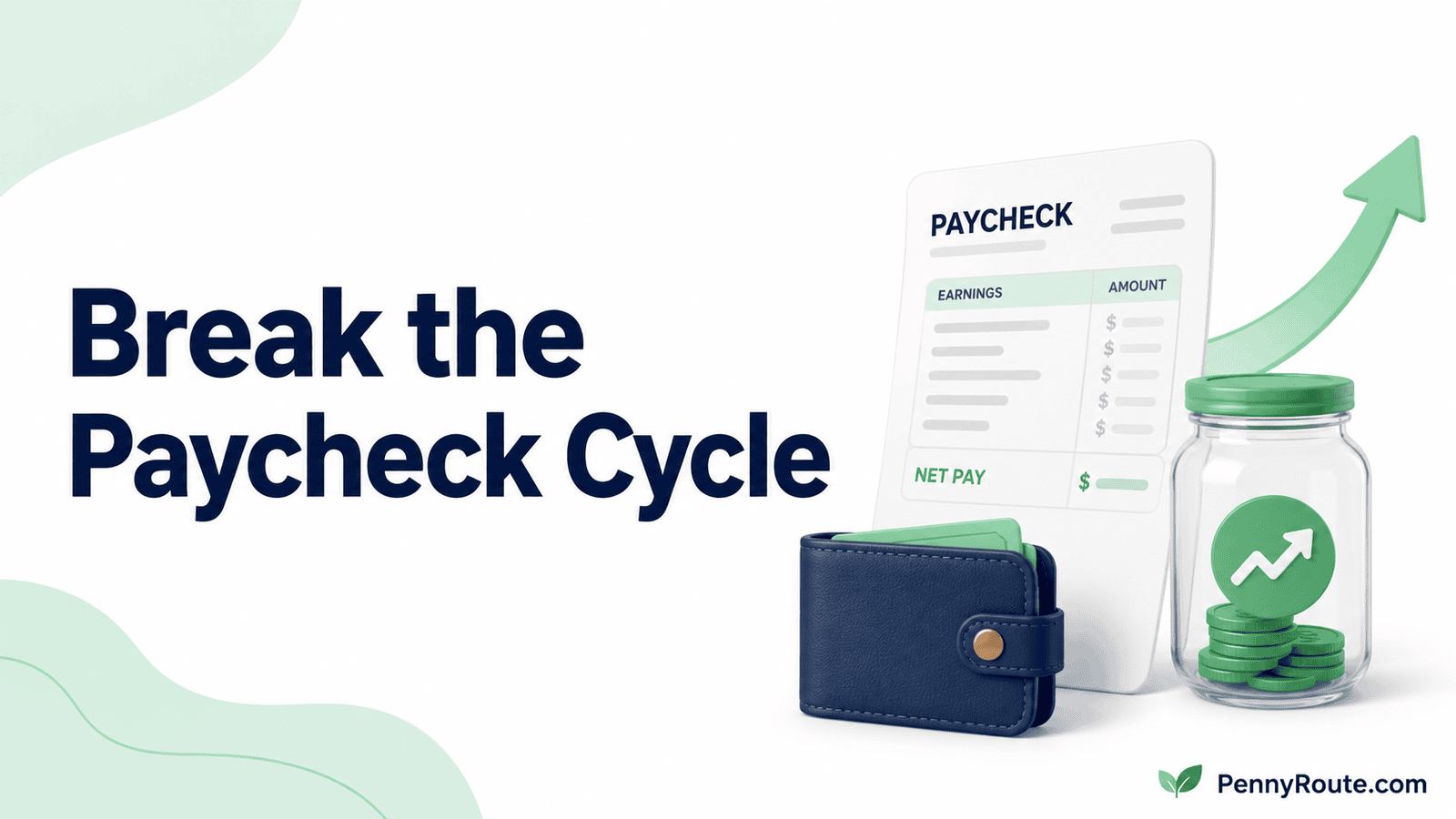
If you’re trying to stop living paycheck to paycheck, the first step is creating a little space between what comes in and what has to go out. Even a small amount left over at the end of a pay period gives you something to build on.
That might be $25, $50, or more depending on your situation. You don’t need a perfect budget or a large savings balance right away. What matters first is getting to the point where every new paycheck isn’t immediately needed to cover what came before.
Disclaimer: This content is for informational purposes only and does not constitute financial advice. Consider your own financial situation before making money decisions, and consult a qualified professional when needed.
Quick Overview
- The first step is creating a small, repeatable gap between income and normal expenses.
- If essential costs already exceed income, focus on reducing that shortfall before forcing a savings target.
- Use the first surplus to build a small buffer instead of immediately assigning every extra dollar elsewhere.
- Plan for irregular expenses so they do not keep wiping out the progress you make.
- You are making progress when the next paycheck starts to feel less urgent.
What Does Living Paycheck to Paycheck Mean?
Living paycheck to paycheck means most or all of the money you earn is needed before the next paycheck arrives. There is little left to carry forward, so a higher-than-usual expense, delayed income, or difficult week can put pressure on the rest of the pay period.
That does not automatically mean you are spending carelessly. High housing costs, debt payments, childcare, irregular income, or other necessary expenses can leave very little room even when everyday spending is fairly controlled.
What matters is the pattern. If each paycheck is already needed to cover the current round of expenses, there is no real cushion between one pay period and the next.
First, Find Out Whether You Have a Margin or a Shortfall
Before trying to save more or cut another expense, work out what your normal month is actually leaving you with.
Take-home income − normal necessary outflow = current margin or shortfall
Calculation
The key word is normal. Include the expenses that regularly happen in your life, not just the bills that arrive every month.
Example
Suppose your take-home income is $3,200 per month and your normal expenses plus required payments come to $3,150. That leaves about $50 of monthly room.
If those same costs total $3,300, you have a $100 shortfall instead. That calls for a different response than trying to force a $50 savings target.
If part of your spending is still unclear, tracking your expenses for a while can help fill in the missing numbers.
A small positive margin gives you something to protect and build on. A recurring shortfall needs to be reduced first.
How to Stop Living Paycheck to Paycheck
1. Protect Essentials Before Trying to Create Extra Room
When money is tight, it helps to separate what truly needs to be covered from what has more flexibility.
Housing, utilities, food, transportation, health needs, childcare, and required payments usually deserve attention first. Once those are clear, it becomes easier to see whether there is any room left to work with.
This does not mean every recurring cost is untouchable. It simply keeps you from trying to create savings by squeezing essentials while a larger expense elsewhere is taking up more of the budget.
If essentials and required payments already use all of your income, the next step is not forcing a savings target. The shortfall itself needs attention first.
2. Create a Small Amount of Recurring Room
One good month helps, but recurring room is what gives you a chance to stay ahead.
A one-time $200 boost from selling something can be useful, but it does not change what happens next month. Lowering a recurring cost by $40 and freeing up another $30 from spending you no longer value creates $70 of room that can keep showing up.
That room might come from one expense, a spending pattern, a fee that keeps repeating, extra work hours, or a mix of smaller changes.
The useful question is not, “What can I cut once?” It is,
What can change often enough to make next month a little easier too?
3. Keep the First Surplus Instead of Giving It Another Job
When you finally have a little money left before payday, it is tempting to immediately put it toward something else.
Sometimes that makes sense. But if you have no cash buffer at all, keeping some of that money available can be useful too. It gives the next pay period a little support from money that was already there.
You might start with $25, $50, or $100. There is no magic number. The important part is that some money stays put instead of being fully used before the next paycheck arrives.
That first bit of retained cash is not a full emergency fund. It is simply the beginning of some breathing room.
4. Make Irregular Expenses Part of the Recovery
A small buffer is easy to lose if every nonmonthly expense has to come out of it.
Car registration, annual insurance, school costs, gifts, maintenance, and medical copays may not show up every month, but many of them are predictable enough to plan for.
Once you know one is coming, start setting aside part of the cost before it is due instead of asking one paycheck to cover the whole amount.
If a $300 expense is six months away, for example, saving toward it gradually is much easier on your cash flow than finding the full $300 at once.
You do not need to plan for every irregular expense at the same time. Start with the one most likely to wipe out the progress you have already made.
5. Grow the Buffer Until the Next Paycheck Is Less Urgent
The point of the buffer is not to reach one perfect number. It is to gradually make each new paycheck less necessary for covering expenses that are already close behind you.
At first, that may simply mean $50 is still there when payday arrives. Later, one regular bill may already be covered, or a few days of groceries and transportation may be funded before the next paycheck comes in.
As that gap grows, your cash flow becomes less fragile. A short delay in income or a slightly more expensive week is less likely to throw everything off.
A consistent payday routine helps protect that progress by separating money needed later from money that is actually available to spend now.
What Should You Do With One-Time Extra Money?
A tax refund, bonus, gift, side-hustle payment, or money from selling something can give you a useful boost. The best use for it depends on what is keeping you stuck in the paycheck-to-paycheck cycle.
If you are short on essentials, covering that gap may come first. If the month is stable but you have no buffer, keeping part of the money available could make the next few pay periods easier. An upcoming irregular expense or expensive debt may also deserve some of it.
There is no fixed percentage that works for everyone. Instead, ask:
What use of this money would make the next few pay periods more stable?
That keeps the decision tied to your actual situation instead of an arbitrary rule.
What If Debt Payments Are Keeping You Paycheck to Paycheck?
Debt can make it much harder to create breathing room when required payments take a large share of what is left after essentials.
Start by knowing which payments are due, what the balances cost, and whether any minimums are becoming difficult to keep up with. The immediate concern here is not choosing the fastest payoff method. It is understanding how much of your cash flow is already tied up.
If you have a small amount of room, keeping some cash available may help reduce the chance that the next unexpected expense goes straight back onto a card or loan. Once your cash flow is steadier, a broader debt payoff plan can address how to reduce balances more aggressively.
If a credit card minimum no longer fits your budget, the CFPB recommends contacting the card issuer promptly and explaining what you can afford rather than waiting until the situation gets worse.
What If Your Income Does Not Cover Basic Expenses?
If your normal essential costs are higher than your income, there is no real surplus to turn into a buffer yet.
In that situation, the first job is reducing the shortfall. A $50 gap and a $700 gap usually need very different responses, so it helps to know how far apart income and necessary expenses actually are.
The biggest pressure points deserve attention first. That could mean a major recurring cost, available work or income, benefits or assistance you qualify for, debt payments that have become difficult to manage, or several of these at once.
Small cuts can still help, but they should not distract from the larger numbers. The aim is to get your normal cash flow back to a point where some money can finally remain after essentials are covered.
Signs You Are Starting to Break the Paycheck-to-Paycheck Cycle
Progress often shows up before you have a large savings balance.
You may be moving in the right direction if:
- some money regularly remains when the next paycheck arrives,
- you rely less often on credit or borrowing for ordinary expenses,
- a predictable irregular expense no longer wipes out an entire pay period,
- one or more bills are already covered with money you had before payday,
- the next paycheck feels helpful rather than immediately necessary.
These are small shifts, but they show that your cash flow is starting to work differently. The buffer can keep growing from there.
FAQs About Living Paycheck to Paycheck
How Much Should I Save to Stop Living Paycheck to Paycheck?
There is no single amount that works for everyone. Start with enough retained cash to make the next pay period a little less dependent on new income, then build from there as your cash flow improves.
Can You Stop Living Paycheck to Paycheck on a Low Income?
Yes, if your income still covers normal essentials with some room left over. If essential costs are higher than income, the first step is reducing that shortfall before trying to build a buffer.
Should You Pay Off Debt or Build Savings First?
There isn’t one answer for every situation. Required payments still need attention, but keeping some cash available can reduce the chance that the next unexpected expense creates new borrowing.
What Is the First Sign You Are No Longer Living Paycheck to Paycheck?
A useful early sign is that some money consistently remains when the next paycheck arrives. As that buffer grows, normal bills and expenses become less dependent on income arriving at exactly the right time.