High-interest debt can take a large share of each payment, especially when several balances are competing for the same extra money. Choosing where that extra payment goes first can affect both your payoff timeline and the amount of interest you pay.
The debt avalanche method gives that decision a clear order by prioritizing interest cost. It can work especially well when some of your debts carry much higher rates than others.
That does not mean the highest APR should control every situation. Promotional terms, overdue accounts, secured debt, or other immediate consequences can change which balance deserves attention first.
Disclaimer: This content is for informational purposes only and does not constitute financial, legal, tax, or credit advice. Debt balances, interest charges, collection status, and repayment options vary. Consider speaking with a qualified professional when needed.
Quick Overview
- The debt avalanche method sends extra money to the debt with the highest interest rate first.
- You keep making the required payments on the other debts while concentrating extra money on one target.
- When the target debt is paid off, its payment rolls into the debt with the next-highest rate.
- The method can reduce total interest, but changing APRs, promotional terms, or more urgent debt problems may affect the order you use.
What Is the Debt Avalanche Method?
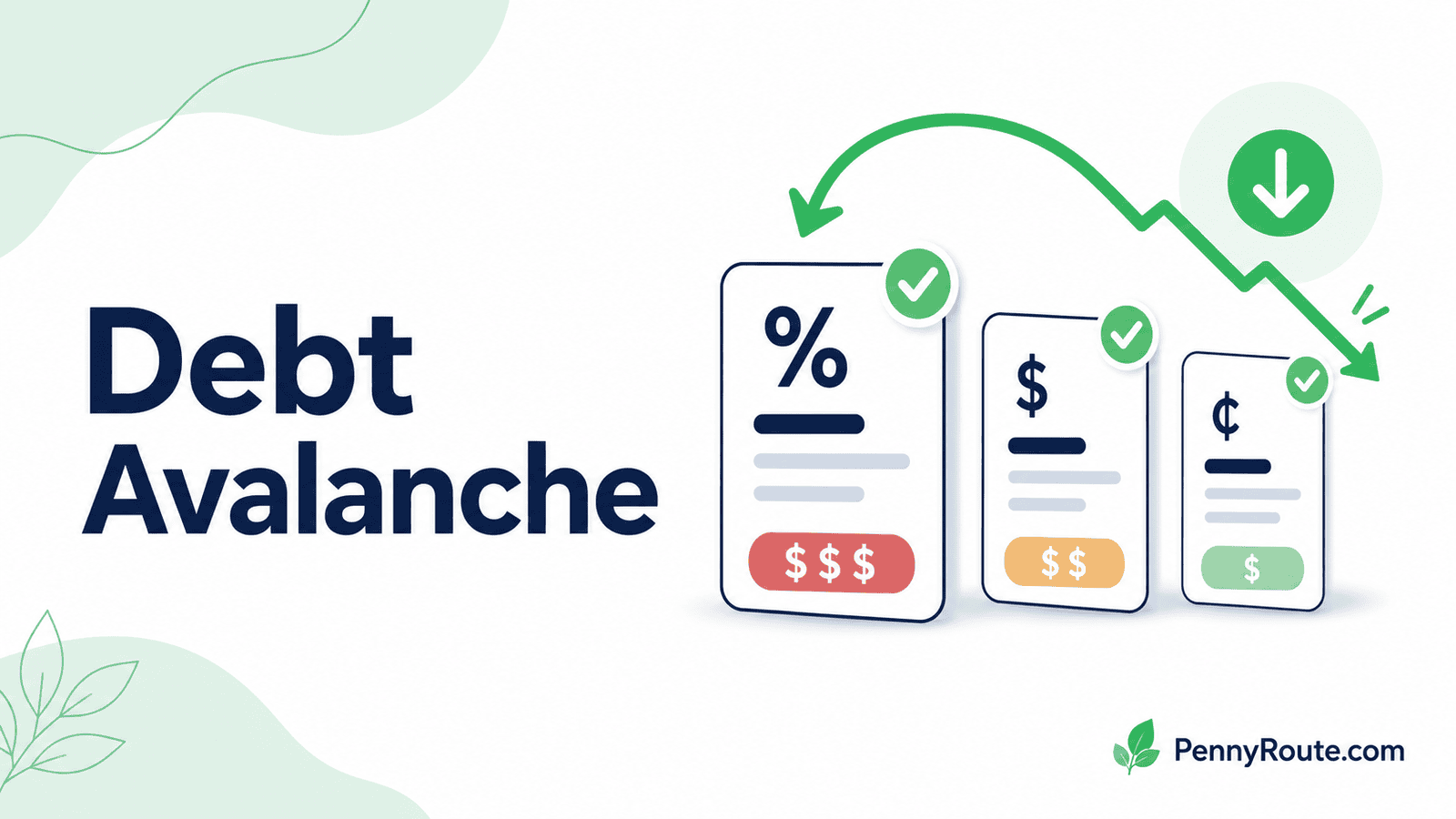
The debt avalanche method is a payoff strategy that prioritizes the debt with the highest interest rate.
You continue making the required payments on every debt, then direct any extra money toward the balance charging the highest APR. After that debt is paid off, the amount you were sending to it moves to the debt with the next-highest rate.
For example, suppose you have:
- a credit card at 24% APR;
- a personal loan at 11% APR;
- a store card at 18% APR.
With the avalanche method, the credit card comes first because it has the highest rate. The store card would be next, followed by the personal loan, assuming no other factor changes the priority.
The method is designed to reduce the amount of interest you pay over time by attacking the most expensive debt first.
How to Build Your Debt Avalanche Order
Once you know which debts are part of the plan, the next step is to put them in the right order.
Gather the Numbers That Affect Priority
For each debt, note:
- current balance;
- APR;
- required monthly payment;
- whether the rate is fixed, variable, or promotional;
- whether the account is current or past due.
The balance helps you track progress, but the APR is what normally determines the avalanche order.
Rank the Debts From Highest APR to Lowest
Put the debt with the highest APR at the top of the list, followed by the next-highest rate, and continue downward.
Using the earlier example, the order would be:
- Credit card at 24%
- Store card at 18%
- Personal loan at 11%
If two debts have very similar rates, a practical tie-breaker may matter more than a tiny difference in APR.
Keep the Required Payments Going on Every Debt
The avalanche only works if the other debts continue receiving their required payments.
Your extra money goes to the highest-rate target. The remaining debts stay current with their regular payments.
If keeping all required payments current is already difficult, that is a different problem from choosing the most efficient payoff order and deserves separate attention later in the article.
Send Extra Money to the Current Target
After the required payments are covered, direct whatever extra amount you have available to the highest-rate debt.
It does not have to be a dramatic number. An extra $50 or $100 still changes how quickly principal falls and how long interest continues to build.
Roll the Payment Forward
When the first debt is cleared, do not reduce the total amount you were putting toward debt if your budget still supports it.
Move that freed payment to the debt with the next-highest APR. The amount going to the target grows as each balance disappears, which is what gives the avalanche momentum over time.
How the Debt Avalanche May Reduce Interest
Interest cost depends on both the balance you owe and the rate charged on that balance. When one debt has a much higher APR than the others, leaving it outstanding longer can make it more expensive to carry.
The avalanche method addresses that by sending extra money to the highest-rate debt first. As that balance falls, less of your future money is exposed to the most expensive rate.
For example, an extra $100 generally does more to reduce future interest when it goes toward a credit card at 24% APR than toward a loan at 8% APR, assuming both accounts are current and there are no other terms that change the priority.
The difference becomes more noticeable when your debts have a wide spread in interest rates. If several balances carry nearly identical APRs, the savings from strictly following the rate order may be quite small.
How Fixed, Variable, and Promotional Rates Affect the Order
The avalanche method looks simple when every debt has a straightforward APR. It gets less tidy when rates can change or when a promotional period is involved.
Fixed-Rate Debt
With a fixed-rate debt, the APR does not change because market rates move.
That makes the avalanche order easier to maintain. If a credit card is at 21% and a personal loan is at 10%, the higher-rate debt will usually stay the higher-rate target unless another account condition changes.
Variable-Rate Debt
A variable APR can move over time, so the order you started with may not stay accurate.
If one balance increases from 16% to 22%, for example, it may move ahead of another debt that previously had the higher rate. Checking updated APRs periodically keeps the payoff order tied to the rates you are actually paying.
Promotional and Deferred-Interest Offers
A temporary 0% APR does not automatically belong at the top of an avalanche simply because the promotional period will eventually end. During a true 0% period, another debt that is already charging interest may be costing you more right now.
A deferred-interest offer deserves different attention. If the required balance is not paid by the promotional deadline, interest may be charged according to the terms of the offer, sometimes reaching back to the original purchase date.
For either type of promotion, note the expiration date and what happens afterward before deciding where the debt belongs in your payoff order.
This is one place where simply sorting today’s APRs from highest to lowest is not enough.
What If Two Debts Have Similar Interest Rates?
When two debts have nearly the same APR, the difference in interest cost between paying one first and paying the other first may be quite small.
In that situation, a practical tie-breaker can make more sense than trying to optimize a tiny rate difference.
You might choose the debt with:
- the smaller balance, if clearing one account sooner would simplify your payments;
- the higher monthly payment, if eliminating it would free more cash flow;
- a promotional deadline that needs attention;
- terms that are more likely to change soon.
For example, if one card is at 19.99% and another is at 19.49%, the half-point difference may not be large enough to outweigh a meaningful difference in balance, payment size, or account terms.
The avalanche method still gives you a default order, but close APRs leave more room for practical judgment.
When the Debt Avalanche May Be a Good Fit
The avalanche method tends to work best when the interest-rate differences between your debts are meaningful and you are comfortable waiting longer for the first balance to disappear.
It may fit well if:
- your required payments are manageable;
- you have some extra money to put toward debt;
- one or two balances carry noticeably higher APRs;
- you are comfortable following a rate-based order even if a smaller debt stays around longer;
- you are willing to update the order when rates or account terms change.
The biggest tradeoff is that the first payoff can take longer than it would with a smallest-balance-first approach. If visible progress is important for keeping you engaged, that slower start is worth considering before you commit to the method.
When the Highest-Rate Debt Should Not Come First
The avalanche method is built around interest cost, but APR is not the only thing that can make one debt more urgent than another.
A different priority may make more sense when:
- an account is past due, especially if catching it up could prevent further fees, collection activity, or other consequences;
- the debt is secured, such as an auto loan tied to a vehicle you rely on;
- a promotional or deferred-interest deadline is approaching and missing it could materially increase the cost;
- another debt carries more immediate financial consequences than the highest-rate balance.
For example, a 24% credit card may be the most expensive debt mathematically, but bringing a past-due auto loan current could deserve attention first if falling further behind puts essential transportation at risk.
Once the urgent issue is addressed, you can return to the APR-based order.
Balance size and interest rate are important, but they do not capture every consequence of falling behind. Situations involving delinquency, secured debt, collections, or essential services can change which debt you should pay off first.
How to Keep Your Avalanche Order Current
Your payoff order does not need constant adjustment, but it should reflect the rates and account terms you are actually dealing with.
Recheck the order when:
- an APR changes;
- a promotional period ends;
- a variable-rate balance becomes more expensive;
- one debt is paid off;
- an account becomes past due or another urgent issue appears.
You do not need to rebuild the plan every month just because balances are smaller. If the relative rates and account conditions have not changed, the order can usually stay the same.
A debt payoff calculator can help you rerun the numbers when something meaningful changes and compare how the updated order affects estimated payoff time and interest.
What If the First Debt Takes a Long Time to Pay Off?
One drawback of the avalanche method is that the highest-rate debt may also have a large balance. That means you could spend months making progress without actually eliminating an account.
If that starts to wear on your motivation, focus on smaller milestones within the balance rather than waiting for the payoff date itself. For example, you might track each $500 or $1,000 reduction, or watch the balance fall below a round-number threshold.
It can also help to track progress in a way that keeps the plan visible. Some debt payoff apps and calculators are better suited to ongoing balance updates, payoff milestones, and month-to-month tracking than a one-time calculation.
If the long wait is causing you to stop making extra payments altogether, the mathematically cheaper method may not be the best fit for you in practice.
What If You Have No Extra Money?
The avalanche method depends on having something left after your required payments. If every available dollar is already going toward minimums and essential expenses, there may be nothing extra to send to the highest-rate debt yet.
In that situation, focus first on keeping required payments current and protecting the expenses you cannot safely skip. If you later free up even a small amount, strategies for paying off debt faster can help you decide where that extra money may realistically come from, without turning this section into a broader budgeting discussion.
If required credit card payments are becoming difficult to afford, you can contact your card issuer as soon as you know you may have trouble making the minimum payment and ask what options may be available. If the problem is broader, a nonprofit credit counselor can help you review your budget, debts, and repayment options.
At that point, the issue is no longer just whether avalanche is the best payoff order. The priority becomes finding a repayment approach that your budget can actually support.
Debt Avalanche vs. Debt Snowball
The two methods use the same basic idea of keeping required payments going while focusing extra money on one debt at a time.
The debt avalanche starts with the highest APR, while the debt snowball starts with the smallest balance. The right choice depends on whether you care more about lowering interest cost or getting earlier balance payoffs, which is the main tradeoff in the debt snowball vs. debt avalanche method.
Keep the Avalanche Focused on What It Does Best
The avalanche gives your extra money a clear priority: the debt costing you the most in interest right now.
Keep the order tied to current rates, update it when account terms change, and make room for more urgent financial consequences when they arise. The strongest payoff plan is one that saves interest without ignoring the rest of your financial situation.