
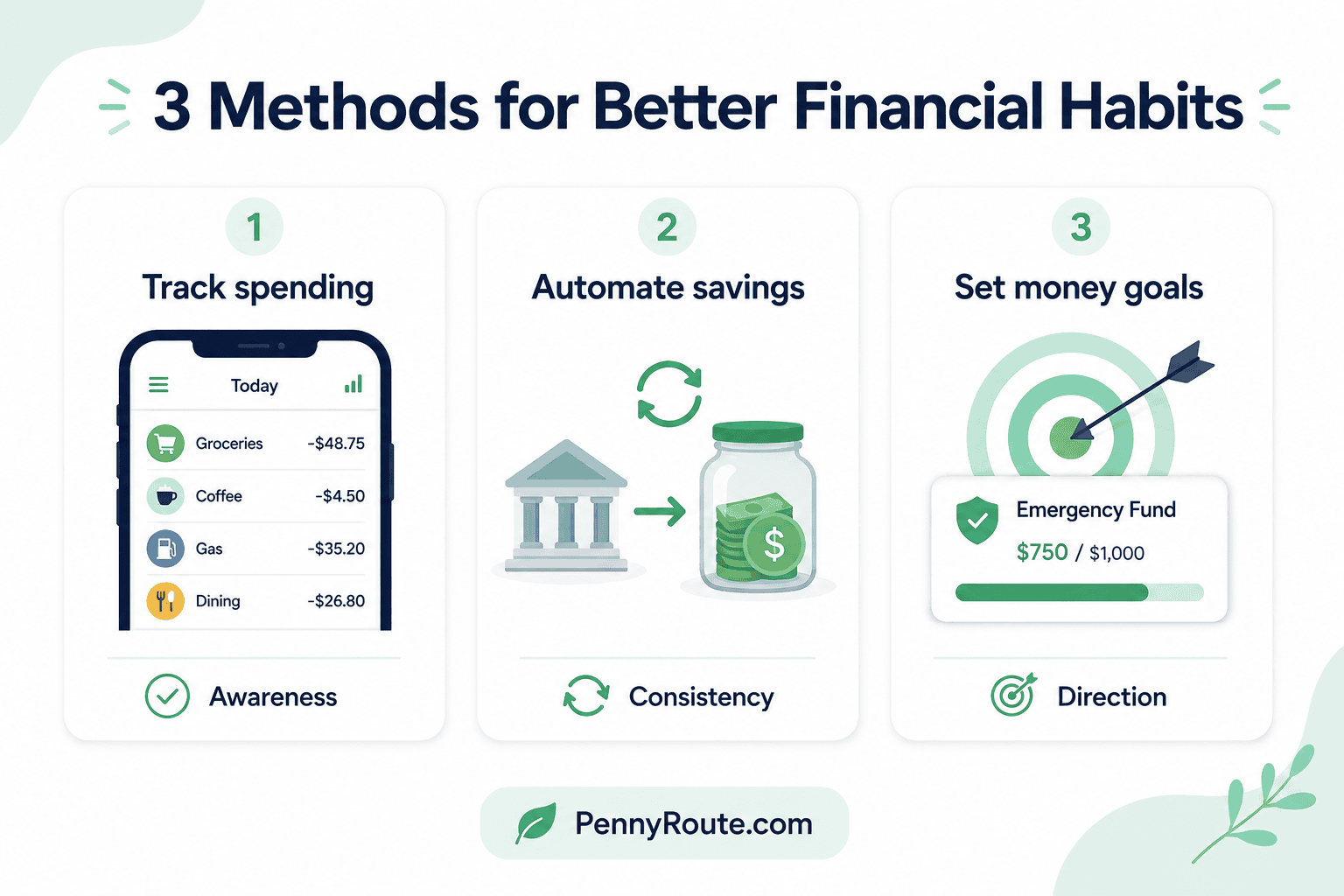
Three methods that help develop successful financial habits are tracking your spending, automating your savings, and setting clear money goals.
These methods work because they give your money three things it needs: awareness, consistency, and direction.
Tracking helps you see where your money is going. Automation helps you save before the money gets spent. Clear goals help you know what you are working toward instead of making random money decisions.
You do not need to fix every part of your finances at once. Starting with these three habits can make your money feel easier to understand, easier to manage, and less dependent on willpower alone.
Disclaimer: This content is for informational purposes only and does not constitute financial advice. Please consult a qualified professional before making financial decisions.
Why These Three Financial Habits Work Well Together
These three habits work well together because each one solves a different money problem.
Tracking your spending helps you understand what is happening with your money right now. Without that awareness, it is easy to guess, underestimate expenses, or wonder where your paycheck went.
Automating your savings helps you build consistency. Instead of waiting to see what is left over, you move money toward savings before everyday spending has a chance to use it up.
Setting clear money goals gives those habits a reason. Saving $25 a week feels more motivating when you know it is going toward a starter emergency fund, a car repair fund, or paying off a specific balance.
Together, these habits create a simple system: you see where your money goes, you save more consistently, and you give your progress a clear purpose.
Quick Summary
| Method | What It Helps With |
|---|---|
| Track your spending weekly | Awareness |
| Automate your savings | Consistency |
| Set small money goals | Direction |
These three methods are a simple starting point for building better money habits without trying to fix everything at once.
Method 1: Track Your Spending Weekly
Tracking your spending is one of the simplest ways to build better financial habits because it shows you what is actually happening with your money.
You do not need to track every dollar forever or create a complicated spreadsheet. Start by reviewing your spending once a week. Look at your bank account, credit card transactions, receipts, or budgeting app and notice where your money went.
You may find small surprises. Maybe takeout was higher than expected. Maybe a subscription renewed. Maybe a few quick online purchases added up more than you realized.
That information is not there to make you feel bad. It is there to help you make better decisions next week.
A simple weekly tracking habit can help you:
- Spot overspending early
- Catch forgotten subscriptions
- Understand your real spending patterns
- Plan better before the next paycheck
- Find money you can redirect toward savings or debt
Start with one question:
Where did my money go this week?
Once you can answer that clearly, your next money decision becomes much easier.
Method 2: Automate Your Savings
Automating your savings helps you build the habit before you have time to talk yourself out of it.
When savings depends on what is left at the end of the month, it is easy for that money to disappear into groceries, bills, small purchases, or unexpected expenses. Automation flips the order. You save first, then plan the rest.
Start with an amount that feels realistic. It could be $10 a week, $25 per paycheck, or a small percentage of your income. The amount matters less than the habit at the beginning.
You can set up an automatic transfer from your checking account to a savings account on payday or the day after payday. If money is tight, keep the transfer small enough that it does not cause stress or overdraft risk.
A payday routine can make automation easier because you decide what happens to your money as soon as it arrives.
This habit works because it removes one extra decision. You do not have to remember to save every time. The system does it for you, and over time, those small transfers can help you build a starter emergency fund or save for a specific goal.
Method 3: Set Small, Achievable Money Goals
Clear money goals give your habits a reason to stick.
It is much easier to track spending or save consistently when you know what the effort is for. Without a goal, saving can feel vague. With a goal, each small step has a purpose.
Start with one goal that feels realistic right now. For example:
- Save $300 for car repairs
- Build a $500 starter emergency fund
- Pay off a $200 credit card balance
- Save $50 a month for holiday spending
- Build one week of grocery money as a buffer
The goal should be specific enough that you know when you have reached it. “Save more money” is too vague. “Save $500 for emergencies” gives you a clear target.
Then break the goal into smaller steps. If you want to save $500, you could save $25 a week for 20 weeks. That feels more doable than trying to find $500 all at once.
Small goals may not look impressive at first, but they build confidence. And confidence makes it easier to keep going.
How to Start With These Three Habits This Week
You do not need to build all three habits perfectly right away. Start with a simple version you can actually repeat.
Here is an easy way to begin this week:
- Choose one day to review your recent spending.
- Pick one spending category to watch more closely, such as takeout, groceries, or online shopping.
- Set up a small automatic savings transfer for your next payday.
- Choose one clear money goal, such as saving $100, paying off one small balance, or building a small emergency fund.
- Check your progress again next week and adjust if needed.
The goal is not to create a perfect system in one day. It is to make your money easier to see, easier to direct, and easier to manage one small step at a time.
Three Simple Habits Can Build a Stronger Money Routine
Successful financial habits do not have to be complicated.
Tracking your spending gives you awareness. Automating your savings builds consistency. Setting small money goals gives your effort a clear direction.
You do not need to change your entire financial life at once. Start with one habit this week, make it easy enough to repeat, and build from there.
Small routines may not feel dramatic in the moment, but they can slowly change how you manage money. The more consistent you become, the less your finances depend on guessing, hoping, or waiting for the “perfect” month to start.
Frequently Asked Questions
What are three methods that help develop successful financial habits?
Three methods that help develop successful financial habits are tracking your spending, automating your savings, and setting clear money goals.
Why is tracking spending a good financial habit?
Tracking your spending helps you see your real money patterns. It can show where you overspend, which expenses surprise you, and where you may be able to save or cut back.
How does automating savings help build better habits?
Automating savings makes saving more consistent because the money moves before you have to think about it. Even small automatic transfers can help you build momentum over time.
What is an example of a small money goal?
A small money goal could be saving $300 for car repairs, building a $500 emergency fund, paying off a $200 credit card balance, or saving $50 a month for holiday spending.
Can I build successful financial habits on a low income?
Yes, but the habits may need to start small. Even reviewing your spending once a week, saving a few dollars when possible, or setting one small goal can help you feel more in control of your money.

PennyRoute Editorial creates beginner-friendly guides on budgeting, saving, and everyday money habits. Our goal is to make personal finance easier to understand with clear explanations, realistic examples, and practical steps.