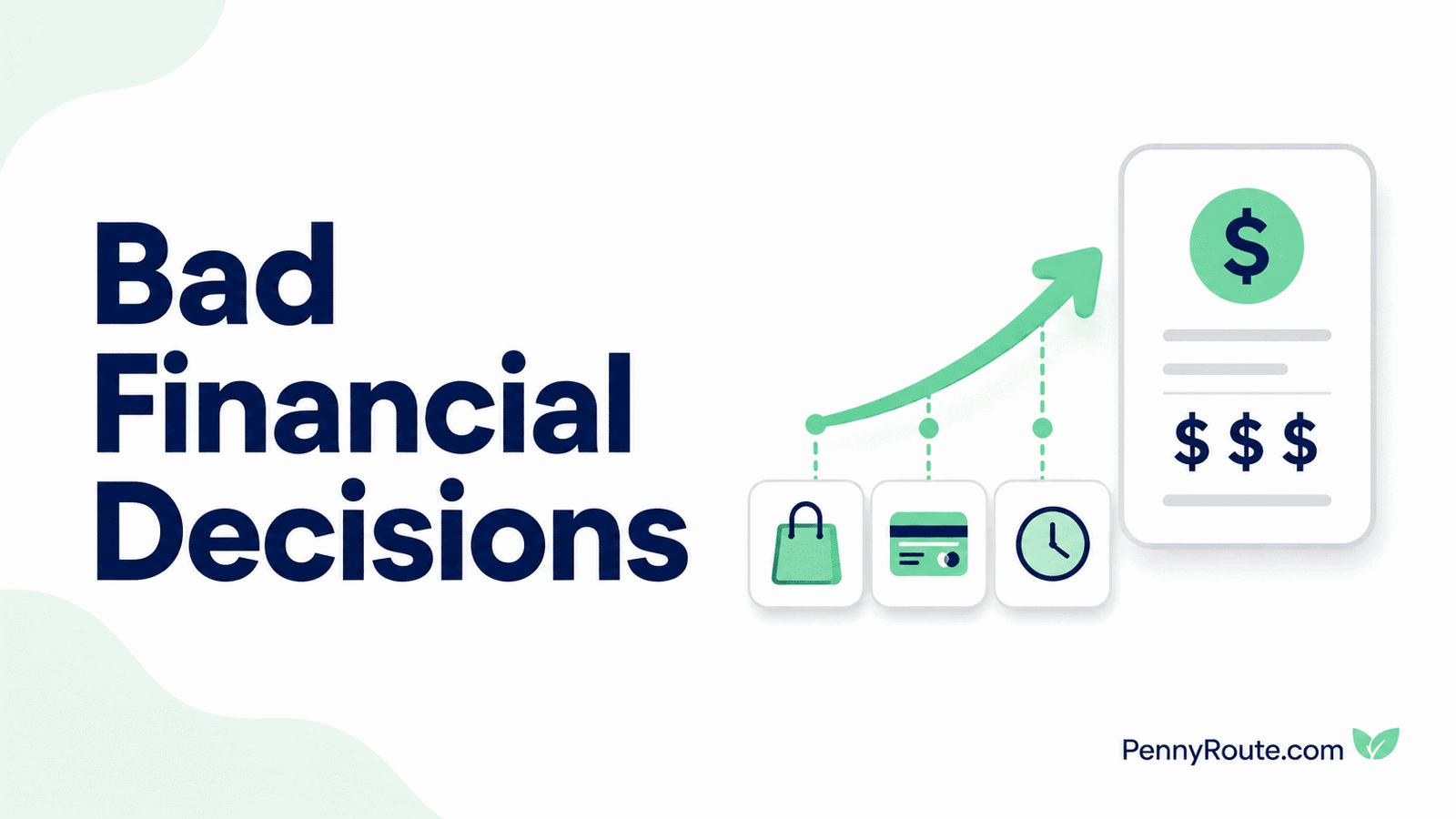
Some money choices are easy to undo. Others can follow you for years through monthly payments, interest, fees, lost savings, or commitments that are expensive to change.
A bad financial decision is not simply a purchase you later regret. It is usually a larger choice where the long-term cost, risk, or tradeoff was not fully considered before you committed.
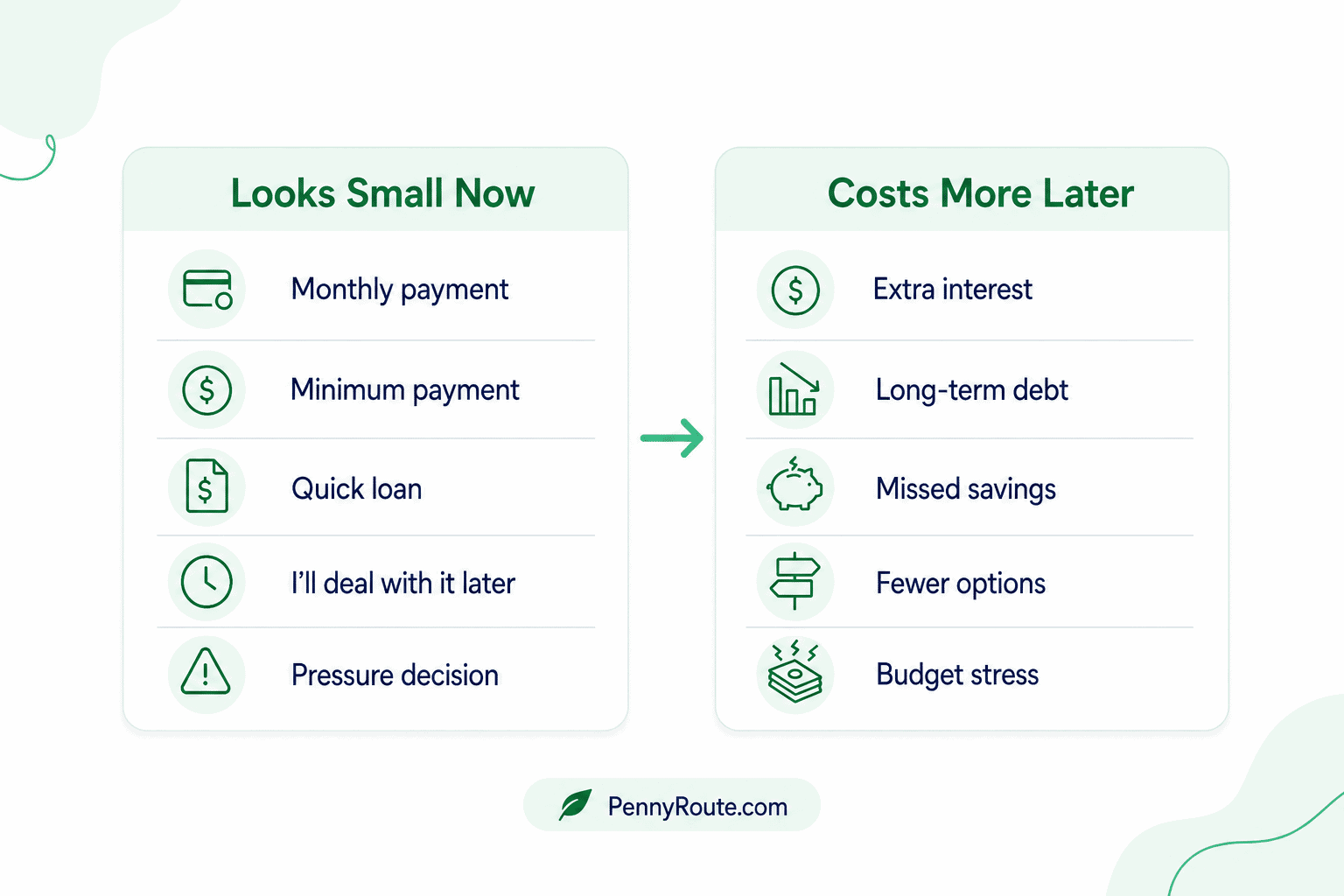
That does not mean every big decision has one right answer. The same loan, car, home, or insurance choice can work well for one person and create pressure for another. Looking beyond the first payment or immediate benefit can help you see what the decision will really ask of your finances over time.
Disclaimer: This content is for informational purposes only and does not constitute financial advice. Consider your own financial situation, costs, and risks before making major financial decisions, and consult a qualified professional when needed.
Quick Overview
- Bad financial decisions usually create costs, commitments, or risks that last beyond the moment you make them.
- A low monthly payment does not always mean the total cost is affordable.
- Big choices deserve more scrutiny when they are expensive to undo or reduce your financial flexibility.
- Before committing, look at the full cost, downside, and what the decision leaves room for elsewhere.
- If you already made a costly decision, focus on what can still be changed rather than adding another problem on top of it.
What Are Bad Financial Decisions?
Bad financial decisions are choices that create costs, commitments, or risks that are harder to undo than they first appear.
They often involve more than the price you see upfront. A loan can affect cash flow for years. A housing choice can leave less room for saving or unexpected expenses. Co-signing can make you responsible for debt you did not personally use.
The decision itself is not automatically bad because it involves debt, a large purchase, or a long-term commitment. The problem usually starts when the choice is made without looking closely enough at the full cost, the downside, or how much flexibility it leaves afterward.
That is why two people can make the same type of decision and end up with very different results. Whether the commitment fits your finances depends on the cost, risk, and flexibility you have after taking it on.
Bad Financial Decisions vs. Bad Spending Habits
A bad financial decision is usually a larger choice with consequences that can last for months or years. A bad spending habit is a repeated pattern that gradually puts pressure on your budget.
For example, financing a car you cannot comfortably afford is a financial decision. Repeatedly buying things you did not plan for is a spending habit.
The difference matters because the fix is not the same. A spending habit can often be changed by adjusting what you do repeatedly. A major financial decision may leave you with a contract, payment, fee, or other commitment that takes much longer to unwind.
That is why this article focuses on the bigger choices that deserve a closer look before you commit, rather than the everyday spending habits that can quietly add up over time.
What Makes a Financial Decision Risky?
Some financial choices deserve a closer look because a small mistake can be expensive to unwind.
Be especially careful when a decision has one or more of these features:
- The commitment lasts a long time. A payment that fits today can become harder to manage if your income or expenses change.
- The total cost is easy to overlook. Interest, fees, maintenance, insurance, or a long repayment term can make the real cost much higher than the headline price.
- Changing course is expensive. Selling, refinancing, canceling, or ending a contract may come with costs or limited options.
- The choice uses up too much flexibility. A large fixed payment can leave less room for saving, emergencies, or other priorities.
- You are taking on responsibility for someone else. Co-signing or sharing a financial obligation can affect you even if you are not the person using the money.
A decision becomes more important to examine when several of these apply at the same time.
7 Bad Financial Decisions That Can Cost You for Years
1. Taking On Debt Without Understanding the Full Commitment
Debt becomes risky when the decision is based mainly on whether the monthly payment looks manageable.
The payment is only one part of the commitment. The interest rate, fees, repayment term, and total amount repaid can change the real cost substantially. A payment that seems comfortable today can also become harder to carry if your income drops or other expenses rise.
Before taking on new debt, check:
- the total amount you will repay
- the interest rate and any fees
- how long the payment will last
- whether the payment still fits if your budget gets tighter
- what happens if you need to pay it off early or miss a payment
Debt is not automatically a bad decision. Understand the full commitment before agreeing, rather than letting a small monthly number make the decision for you.
2. Buying a Car Based Only on the Monthly Payment
A lower monthly car payment can make a vehicle look affordable even when the total cost is much higher than expected.
A longer loan term can reduce the payment while keeping you in debt for more years and increasing the amount of interest you pay. The payment also does not include every ongoing cost of owning the car.
Before deciding what fits your budget, look at:
- the vehicle price
- the loan term and interest rate
- the total amount financed
- insurance
- fuel
- maintenance and repairs
- registration and other ownership costs
A payment can fit comfortably on paper while the full cost of the car puts pressure on the rest of your finances. The better question is whether the vehicle works with your overall budget, not simply whether you can make the monthly payment.
3. Choosing Housing That Leaves Too Little Room Elsewhere
A home can be affordable on paper and still leave the rest of your budget uncomfortably tight.
Rent or a mortgage payment is only part of the cost. Depending on the situation, you may also have utilities, insurance, property taxes, maintenance, association fees, commuting costs, or higher everyday expenses tied to the location.
The housing cost also has to leave room for the rest of your financial life.
Before stretching for a more expensive home, consider whether the payment would still leave enough room for:
- regular bills and everyday spending
- saving
- debt payments
- unexpected expenses
- other priorities you do not want housing to crowd out
A larger home or more expensive location may be worth the tradeoff. The decision becomes risky when housing takes up so much of your income that almost every other part of your finances has to bend around it.
4. Co-Signing a Loan Without Being Ready to Repay It
Co-signing can look like a way to help someone qualify for credit, but it also puts your own finances behind the agreement.
If the borrower misses payments or stops paying, you can become responsible for repaying the debt if the primary borrower does not.
Before co-signing, be clear about:
- the full amount you could become responsible for
- the monthly payment and loan term
- whether you could cover the payment yourself if needed
- how missed payments would affect your own finances
- how long the obligation could remain on your credit
Helping someone does not make the risk smaller. Co-signing only makes sense when you understand that you are taking on a real financial responsibility, not simply adding your name to someone else’s application.
5. Using Retirement Savings to Solve a Short-Term Cash Problem
Retirement money can be tempting when cash is tight because the balance is already there. The problem is that taking money out early can cost more than the amount you withdraw.
Depending on the account, your age, and why you are taking the money out, an early withdrawal can trigger income taxes and sometimes an additional tax unless an exception applies. You also give up future growth on the money you remove, which can make the long-term cost easy to underestimate.
Before using retirement savings for a short-term expense, check:
- whether taxes or penalties would apply
- whether your retirement plan offers another option, such as an eligible loan or hardship distribution
- how much of the withdrawal you would actually keep after taxes
- what other ways you have to cover the expense
- how the withdrawal could affect your longer-term retirement savings
There are situations where using retirement money is the least harmful option available. It is still worth treating the withdrawal as a major financial decision, not just a convenient source of cash.
6. Leaving a Major Financial Risk Uninsured
Insurance is easy to treat as an expense you can cut because you may go months or years without using it. The risk shows up when one expensive event would be difficult to cover on your own.
That does not mean you need every type of policy available. The more useful question is whether you are exposed to a loss that could seriously damage your finances.
Before deciding to go without coverage, consider:
- how large the potential loss could be
- whether you could pay that cost from savings
- whether coverage is required by law or as part of a loan, lease, or other agreement
- what the policy would actually cover
- the deductible, limits, exclusions, and ongoing premium
Insurance is most valuable when it protects you from a loss you could not comfortably absorb yourself. Skipping coverage becomes risky when saving the premium leaves you exposed to a much larger financial hit.
7. Making a Big Money Decision Under Pressure
Pressure can make a financial choice seem more urgent than it really is.
A salesperson says the deal ends today. A lender emphasizes how quickly you can be approved. Someone close to you wants an answer now. In those moments, the risk is not simply making the “wrong” choice. It is agreeing before you have had enough time to understand the cost, terms, or alternatives.
Before committing, pause long enough to ask:
- Do I understand the full cost and terms?
- Is this deadline real, or is it mainly creating urgency?
- What happens if I wait a day or two?
- Have I compared at least one reasonable alternative?
- Would I make the same choice without the pressure?
Some decisions genuinely are time-sensitive. But when the urgency is coming from the seller, lender, or another person rather than your own situation, slowing the decision down can give you a clearer view of what you are agreeing to.
What to Check Before a Big Financial Decision
The seven decisions above are different, but the same few questions can help you slow down before taking on a major financial commitment.
| Check | Ask yourself |
|---|---|
| Total cost | What will this cost from start to finish, not just today? |
| Monthly impact | What will this payment leave room for after my other regular expenses? |
| Downside | What happens if my income drops, costs rise, or the situation changes? |
| Flexibility | How difficult or expensive would it be to change course later? |
| Pressure | Would I still make this choice if I had more time to think about it? |
You do not need every big decision to be risk-free. That is rarely realistic.
You need enough information to understand the commitment before you make it. If the total cost is unclear, the payment leaves almost no breathing room, or getting out would be expensive, that is a good reason to look more closely before saying yes.
What to Do If You Already Made a Bad Financial Decision
A costly financial decision does not always mean every part of the situation is fixed.
Start by getting clear on where things stand now. Depending on the decision, that might mean checking the remaining balance, monthly payment, fees, contract terms, insurance coverage, or what it would cost to change course.
Then separate the situation into three parts:
- What is fixed: costs or commitments you cannot easily change right now.
- What can still be changed: refinancing, selling, canceling, adjusting coverage, changing a payment arrangement, or reducing related costs.
- What could make the problem worse: taking on more debt, missing important deadlines, or adding another expensive decision on top of the first one.
For example, a car loan may not disappear just because the payment is uncomfortable, but you can still find out the payoff amount, current vehicle value, and whether refinancing or selling is realistic.
If the situation involves collections, taxes, legal issues, or a contract you do not understand, getting qualified help can be more useful than guessing at the next move.
The focus now is not on undoing the past. It is on understanding the options you still have and choosing the next move from the situation as it exists today.
One Bad Decision Does Not Have to Become a Pattern
A costly choice can affect your finances for a long time, but it does not have to shape every decision that follows.
You may not be able to undo the original commitment quickly. You can still make the next choice with a clearer understanding of the cost, risk, and flexibility you want to protect.

PennyRoute Editorial creates beginner-friendly guides on budgeting, saving, and everyday money habits. Our goal is to make personal finance easier to understand with clear explanations, realistic examples, and practical steps.