You did not plan to buy it, but it looks useful. The sale ends soon. Shipping is almost free. Your card is already saved.
That is how impulse buying often happens: the gap between wanting something and paying for it becomes so small that there is barely time to reconsider.
Stopping impulse buying does not mean cutting out every fun or spontaneous purchase. It means creating enough space before checkout to decide whether you still want the item once the urgency wears off.
A few simple changes, such as waiting before buying, removing checkout shortcuts, and setting limits for unplanned spending, can make that pause much easier to use.
Disclaimer: This content is for informational purposes only and does not constitute financial advice. If spending is causing serious financial or personal problems, consider seeking support from a qualified professional.
Quick Overview
- Impulse buying usually happens when there is little time between wanting something and paying for it.
- A waiting rule can weaken the urgency behind an unplanned purchase.
- Removing saved cards, shopping alerts, and other checkout shortcuts adds useful friction.
- Tracking impulse purchases can reveal the stores, situations, and times when they happen most often.
What Is Impulse Buying?
Impulse buying is an unplanned purchase made with little time between seeing something you want and deciding to pay for it.
It can happen online or in a store. For example, you might:
- add something to your cart because it is on sale;
- buy an item after seeing it in a social media post;
- grab an extra product near the checkout;
- spend more to reach a free-shipping minimum.
The purchase does not have to be expensive to matter. A series of small impulse buys can quietly take money away from bills, savings, or spending you had already planned.
An occasional spontaneous purchase is not necessarily a problem. The concern is when quick, unplanned buying happens often enough that it starts working against your budget or other financial priorities.
Impulse Buying vs. Other Spending Patterns
These terms are related, but they describe different problems.
| Pattern | What It Usually Means |
|---|---|
| Impulse buying | An unplanned purchase made quickly, often with little time to reconsider |
| Emotional spending | Buying that is driven mainly by an emotional state, such as stress, boredom, or excitement |
| Overspending | Spending more than your budget or finances can comfortably support |
| Compulsive shopping | Repeated shopping that feels difficult to control and may cause serious financial or personal consequences |
An impulse purchase can also be emotional or lead to overspending, but that is not always the case. You might buy something simply because a sale created urgency or checkout was unusually easy.
If emotions are the main reason behind the spending, the strategies for emotional spending need to address the trigger as well as the purchase itself. If the larger issue is repeatedly spending beyond what your budget can support, how to stop overspending is a broader problem than one quick checkout decision.
With impulse buying, the best chance to interrupt the purchase is often the short window between “I want this” and “I bought it.”
Why Impulse Buying Happens So Fast
Impulse buying gets easier when shopping leaves very little space between seeing something and paying for it. Several parts of modern shopping are designed to keep that decision moving.
Checkout Removes Friction
Saved cards, one-click checkout, shopping apps, and digital wallets can turn a purchase into a few taps.
That convenience is useful when you already planned to buy something. With an unplanned purchase, though, it removes moments when you might otherwise reconsider the price, check your budget, or decide you do not need the item after all.
Shopping Creates Urgency and New Wants
Limited-time sales, low-stock messages, personalized recommendations, and free-shipping thresholds can make waiting seem costly.
Social media adds another layer. You may open an app with no intention of shopping and encounter a product, promotion, or creator recommendation within minutes.
Urgency does not necessarily mean the purchase is a good deal for you. It simply makes postponing the decision harder.
Small Purchases Are Easy to Dismiss
A $7 add-on or $15 sale item may not seem important enough to think about for long.
The problem appears when small unplanned purchases happen repeatedly. Each one may be manageable on its own, while the combined spending takes a noticeable amount away from money you intended to use elsewhere.
That is why impulse control is not only about stopping large purchases. Creating a pause can be just as useful for the small ones that are easiest to overlook.
Before You Buy: A 5-Question Impulse Check
When you catch yourself hovering over “Buy Now,” you do not need a complicated decision process. A few questions can slow the purchase down enough to see it more clearly.
1. Did I Plan to Buy This?
If the item was already on your shopping list or you had set money aside for it, the purchase may simply be part of your plan.
If you had no intention of buying it until a few minutes ago, that is a good reason to pause.
2. Would I Still Want It at Full Price?
A discount can make the deal seem more important than the item itself.
Ask yourself whether you would still be interested without the sale price, coupon, or limited-time offer. If the answer is no, you may be responding more to the promotion than to something you actually want.
3. Do I Already Own Something That Does the Same Job?
This is especially useful for clothes, kitchen items, beauty products, electronics, and hobby purchases.
You do not need an identical item for there to be overlap. If something you already own solves the same problem well enough, the new purchase may not add much.
4. Where Will the Money Come From?
Instead of asking only, “Can I afford this?” decide what the purchase would reduce.
Would the money come from:
- this week’s spending money;
- savings;
- another planned purchase;
- money already needed for a bill?
Seeing the tradeoff makes the real cost easier to judge.
5. Will I Still Want It After I Wait?
You do not have to decide immediately just because the store wants an answer immediately.
Close the tab, leave the item in your cart, or take a photo in the store. If you still want it after the urgency has passed, you can reconsider it with a clearer head.
You do not need every question to produce a firm “no.” The purpose is simply to turn an automatic purchase into a decision.
How to Stop Impulse Buying Before Checkout
The easiest time to stop an impulse purchase is before payment, while the item is still just a possibility. The aim is to make that moment a little slower and less automatic.
Use a Waiting Rule
Instead of deciding on the spot, give unplanned purchases a set amount of time.
For example, you might wait until the next day for smaller wants, 48 hours for mid-priced purchases, and several days for larger ones.
The exact timing matters less than having a rule you can follow consistently. If you still want the item after the wait and it fits your budget, you can reconsider it then.
Move Wants to a Wishlist
A wishlist gives you somewhere to put an item without having to choose between buying it now or forgetting about it completely.
Save the product, close the store, and come back later. After a few days, some items will still seem worthwhile. Others will look much less interesting once the initial excitement is gone.
Add Friction Before Online Checkout
Make unplanned purchases require a few extra steps.
You could:
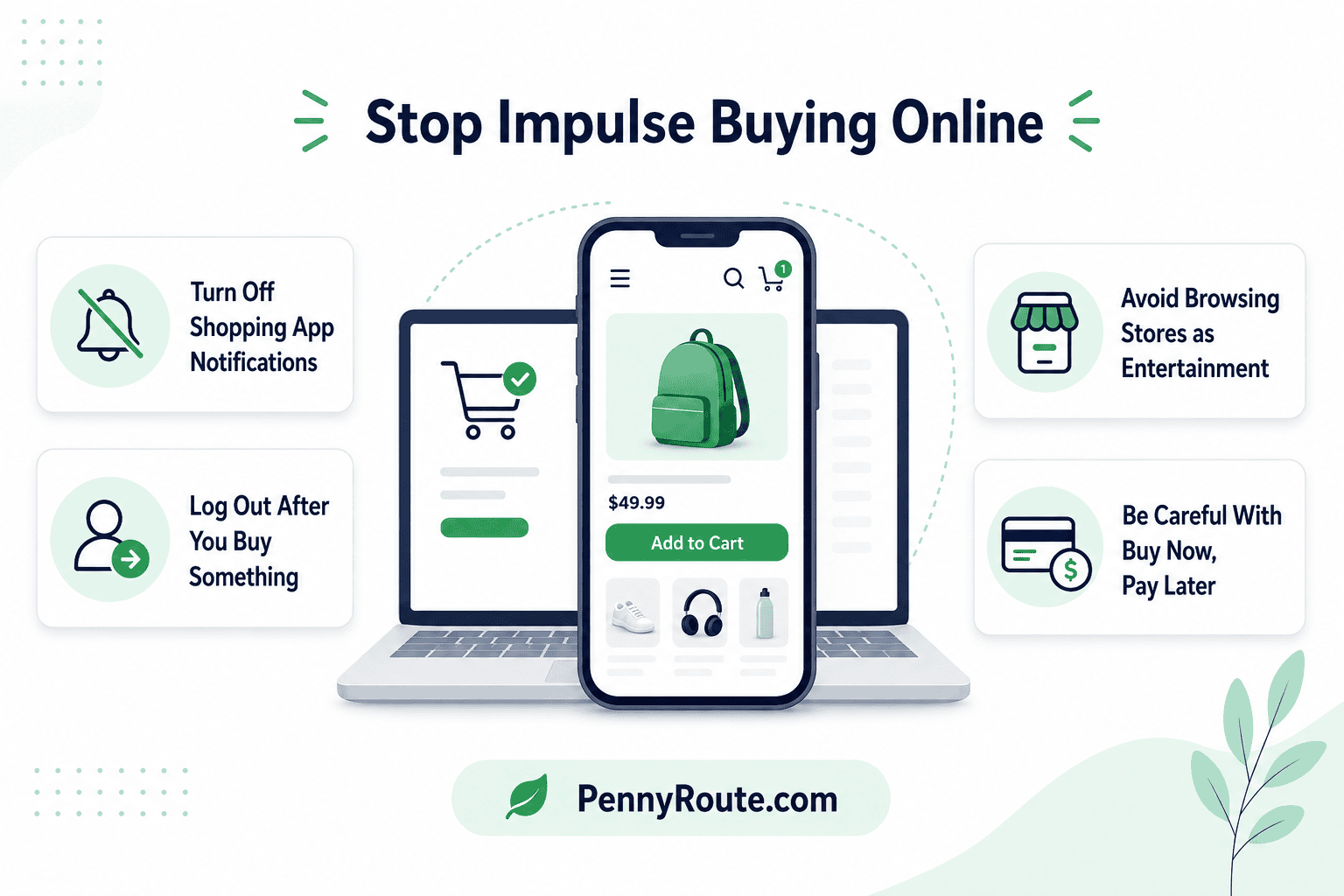
- remove saved card details;
- turn off one-click purchasing;
- delete shopping apps you open out of habit;
- unsubscribe from sale alerts you rarely need;
- disable shopping notifications.
None of these makes buying impossible. They simply give you another chance to decide before the payment goes through.
If you use buy now, pay later, include the full purchase price in the decision rather than focusing only on the smaller installment. Breaking the cost into payments can make an unplanned purchase look easier to absorb than it really is.
Set a Limit for Unplanned Purchases
A small amount of planned flexibility can be easier to maintain than trying to ban every spontaneous purchase.
For example, you might give yourself a set amount each month for unplanned treats or extras. Once that money is used, additional wants go on the wishlist until the next month.
This keeps an occasional impulse purchase from quietly competing with bills, savings, or other planned spending.
Track Impulse Purchases for 30 Days
For one month, write down only the purchases you did not plan to make.
Record a few details:
- what you bought;
- how much it cost;
- where you saw it;
- roughly when you bought it;
- what made you decide to buy.
You are not trying to document every dollar you spend. You are looking for patterns.
After a few weeks, you may notice that most impulse purchases happen on one shopping app, after payday, late at night, or when a sale notification arrives. Once the pattern is visible, you can put the strongest barrier in the place where it is most likely to help.
How to Stop Impulse Buying in Stores
In-store impulse buying works a little differently from online shopping. You cannot remove saved cards or close a browser tab, but you can reduce the amount of unplanned browsing that happens before you reach the register.
Shop With a Clear List
Decide what you are there to buy before you start walking through the store.
Your list does not have to account for every dollar, but it gives you something concrete to return to when an extra item catches your attention.
If something is not on the list, you do not have to put it back automatically. Treat it as an unplanned purchase and give yourself a reason to think before adding it.
Reduce Browsing
The longer you spend looking at products you did not come in for, the more opportunities there are to find something appealing.
For a quick trip, a basket instead of a cart can make it easier to notice how much you are adding. You can also skip aisles or store sections that have nothing to do with what you came to buy.
This is not about rushing through every shopping trip. It is about avoiding extra browsing when you already know it tends to turn into extra spending.
Review One Unplanned Item Before Checkout
Before you pay, look at anything in your basket that was not part of the original plan.
Pick one item and ask whether you would make a separate trip back for it tomorrow. If not, putting it back is usually easier than regretting it after you get home.
If there are several unplanned items, review them one at a time rather than treating the whole basket as a single decision.
What to Do After an Impulse Purchase
Sometimes you notice the impulse only after the payment goes through. At that point, the useful question is not how to undo the past decision, but what you can still do with the purchase and what it tells you about the next one.
Cancel or Return It Quickly
If the order has not shipped, check whether it can still be canceled.
For an in-store purchase, review the return policy while the receipt, packaging, and tags are still easy to find. Waiting too long can turn a reversible purchase into one you are stuck with.
A return makes the most sense when you genuinely do not want the item, not simply because you are trying to erase every spontaneous purchase.
Notice What Prompted the Purchase
Look at what happened immediately before you bought it.
Maybe you:
- opened a sale email;
- saw a social media ad;
- added something to reach free shipping;
- shopped right after payday;
- started browsing late at night.
You do not need to analyze your entire relationship with money. You are looking for the practical cue that pushed this particular purchase forward.
If the same cue shows up repeatedly, that is where a new boundary can be most useful.
Do Not Let One Purchase Turn Into a Spending Spiral
One impulse buy does not make the rest of the day or month a lost cause.
Avoid the “I already spent money, so it does not matter now” response. Return to your normal spending plan with the next decision instead of trying to compensate with extreme cuts or continuing to spend.
The purchase can be useful information even if you keep it. The aim is to make the next impulse easier to catch earlier.
When Impulse Buying May Need Extra Help
The strategies in this article are meant for everyday impulse purchases that you can usually interrupt with a pause, a spending boundary, or a little more friction.
It may be worth getting additional support when shopping repeatedly feels difficult to control or starts causing bigger problems, such as:
- bills going unpaid because of shopping;
- growing debt tied to repeated purchases;
- hiding purchases or spending from other people;
- repeated attempts to stop that do not last;
- shopping creating serious stress or conflict at home.
At that point, another waiting rule may not address the whole problem. A qualified mental health professional can help with the behavior itself, while a reputable financial counselor can help with debt, bills, and the practical financial effects.
Make the Pause Easier Than the Purchase
You do not need to eliminate every spontaneous purchase. The bigger change is giving yourself enough time to decide whether you actually want something before the payment goes through.
Start with the point where impulse buying catches you most often. A waiting rule, fewer checkout shortcuts, or one clear spending boundary can make the next decision easier without making shopping unnecessarily restrictive.