A bill sits unopened. You keep meaning to check your bank balance, but another day passes. Or you already know there is a money problem and keep putting off the call or decision that comes next.
That pattern is financial avoidance. It happens when you repeatedly put off dealing with something financial that needs your attention. Putting them off can bring temporary relief, but the bill, balance, or decision is still waiting when you come back to it.
Getting past financial avoidance does not require sorting out your entire financial life at once. It starts with identifying exactly what you have been avoiding and dealing with the part that needs your attention first.
Disclaimer: This content is for informational purposes only and does not constitute financial advice. Consider your own financial situation when making money decisions, and consult a qualified professional when needed.
Quick Overview
- Financial avoidance means repeatedly putting off money tasks, information, decisions, or conversations.
- Avoidance can bring short-term relief while leaving the financial issue unresolved.
- Start by identifying exactly what you have been avoiding.
- Looking at the numbers does not mean you have to solve everything at once.
- Some situations need more than a small first step, especially when serious financial consequences are already involved.
What Is Financial Avoidance?
Financial avoidance is the habit of putting off money information, tasks, decisions, or conversations that need your attention.
It can be as simple as not opening a bill, delaying a bank-balance check, ignoring a statement, or postponing a call because you do not want to deal with what might come next.
Financial avoidance is not the same as financial anxiety. Financial anxiety is about worry or stress around money. Financial avoidance is the behavior of not engaging with something financial, even when you know it needs attention.
The two can happen together, but they do not always. You can worry about money and still deal with it promptly, or avoid a financial task because it feels confusing, unpleasant, or difficult to face.
What Financial Avoidance Can Look Like
Financial avoidance does not always look like ignoring your finances completely. Sometimes you stay on top of certain things while repeatedly putting off one area you do not want to deal with.
That can look like:
Avoiding Financial Information
You may put off checking a bank balance, opening a statement, reviewing a credit-card account, or looking at recent transactions because you are worried about what you will find.
Avoiding Financial Tasks
The numbers may already be clear, but the task keeps getting delayed. That could mean leaving a bill unpaid, putting off paperwork, or not canceling an expense you no longer want.
Avoiding Financial Decisions
Sometimes the problem is not knowing the numbers. It is choosing what to do with them.
You may keep postponing a repayment choice, a spending decision, or another financial decision because you are afraid of making the wrong call.
Avoiding Money Conversations
A financial issue can also stay unresolved because you keep delaying a conversation with a creditor, service provider, partner, or someone else involved in the decision.
The details vary, but the pattern is similar: something needs your attention, and dealing with it keeps getting pushed to another day.
Why Avoiding Money Can Make the Problem Harder
Avoidance can make a money problem easier to ignore for a little while, but it also gives the situation more time to change without you.
A missed due date can lead to a late fee. An unpaid balance can become more expensive. A service problem can move closer to interruption. A creditor or provider may also have fewer options available if you wait until the account is already seriously overdue.
There is another cost too: uncertainty. When you do not know the balance, status, or deadline, your mind has to fill in the gaps. The situation may be better than you expect, worse than you expect, or simply different from what you have been assuming.
Dealing with the issue earlier does not guarantee an easy solution, but it usually gives you more information, more time, and more room to decide what happens next.
What Are You Actually Avoiding?
Before you decide what to do next, it helps to separate the kind of avoidance you are dealing with.
| You are avoiding… | Example | What you need first |
|---|---|---|
| Information | “I do not want to see my bank balance.” | The actual number |
| A task | “I keep putting off this bill.” | The next required action |
| A decision | “I know the options, but I keep delaying the choice.” | A clear comparison of the tradeoffs |
| A conversation | “I need to call, but I keep putting it off.” | A short list of what you need to ask |
These situations can look similar from the outside, but they are not the same problem.
If you are avoiding information, the first step is usually to find out what is actually happening. If you already know the numbers, more information may not help. You may need to make a decision, complete a task, or have a conversation instead.
That distinction can keep you from turning every avoided money issue into one vague problem you have to “fix.”
How to Stop Financial Avoidance
Once you know what you have been avoiding, the next move is to make that issue specific enough to deal with.
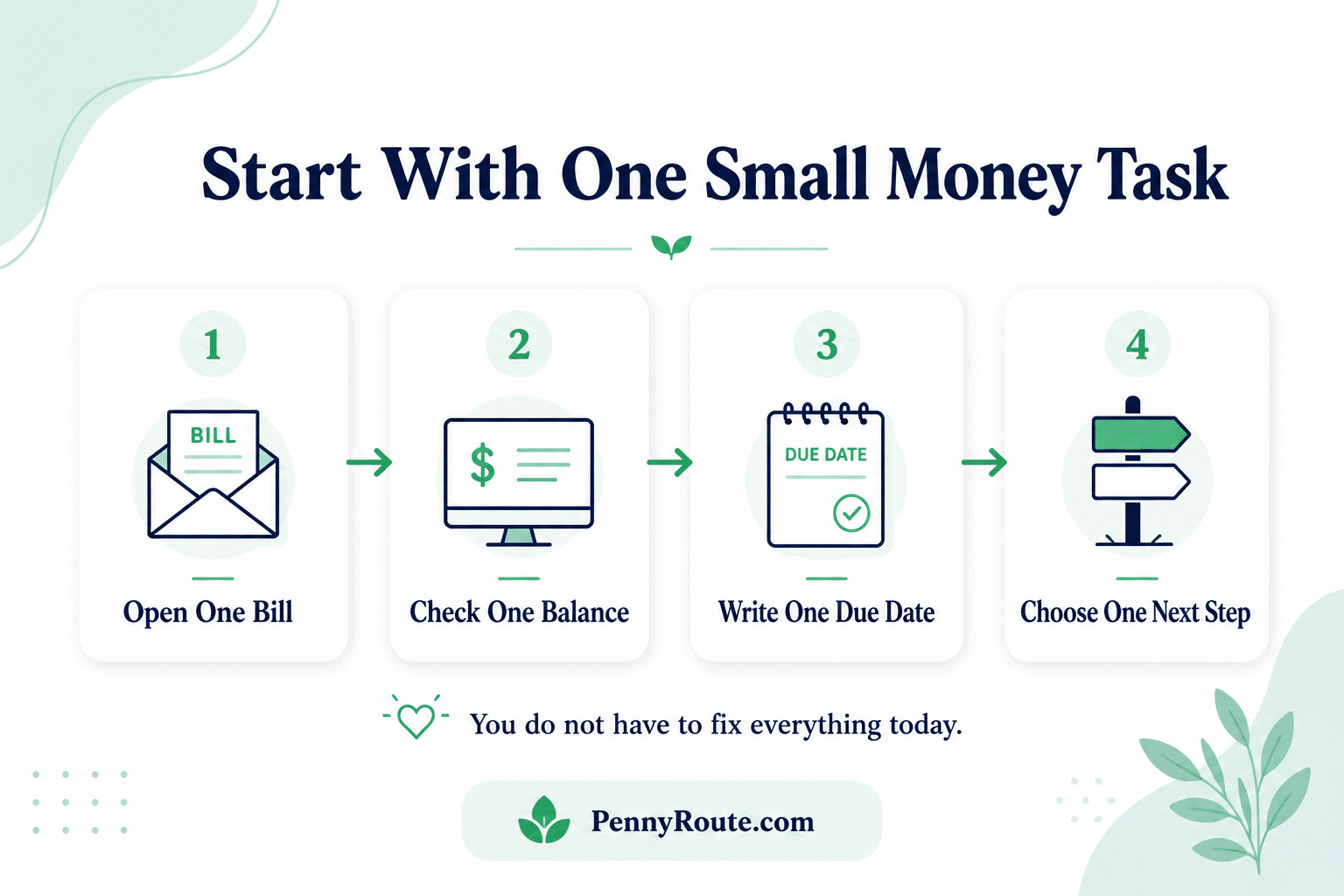
Start With the Exact Thing You Have Been Putting Off
“I need to sort out my finances” is too broad to act on.
A more useful starting point is something concrete, such as:
- “I need to open the credit-card statement.”
- “I need to check whether the bill is overdue.”
- “I need to call the provider about the balance.”
- “I need to decide whether I can make this payment.”
The smaller the issue becomes, the easier it is to see what actually needs to happen next.
Find Out Only What You Need to Know First
If information is what you have been avoiding, do not turn the first look into a full financial review.
Check the number or detail that matters for the issue in front of you. That might be the current balance, due date, minimum payment, account status, or amount already overdue.
You can look at everything else later if needed.
Separate the Information From the Action
Seeing a number and fixing the problem are two different things.
For example:
Information: The electric bill is $146 and due Friday.
Action: Schedule the payment or contact the provider if you cannot pay it by then.
This keeps the first look from turning into an expectation that you must solve the entire situation immediately.
Decide What Happens Next Before You Move On
Once you know what you are dealing with, give the issue a clear next action.
That could be making a payment, scheduling it, canceling something, making a call, requesting information, comparing two options, or putting a specific follow-up on your calendar.
Try to avoid ending with “I’ll deal with it later.” If later is genuinely the right time, decide when “later” is.
Give Yourself a Clear Stopping Point
Dealing with financial avoidance does not mean spending the rest of the evening checking accounts and looking for new problems.
Once you have the information you needed and know the next action, you can stop. The purpose is to re-engage with the issue, not turn one avoided task into a complete financial overhaul.
Scared to Check Your Bank Balance? Start Here
Being afraid to check your bank balance is a specific kind of financial avoidance. The hardest part is often the moment before you look, when you are imagining what the number might be.
Give the balance check one specific purpose before you open the app.
Know What You Are Checking For
Give yourself a clear reason to open the account.
For example:
I need to know whether this account can cover the $80 payment due tomorrow.
That is much easier to act on than opening your banking app with the vague idea that you need to “see how bad things are.”
Look at the Current Balance First
Start with the number that answers your immediate question.
You can review recent transactions or other details afterward if they are actually relevant. The balance is information, not a judgment about how well you are managing money.
Check for Anything That Needs Attention Today
Once you know the balance, look only for something that changes what you need to do next.
That might be:
- a payment due soon
- a negative or very low balance
- an unexpected charge
- not having enough available for a known bill
If nothing requires action today, you do not need to keep searching for another problem.
Decide What Happens Next
If something does need attention, choose the next action while the information is still in front of you.
You might schedule a payment, move money between accounts, contact a provider, or set a specific time to deal with the issue later.
Checking the balance has already done its job once you know where things stand and what, if anything, needs attention next.
What If You Know the Numbers but Still Keep Putting Off the Decision?
Sometimes the avoidance continues after you have already looked at the account, opened the bill, or worked out what you owe.
At that point, the problem is no longer missing information. It is the decision that comes next.
You might know a payment is due but keep delaying whether to pay it in full, make the minimum, or contact the provider. You might know an expense is no longer worth keeping but still avoid canceling it. Or you may understand the options and still hesitate because none of them feels especially good.
In that situation, narrow the decision down to the choices that are actually available.
Instead of asking:
What am I going to do about all of this?
ask:
What are my realistic options for this payment before Friday?
Then check whether you are still missing anything important. Sometimes indecision is really a lack of information about fees, deadlines, payment options, or consequences.
If you already have what you need, give the decision a clear deadline. Waiting indefinitely rarely makes the choice easier. A decision can still be imperfect and useful if it is based on the information and options you have now.
When Avoidance Has Already Created a Bigger Problem
Sometimes putting a money issue off has already changed the situation. A bill may be overdue, an account may be in collections, or a notice may now carry a deadline you cannot ignore.
At that point, the priority is no longer simply getting yourself to look. It is finding out what has changed and what still needs action now.
Start with the most time-sensitive part of the problem:
- If a bill is late, check the current amount due, any added fees, and the next deadline.
- If a debt account is seriously overdue, confirm its status before deciding what to do next.
- If you received a tax, collection, utility, housing, or legal notice, read the notice carefully and pay attention to any response date.
- If you are not sure what the notice means or what options you have, contact the organization involved or an appropriate qualified professional.
Avoidance can reduce your options over time, but it does not automatically mean there are no options left. Knowing the current status gives you a much better starting point than continuing to work from an old balance, an outdated deadline, or an assumption about what might happen next.
Some situations need more than a small first step. If you are dealing with debt you cannot comfortably manage, collection activity, a tax issue, or another financial problem with an important deadline, getting the right support can help you understand your options and what needs attention first.
Keep Financial Tasks From Becoming Easy to Avoid Again
Once you have dealt with the immediate issue, a little structure can make it easier to keep similar tasks from piling up again.
You might:
- turn on useful bill or account alerts
- keep financial mail and notices in one place
- put important due dates somewhere you will actually see them
- choose a regular time to review anything that needs attention
A simple weekly money check-in can help you catch small tasks before they become urgent without requiring you to think about money every day.
The idea is not to create a complicated system. It is to make important financial tasks easier to notice and harder to keep postponing.
Facing the Money Does Not Mean Solving Everything Today
You may finally open a bill and realize you cannot pay it in full today, or check an account and find that the numbers are tighter than you expected.
Facing the issue still changes your position. You now know what needs attention, what can wait, and whether you need more information or outside help.
The full solution may take time. You do not have to keep the problem out of sight while you work toward it.