Keeping too much money in checking can make savings look available to spend. Move too much into savings, though, and you may find yourself transferring it straight back when a bill is due.
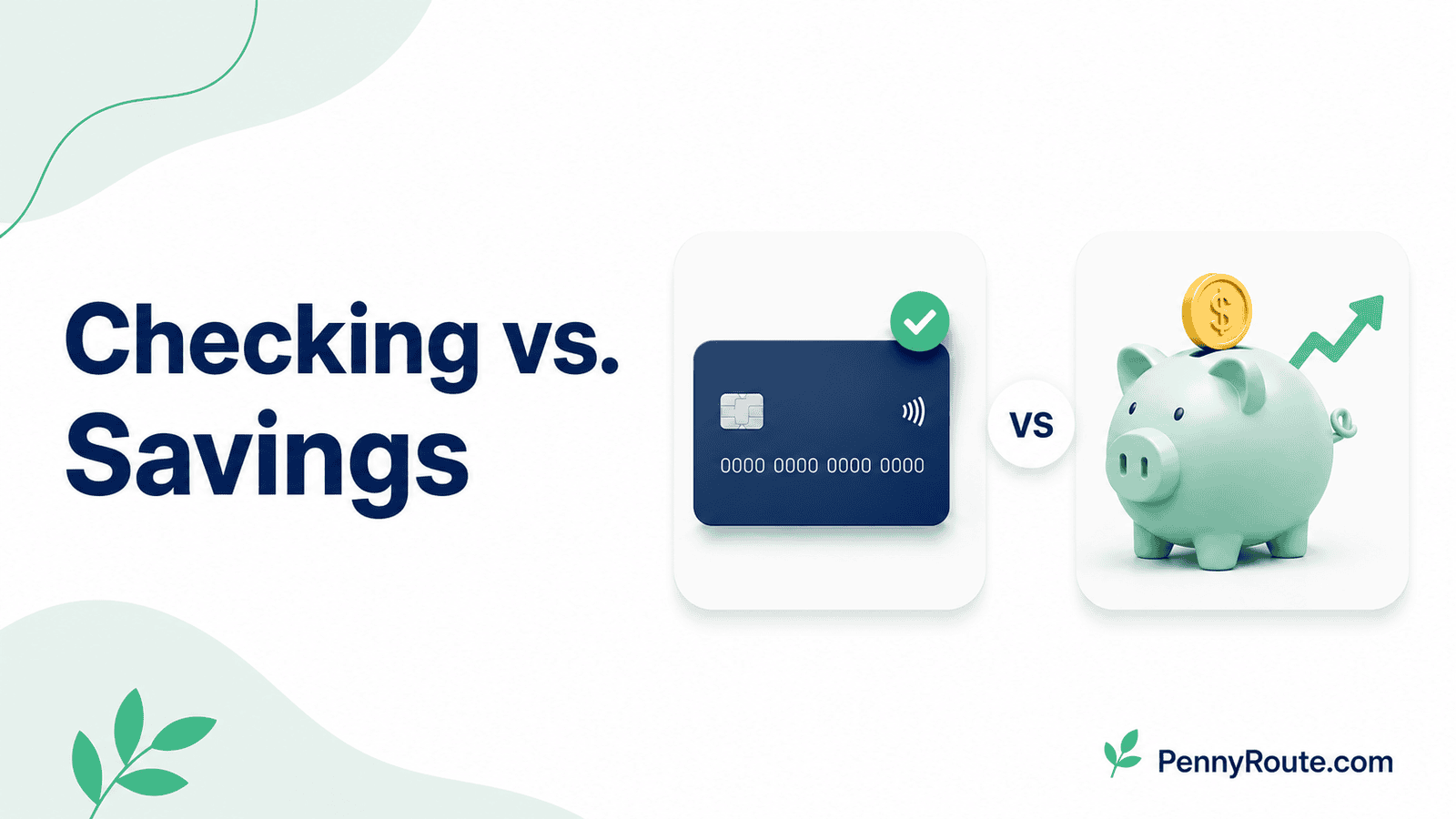
That’s the practical difference behind checking vs. savings accounts. Checking is designed for everyday payments and purchases, while savings is generally better for money you want to keep for later. The right balance depends on when you’ll need that money.
This content is for informational purposes only and does not constitute financial advice. Account features, fees, interest rates, withdrawal rules, and eligibility requirements vary by financial institution.
Checking vs. Savings Account
Both accounts hold your money, but they’re designed to be used differently.
| Feature | Checking account | Savings account |
|---|---|---|
| Main purpose | Everyday spending and payments | Money set aside for later |
| Access | Designed for frequent transactions | Usually used less frequently |
| Debit card access | Common for purchases and cash withdrawals | Purchase access is less common |
| Interest | May pay little or no interest | Often pays more interest |
| Withdrawal rules | Bank limits and account terms apply | May have institution-set transaction limits |
| Best for | Bills, purchases, transfers, cash | Emergency savings and planned goals |
The differences are useful starting points, but account features vary. Some checking accounts pay competitive interest, while some savings accounts offer limited payment features or charge fees for certain transactions.
Access and Payment Options
Checking accounts are designed for regular activity. Debit card purchases, bill payments, transfers, cash withdrawals, and direct deposits are common parts of everyday use.
Savings accounts are usually better for money that does not need to move as often. You can still transfer or withdraw funds, but the account is not typically designed to handle day-to-day spending in the same way.
You may have heard that savings accounts allow only six withdrawals or transfers per month. That used to be a federal restriction on certain types of transactions, but the Federal Reserve removed that limit in April 2020.
Individual banks and credit unions can still set their own transaction limits or charge fees for exceeding them.
So, before opening a savings account, check its current withdrawal and transfer rules rather than assuming every institution follows the same six-transaction limit.
Interest, Fees, and Minimum Balances
Savings accounts often pay more interest than checking accounts, but the rate alone should not decide where you keep your money.
When comparing interest-bearing accounts, look at APY.
APY stands for annual percentage yield. It accounts for compound interest, making it easier to compare how much different accounts could earn over a year.
Some checking accounts pay interest too. And a high-yield savings account may offer a higher APY than a traditional savings account, although rates vary between institutions.
A few things are worth checking:
- Whether the APY is variable and can change.
- Whether you need to maintain a minimum balance to earn the advertised rate.
- Whether monthly maintenance fees apply.
- Whether the account has withdrawal or transfer fees.
- Whether any special requirements apply to the interest rate.
Fees and balance requirements matter too. A higher APY can lose some of its value if the account charges fees you are likely to pay, while a lower-rate account may still work better if it has fewer costs or easier requirements.
Are Checking and Savings Accounts Federally Insured?
Both checking and savings accounts can qualify for federal deposit insurance when held at an insured institution.
At an FDIC-insured bank, the standard coverage limit is $250,000 per depositor, per insured bank, for each ownership category.
Important
Having both a checking account and a savings account at the same bank doesn’t automatically give you two separate $250,000 insurance limits.
If both accounts belong to you individually and fall under the same ownership category, their balances are combined when calculating your coverage.
Different ownership categories may qualify for separate coverage when their requirements are met.
Federally insured credit unions have similar protection through the National Credit Union Administration (NCUA). The standard share-insurance amount is also $250,000, with coverage depending on ownership arrangements.
The key is to confirm that the institution is federally insured and understand how your accounts are covered.
When to Use a Checking Account
A checking account is usually the better place for money you expect to use in the near term.
That can include:
- Rent or mortgage payments
- Utilities and other recurring bills
- Groceries and everyday purchases
- Debit card spending
- Cash withdrawals
- Transfers to other accounts
Keeping near-term spending money in checking makes it easier to handle regular payments without moving money back and forth unnecessarily.
The account itself still needs to fit how you bank. Fees, ATM access, overdraft policies, balance requirements, and digital tools are some of the main things to compare when you choose a checking account.
When to Use a Savings Account
A savings account is usually a better place for money you do not expect to spend right away.
That can include:
- Emergency savings
- Annual or irregular expenses
- Travel or holiday spending
- Insurance deductibles
- A future car purchase
- Other short-term savings goals
Keeping this money separate from everyday spending can make it easier to see what is actually available for current expenses.
If you prefer to separate goals instead of keeping everything in one balance, using multiple savings accounts can make those categories easier to track.
Should You Have Both Checking and Savings Accounts?
Having both accounts can make it easier to see what’s available for everyday spending and what’s reserved for later. But that convenience needs to be worth any additional fees, balance requirements, or effort involved.
For example, if you’re just starting out and regularly need most of your money for everyday expenses, maintaining a separate savings account with a monthly fee may offer little benefit.
On the other hand, if you have money you’re trying to keep available for future expenses, a separate savings account may help you avoid mixing it with regular spending.
If you can open only one account right now, checking is usually the more practical starting point when you need to receive income, make purchases, and pay regular bills. If those everyday needs are already covered and your priority is keeping money aside, a savings account may be the more useful choice.
You can also start with one account and add another when it serves a practical purpose.
How to Divide Money Between Checking and Savings
There is no single percentage that works for every household. The split depends on how much money needs to stay in checking before the next paycheck or transfer and what money you are intentionally setting aside.
Money That May Stay in Checking
Checking usually needs enough to cover:
- Upcoming bills
- Everyday spending
- Scheduled transfers
- Expected cash withdrawals
- A small cushion for timing differences or variable expenses
The point is not to keep the balance as low as possible. It is to leave enough available that normal payments do not depend on repeatedly moving money back from savings.
This matters especially when you have automatic payments scheduled. A payment may be processed before you have time to transfer money back into checking.
Money That May Move to Savings
Money reserved for emergencies, irregular bills, planned purchases, or other short-term goals may be better kept in savings when you won’t need it for upcoming payments.
Moving reserved money out of checking can also make the spending balance easier to read because money intended for later is no longer mixed with everyday cash flow.
Example
Suppose you have $2,500 available after payday.
You expect $1,700 in bills and everyday spending before the next paycheck and want an extra $200 cushion in checking.
That would leave:
$2,500 − $1,700 − $200 = $600
Calculation
The $600 could move to savings if it is not needed for another near-term expense.
That assumes the $1,700 covers all the payments and spending expected before your next reliable income arrives.
If you have an additional bill coming due or an expense you’re uncertain about, it may make sense to keep more in checking for now.
Review the Split When Your Expenses Change
The amount you keep in each account does not need to stay fixed. A higher utility bill, upcoming insurance payment, change in income, or new savings goal can all change how much needs to remain in checking.
Reviewing the split when those circumstances change is usually more useful than trying to maintain the same checking balance every month.
You can move money between checking and savings when necessary. Just consider how quickly it will become available, particularly if the accounts are held at different institutions.
Should Checking and Savings Be at the Same Bank?
They do not have to be.
Keeping both accounts at the same bank can make transfers and account management simpler. It may also be useful if the bank offers relationship benefits for holding multiple accounts.
Using different institutions can make sense when one offers a stronger checking account and another offers a better savings rate or fewer fees. Keeping savings elsewhere can also create a little more separation between everyday spending and money you are trying not to touch.
The tradeoff is convenience. Transfers between different institutions can take longer, and you may need to manage separate apps, login details, and account rules.
Consider How Quickly You’ll Need the Money
Suppose you have a bill due tomorrow, but the money is sitting in savings at another bank.
Even though you have enough money overall, the transfer might not arrive in your checking account before the payment is processed.
Some electronic transfers are completed quickly, while others can take multiple business days. The timing depends on the institutions involved, the transfer method, and when you initiate it.
Check Transfer Timing
Before relying on savings to cover an upcoming payment, check when the transferred funds will actually be available.
You can also look into low-balance alerts or linked-account overdraft protection if your bank offers them.
Some banks and credit unions allow you to link savings to checking so money can be transferred when checking doesn’t have enough to cover certain transactions. That service may have a transfer fee, and its rules vary.
It’s useful to understand those options, but they don’t replace keeping enough available for expected payments.
If you’re constantly moving money back from savings to cover ordinary bills, you may need to leave a little more in checking.
Keep enough available for the payments you know are coming, then set aside what you can realistically leave for later. That way, your savings can stay separate without making everyday banking more complicated.