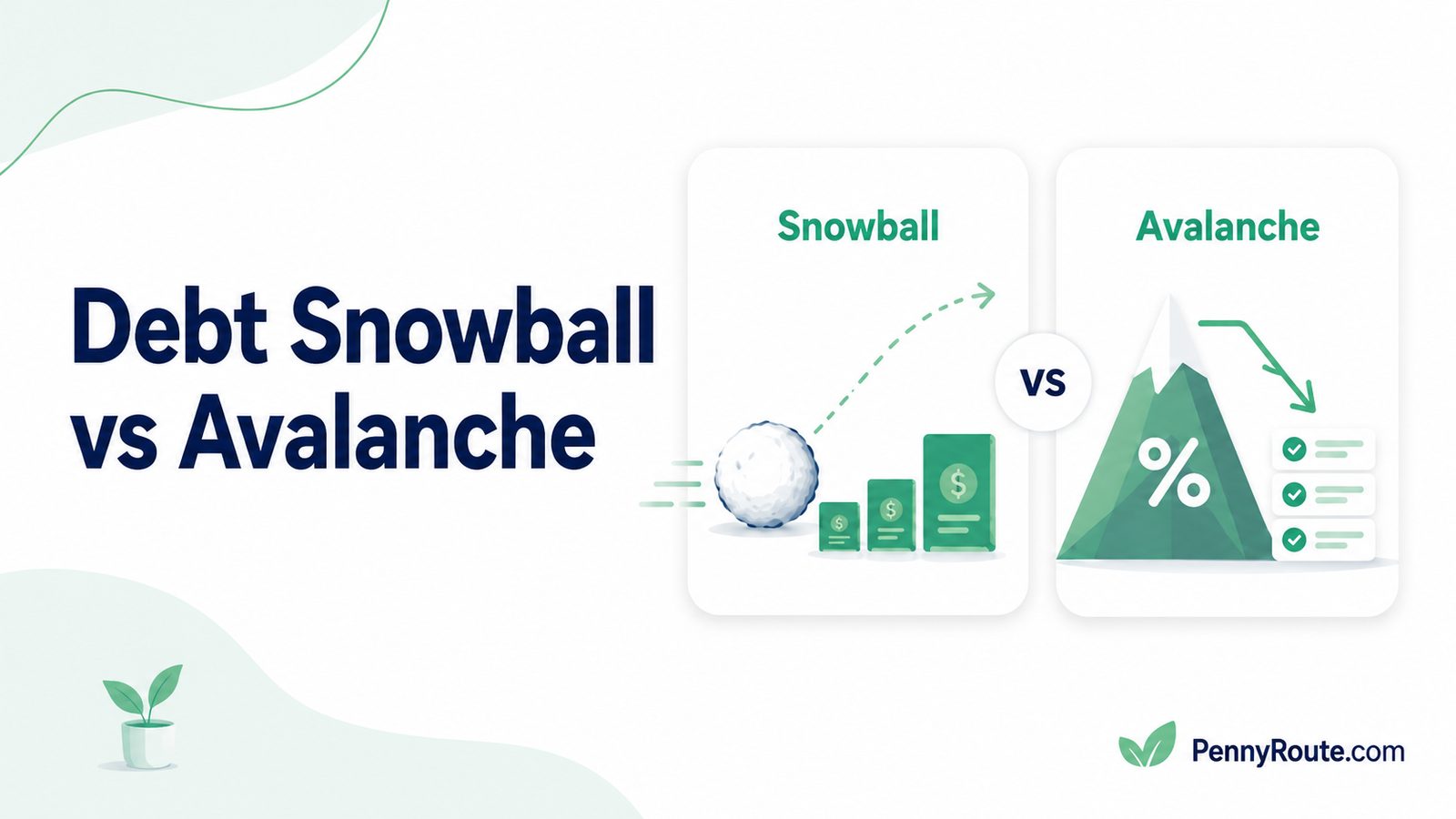
Debt snowball and debt avalanche use the same basic structure: keep making the required minimum payment on every debt, then direct all available extra money to one target at a time.
The difference is how that target is chosen. The snowball starts with your smallest balance, while the avalanche starts with your highest interest rate. One offers an earlier visible win. The other is designed to reduce interest costs.
The better choice depends on how much the methods differ in cost, how long the first payoff will take, and which kind of progress will help you stay consistent.
Disclaimer: This content is for general informational purposes and does not constitute financial advice. Debt costs, account terms, and repayment options vary, so review your agreements and financial situation before choosing a payoff strategy.
Debt Snowball vs. Debt Avalanche at a Glance
Both the highest-interest-rate and snowball approaches concentrate extra money on one target while required payments continue on the remaining debts.
| Feature | Debt snowball | Debt avalanche |
|---|---|---|
| First target | Smallest balance | Highest APR |
| Main advantage | Earlier visible payoff | Lower interest cost |
| Main tradeoff | May cost more overall | First payoff may take longer |
| Order changes when | A balance is cleared | A balance is cleared or an APR changes |
| Often suits you when | Quick milestones support consistency | Interest savings support consistency |
When using the debt snowball method, you will also need rules for tied balances, new accounts, and rolling each cleared payment into the next target. The debt avalanche method requires accurate APRs and extra attention to promotional or changing rates.
One Debt List, Two Different Payoff Orders
Consider four debts with a combined balance of $13,000.
| Debt | Starting balance | APR | Starting minimum |
|---|---|---|---|
| Medical payment plan | $700 | 0% | $50 |
| Store card | $1,600 | 18% | $55 |
| Credit card | $4,200 | 27% | $130 |
| Personal loan | $6,500 | 11% | $180 |
The combined starting minimum payments total $415. Suppose you can put $700 per month toward these debts, leaving $285 in the first month for the target account.
For this illustration:
- interest is estimated monthly using APR divided by 12;
- minimum payments remain fixed until an account is cleared;
- freed payments move to the next target;
- no new debt or fees are added;
- and any unused payment moves to the next debt in the same month.
Real accounts may use daily interest, changing minimum-payment formulas, fees, or different payment-allocation rules. The figures below are estimates rather than payoff quotes.
Snowball payoff order
The debt snowball orders the balances from smallest to largest:
- Medical payment plan
- Store card
- Credit card
- Personal loan
The $700 medical balance receives its $50 minimum plus the initial $285 extra payment. It is cleared during month three.
Once that payment is gone, the full amount rolls to the store card. The store card is paid off in month seven, leaving two active debts.
The early account closures are the snowball’s main advantage. The total debt has not disappeared, but the number of separate payments falls quickly.
Avalanche payoff order
The debt avalanche ranks the same accounts by APR:
- Credit card at 27%
- Store card at 18%
- Personal loan at 11%
- Medical payment plan at 0%
The extra $285 initially goes to the credit card because it is producing the most interest. That card is cleared in month 12.
The medical payment plan continues receiving its regular $50 payment during that time. It reaches zero in month 14 even though it was last in the avalanche target order.
That distinction matters: target order and actual payoff order are not always identical. Minimum payments continue reducing non-target debts, so a small or interest-free balance may disappear before it receives the extra payment.
How Much Difference Does the Method Make?
Using the assumptions above, both methods finish in about 22 months. The main differences are the timing of the first payoff and the estimated interest cost.
| Result | Debt snowball | Debt avalanche |
|---|---|---|
| First account paid off | Month 3 | Month 12 |
| Accounts remaining after 6 months | 3 | 4 |
| Accounts remaining after 12 months | 2 | 3 |
| Estimated total payoff time | 22 months | 22 months |
| Estimated total interest | $2,039.70 | $1,813.98 |
In this example, the avalanche saves approximately $225.72 in interest.
The snowball does not extend the estimated final payoff month, but it provides a much earlier account closure. By month seven, two debts are gone. Under the avalanche, the first account remains open until month 12.
That is the real tradeoff here:
- Pay roughly $226 more for earlier visible progress.
- Or keep all four accounts active longer to reduce interest.
A different debt list could produce a much larger or smaller gap. When the smallest debt also has a high APR, the methods may give similar results. When a low-rate small balance sits beside a large high-rate credit card, the cost of choosing snowball can be more substantial.
Which Method Is Actually Faster?
“Faster” can mean three different things in a debt payoff plan.
Faster first account payoff
The snowball often wins this comparison because every extra dollar goes to the smallest balance.
In the example, the first snowball account is gone in month three. The avalanche does not produce its first closure until month 12.
That earlier result can matter when several monthly payments are difficult to track or when a long payoff plan has been hard to maintain in the past.
Faster total debt payoff
Under identical payment assumptions, the avalanche generally finishes at the same time or sooner because less of the monthly payment is absorbed by interest.
In this example, both methods finish in the same estimated month. The avalanche still costs less.
With a larger APR gap or a longer payoff period, reducing interest sooner could also shorten the final timeline.
Faster in real life
A spreadsheet assumes every payment happens exactly as planned. Real life is less tidy.
Someone who stops making extra payments after six months will not receive the projected avalanche savings. Someone who chooses snowball but stays consistent through the final account may finish earlier than they would with an abandoned avalanche plan.
This does not make the math unimportant. It means the most efficient method on paper still requires a payment routine you can maintain.
When the Debt Snowball Makes More Sense
The debt snowball is more defensible when clearing a small account soon would create a meaningful practical benefit.
It may fit better when:
- one or two balances can disappear within a few months;
- the APR differences are modest;
- managing several due dates is creating confusion;
- you have abandoned long payoff plans before;
- or eliminating a minimum payment would quickly simplify your monthly cash flow.
Suppose your smallest balance is $350 and your highest-rate debt is $9,000. Clearing the $350 account may give you a useful early result without creating a large interest penalty, especially when the other APRs are fairly close.
Snowball becomes harder to justify when a low-rate small balance delays attention to expensive credit card debt for a long time. In that situation, calculate the cost difference before treating motivation as the only factor.
When the Debt Avalanche Makes More Sense
The avalanche is usually stronger when interest rates vary widely and the expensive balances are large.
It may fit better when:
- a high-APR card is generating substantial monthly interest;
- the smallest balances have low or 0% rates;
- you are comfortable waiting longer for the first account closure;
- reducing borrowing cost is motivating on its own;
- or the estimated snowball premium is large enough to affect other goals.
The method also requires accurate rate information. A variable APR, expiring promotion, or deferred-interest deadline can change which account is truly the most expensive.
Do not rank a promotional balance by the headline rate alone. Look at the current APR, expiration date, and what happens if the balance remains after the offer ends.
When Both Methods Give Nearly the Same Answer
Not every debt list creates a meaningful snowball-versus-avalanche decision.
The methods may produce the same or a very similar order when:
- the smallest debt also has the highest APR;
- interest rates are close;
- balances are similar;
- only two accounts remain;
- or the estimated difference is small compared with the total payoff budget.
For example, if one card has a $900 balance at 22% and another has a $3,000 balance at 20%, both methods start with the $900 card.
There is little value in debating the strategy when both point to the same target. Choose the clear order and begin directing the extra payment.
A Hybrid Method Can Work, but Keep the Rule Clear
A hybrid approach can provide one quick payoff before moving to the lower-cost method.
A simple version looks like this:
- Choose one genuinely small balance that can be cleared quickly.
- Pay it off while maintaining all other minimum payments.
- Switch to the highest-interest-rate debt.
- Continue with avalanche until the remaining balances are gone.
The value comes from making one intentional switch. It creates an early milestone without allowing low-rate balances to delay expensive debt indefinitely.
A hybrid loses its structure when the target changes every month. Splitting extra money among several accounts or following whichever balance is most frustrating at the time usually slows visible progress and makes results harder to track.
When Neither Snowball nor Avalanche Should Come First
Snowball and avalanche are payoff-order strategies. They do not solve a situation where there is no reliable money available beyond minimum payments.
Pause the method decision when:
- required minimums no longer fit the budget;
- rent, utilities, food, insurance, or transportation are at risk;
- a secured debt is past due;
- an account has an urgent legal or collection deadline;
- or a promotional balance has a deadline that would trigger a major cost.
In those situations, deciding which debt to pay off first begins with urgency and consequences rather than balance size or APR.
If the budget currently supports only the required amounts, focus on what to do when you can only make minimum payments before committing to an accelerated strategy.
Both methods assume you keep making the required payment on every non-target debt. Missing those payments to send more money to one account can lead to late fees, credit damage, and other consequences.
How to Choose Your First Target
You do not need to choose based on a personality label. Compare what the methods would actually do with your accounts.
Ask four questions:
- How much interest does the avalanche save?
A small difference may make an early snowball payoff more attractive. A large difference deserves more weight. - How long will the first target take under each method?
Waiting 14 months for an avalanche payoff is different from waiting four. - What has helped you stay consistent before?
Use your past behavior rather than guessing which method sounds more disciplined. - Is any account urgent enough to override both?
Past-due secured debt, legal risk, and important promotional deadlines require separate attention.
Once you have those answers, choose one target and direct the full extra payment there. The comparison does not need to produce a perfect strategy. It needs to give you an order you understand and can follow consistently.
Choose One Order and Give It Time to Work
The method affects the result, but repeatedly switching targets can weaken either strategy. A clear target allows every extra payment to work in the same direction.
List your current balances, APRs, and minimum payments. Compare the expected interest cost and time to the first payoff, then choose an order you can maintain. Once the target is set, keep sending the available extra money there until the account is cleared or a genuine change in urgency or account terms gives you a reason to reconsider.