A budget can look perfectly reasonable at the start of the month and still fall apart in a few categories. Groceries run high, takeout creeps up, or personal spending quietly uses money that was meant to last another week.
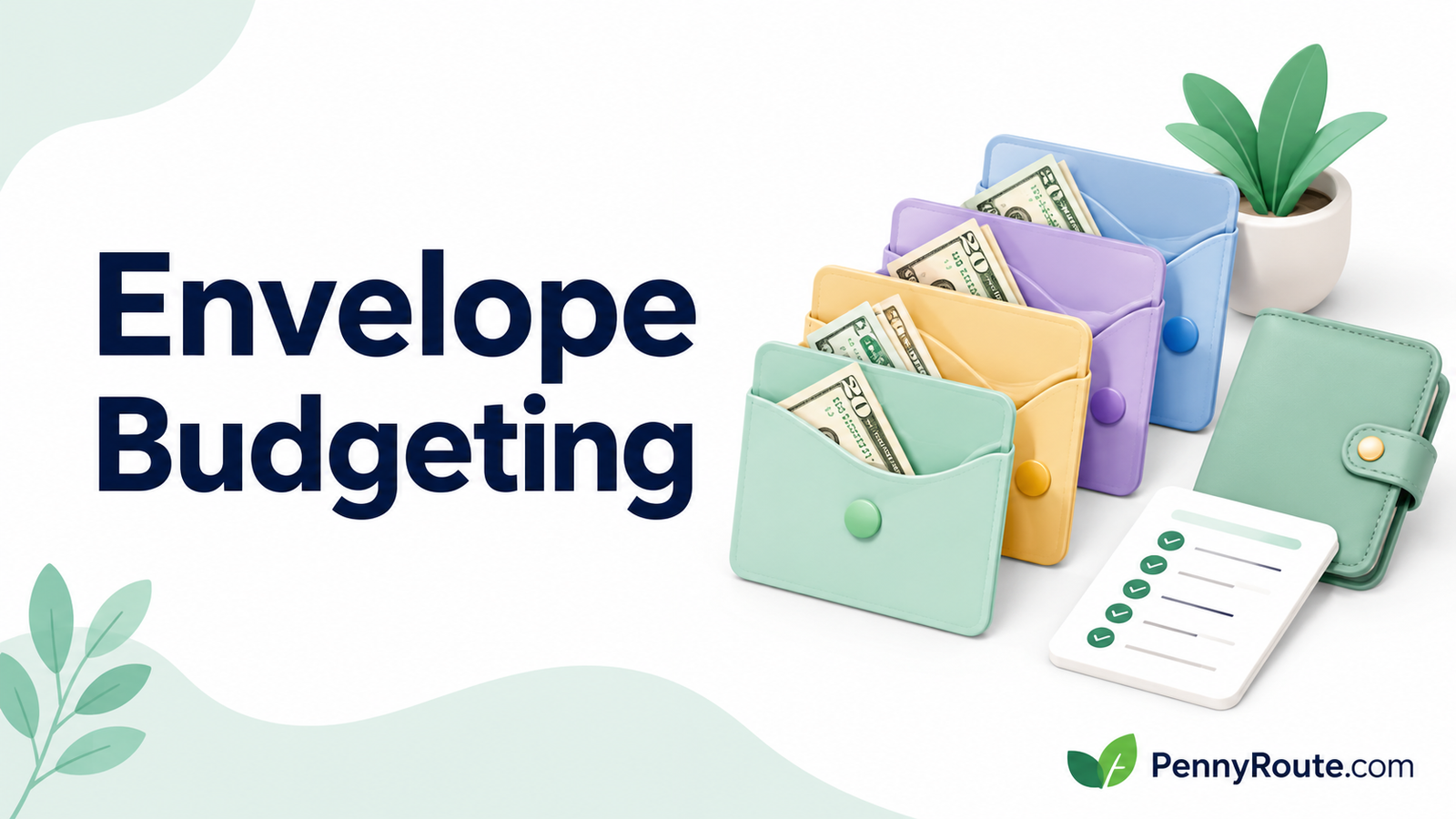
The envelope budgeting method puts a clear spending limit around those problem areas. You decide how much a category gets, keep that amount separate in cash or digitally, and use the remaining balance to guide your choices as the month goes on.
You don’t have to put your entire budget into envelopes. For many people, the method works best when it is used only for the categories where spending tends to drift.
Disclaimer: This content is for informational purposes only and does not constitute financial advice. Choose a budgeting approach that fits your financial situation, and consult a qualified professional when needed.
Quick Overview
- Each envelope gives one spending category a set amount of money.
- Cash, digital, and hybrid versions can all work.
- Flexible categories such as groceries, dining, and personal spending usually benefit most.
- Envelope limits should come from realistic spending needs, not an arbitrary target.
- When an envelope runs out, the next step depends on whether the expense is optional, necessary, or repeatedly underestimated.
What Is the Envelope Budgeting Method?
Envelope budgeting is one of several budgeting methods, but its main focus is controlling spending in specific categories. Instead of shaping the entire budget, envelopes create clear limits around the areas where spending tends to vary.
Traditionally, that meant putting cash into physical envelopes labeled “Groceries,” “Dining Out,” or “Entertainment.” Once the cash was gone, spending in that category stopped until the envelope was refilled.
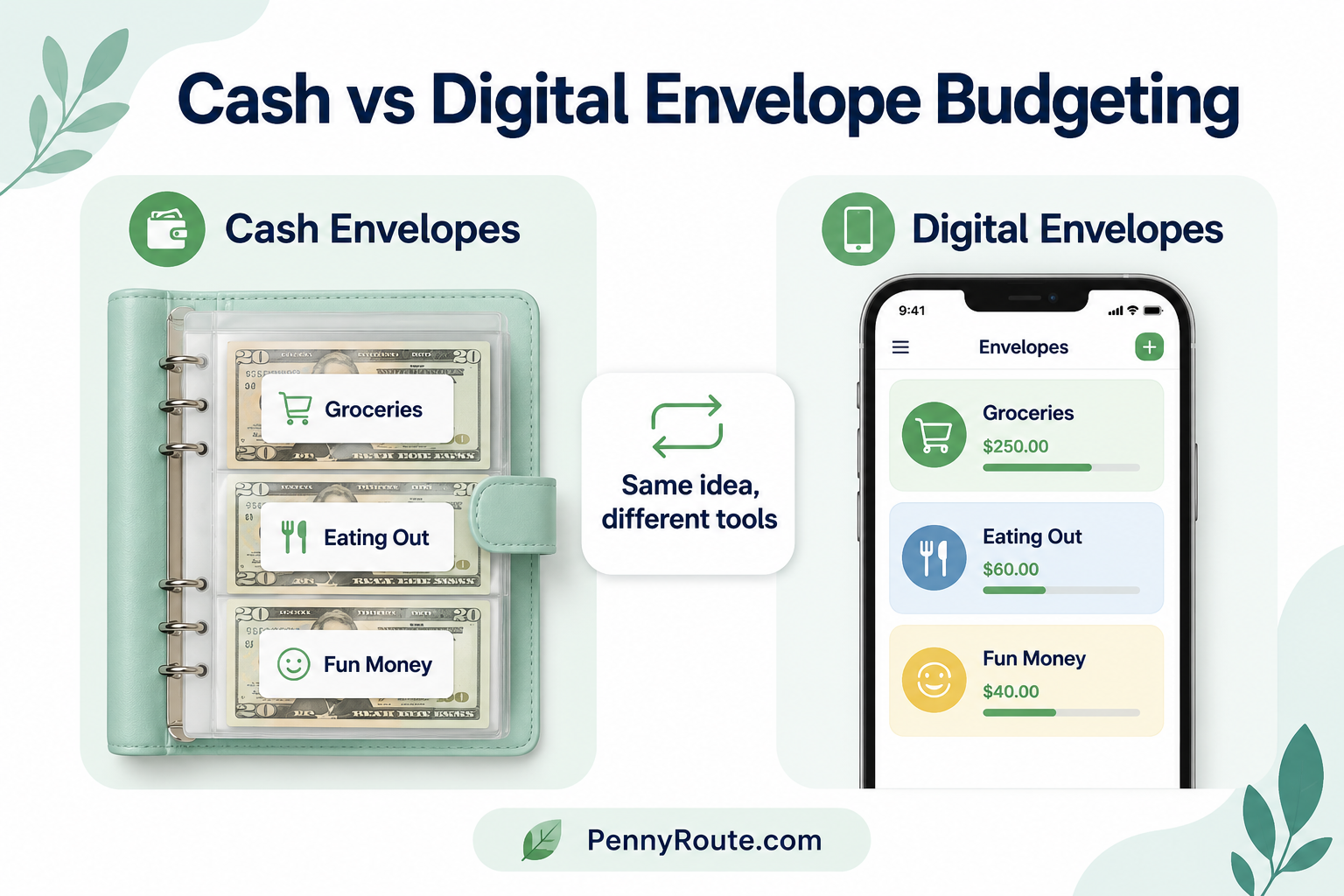
The same idea works digitally. Instead of physical cash, you might use an app category, a budgeting feature inside your bank account, or another system that keeps each spending amount visible.
The important part isn’t the envelope itself. It is the boundary.
If you give groceries $450 for the month, the remaining grocery balance tells you how much of that $450 is still available. That is different from looking at your checking account and trying to remember how much of the total balance belongs to groceries, bills, transportation, and everything else.
Envelope budgeting is often associated with cash stuffing, but cash stuffing is simply the physical-cash version of the broader method.
Cash Envelopes, Digital Envelopes, or a Hybrid?
The best format depends on how you actually spend money.
| Approach | How It Works | Best Fit |
|---|---|---|
| Cash envelopes | Put cash into physical envelopes for specific spending categories | You want a clear physical limit and mostly spend in person |
| Digital envelopes | Track category balances in an app, bank feature, or budgeting tool | You mostly pay by card or shop online |
| Hybrid | Use cash for selected categories and digital tracking for the rest | Only a few spending categories need firmer limits |
Cash creates the clearest stopping point. If the dining envelope is empty, there is no balance left to spend without deliberately changing the plan.
Digital envelopes are easier when most purchases happen by card or online. The tradeoff is that the category balance has to stay up to date. A digital envelope showing $200 isn’t useful if $75 of recent card purchases haven’t been counted yet.
A hybrid setup can be more practical than forcing every expense into the same format. You might use cash for dining and personal spending while keeping groceries digital because you regularly order them online.
Separate bank accounts can also create broader spending boundaries, but that is a different level of organization. A multiple-bank-account budget is better suited to separating larger purposes such as bills, everyday spending, and savings rather than creating an account for every envelope category.
Which Expenses Should Use Envelopes?
Envelopes are most useful where your spending choices can change the final amount.
Good candidates often include:
- groceries;
- dining out;
- transportation;
- entertainment;
- personal spending.
These categories don’t necessarily need to be optional. Groceries and transportation are essential for most households. What matters is that the amount can move from month to month and that your choices influence how quickly the money is used.
Fixed expenses are different.
Rent, a fixed loan payment, or a subscription with a predictable monthly charge usually doesn’t need the same kind of spending boundary. If $1,200 is due for rent, there isn’t much value in repeatedly checking how much of the “rent envelope” remains.
The envelope method becomes more useful when the balance helps you make a real decision.
You also don’t need an envelope for every flexible category. Start with the areas where spending regularly gets away from the plan. If groceries and dining are the only trouble spots, two envelopes may be enough.
That keeps the method focused on the problem instead of turning the whole budget into a tracking project.
How to Start Envelope Budgeting
Before assigning envelope amounts, make sure your fixed obligations and broader budget still fit within your income. The envelope system controls selected spending categories. It does not decide whether the full monthly budget is affordable.
If you are still working out income, bills, savings, and regular expenses, a beginner budget should come first.
Once those numbers are in place, the envelope setup is fairly simple:
- Choose the flexible categories where stronger limits would help.
- Look at what you have actually been spending in those categories.
- Set an amount that is realistic within the rest of your budget.
- Put or record that amount in each envelope after income arrives.
- Reduce the envelope balance as you spend.
- Review the result before setting the next month’s amounts.
The most important step is number three.
Before lowering a category, it helps to look at your recent spending patterns rather than choosing a number based only on what you wish you were spending. A few weeks or a month of transactions can show whether a higher month was unusual or whether it reflects your normal costs.
Suppose you spent $620 on groceries last month. Setting the next envelope at $350 simply because you want to spend less may look disciplined on paper, but it could leave you short before the month ends.
A better question is why the $620 happened.
Perhaps $500 reflects normal groceries and $120 came from a one-time stock-up. Or $620 may simply be your household’s normal cost at current prices.
A realistic envelope starts with what the category actually requires, then looks for changes you can reasonably make.
Example: Setting and Using Envelope Limits
Example
Suppose you decide to use envelopes for three categories: $500 for groceries, $140 for dining out, and $100 for personal spending.
Halfway through the month, groceries have $270 left, dining has $30 left, and personal spending has $65 left.
The grocery balance is roughly on track. Dining is running low, so another restaurant meal now means either spending less later or deliberately moving money from another category.
That is where the method becomes useful.
The envelope doesn’t merely tell you what you spent. It gives you information before the money is gone.
If dining has $30 left and you were planning a $60 meal, you now have a decision to make while there is still time to change it.
What to Do When an Envelope Runs Out
An empty envelope isn’t automatically a failure.
What matters is why the money ran out and what the expense is.
If the expense is optional
Stopping or delaying the purchase is the cleanest response.
If the dining envelope is empty, waiting until it is funded again keeps the limit meaningful. Reaching for another payment method without adjusting the budget simply bypasses the boundary.
The same principle applies to digital envelopes. Paying with a credit card doesn’t create new money for the category.
If the expense is necessary
Some costs can’t simply wait.
If the grocery envelope is empty and you still need food for the week, moving money from another category may be reasonable. The important part is making the tradeoff visible.
Taking $40 from entertainment means entertainment now has $40 less. You haven’t increased the budget. You have changed where the existing money is going.
That is a much more useful response than treating the transfer as though nothing changed.
If the same envelope keeps running out
Repeated shortfalls usually mean the limit deserves another look.
Maybe the amount was too aggressive from the beginning. Maybe prices changed. Maybe the category includes expenses you didn’t realize were there.
Review the actual spending before simply adding more money.
A grocery envelope that has run short for four months probably needs a different number or a different plan. Repeatedly “rescuing” it from another envelope makes the budget harder to understand and can leave those other categories permanently underfunded.
Card Spending Needs to Reduce the Envelope Too
Cash envelopes update themselves. You hand over $40 and there is $40 less cash in the envelope.
Digital spending requires more attention.
Suppose your dining envelope has $120 left and you charge a $55 meal to a credit card. The category should now be treated as having $65 left, even though the credit-card payment won’t leave your bank account until later.
If you wait until the card bill is paid to update the envelope, the displayed balance can overstate what is still available.
The same problem occurs with pending debit-card transactions and online purchases that have not fully posted.
A digital envelope only works when it reflects spending close to the time the spending happens.
That doesn’t mean you need to update a spreadsheet after every cup of coffee. An app or banking tool may handle the tracking automatically. But the category balance needs to stay close enough to reality that you trust it when making the next purchase.
Is Envelope Budgeting a Good Fit for You?
Envelope budgeting tends to work best when the problem is concentrated in a few spending categories.
It may be worth trying when you regularly reach the end of the month wondering where grocery, dining, entertainment, or personal-spending money went. Seeing a category balance before you spend can make the tradeoff clearer.
It also suits people who prefer firm boundaries over detailed after-the-fact analysis. You don’t need to study every transaction to know that a $25 dining balance cannot support a $70 restaurant bill.
The method adds less value when you already stay within flexible spending comfortably, dislike category-level tracking, or want most of your financial routine automated.
It can also become frustrating when too many envelopes are created. Tracking twelve or fifteen small balances may require more attention than the spending problem deserves.
Using envelopes only for the categories that need them is often enough.
Envelope Budgeting vs. Zero-Based Budgeting
Envelope budgeting and zero-based budgeting are related, but they solve different parts of the budgeting process.
| Envelope Budgeting | Zero-Based Budgeting |
| Creates spending limits for selected categories | Assigns a purpose to all available income |
| Often focuses on flexible expenses | Covers the full budget |
| Uses category balances as spending boundaries | Plans income until nothing is left unassigned |
| Can be used on its own or inside another budget | Acts as the overall budgeting framework |
With zero-based budgeting, every dollar of available income receives a job. Envelope budgeting can then sit inside that plan to create firmer boundaries for categories such as groceries, dining, or personal spending.
So the two methods do not have to compete.
Zero-based budgeting can provide the full plan, while envelopes add a guardrail where day-to-day spending needs more control.
Keep the Envelopes That Actually Help
Envelope budgeting does not need to take over your entire financial routine.
If two or three categories are where spending regularly gets off track, start there. Give those categories realistic limits, keep the balances current, and pay attention to what happens when the money runs low.
The useful part isn’t having a neat set of envelopes. It is knowing, before you spend, what that purchase means for the rest of the money available.