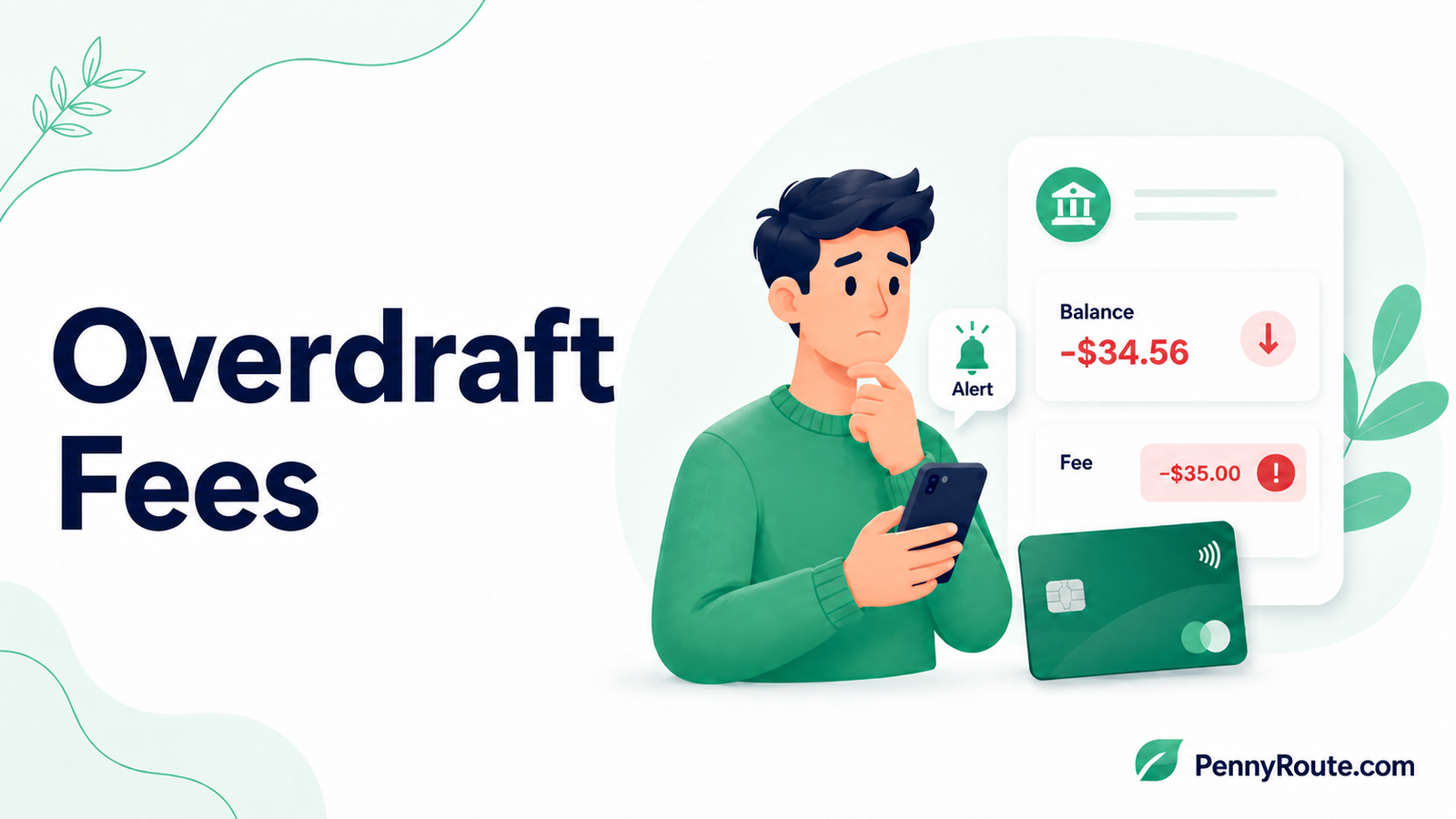
Banks charge overdraft fees when they approve a transaction that your available balance cannot fully cover.
The bank is effectively covering the shortfall so the payment goes through, but the result depends on the transaction and the account’s rules. Another payment could be declined, returned unpaid, covered from linked savings, or handled through a line of credit instead.
Understanding what the bank did with the transaction is the first step toward knowing whether the charge was expected, avoidable, or worth questioning.
Disclaimer: This content is for informational purposes only and does not constitute financial or legal advice. Overdraft programs, transaction processing, fees, grace periods, and account terms vary by financial institution.
What Is an Overdraft Fee?
An overdraft fee is a charge a bank can apply when it pays a transaction even though your account does not have enough available money to cover it.
For example, if your available balance is $40 and a $65 payment goes through, the bank covers the $25 shortfall. Your account becomes negative, and the bank could charge an overdraft fee under the account terms.
The fee is separate from the amount you overspent. You still need to repay the negative balance, along with any charge the bank adds.
Not every insufficient-balance transaction creates an overdraft fee. The bank could decline the payment, return it unpaid, transfer money from a linked account, or cover it without a fee, depending on the transaction and the account’s rules.
Why Banks Charge Overdraft Fees
Banks charge overdraft fees when they choose to complete a payment that your available balance cannot cover.
By paying the transaction, the bank temporarily covers the shortage and allows the account to fall below zero. The account agreement determines whether that decision creates a fee.
The charge does not usually increase or decrease with the exact shortage. An account that is short by $10 could face the same fee as one that is short by $100.
That is one reason the cost can seem disproportionate to the amount involved.
Not every bank follows the same approach. Some charge for each transaction they cover, while others offer a grace period, allow a small negative balance, move money from a linked account, or do not charge an overdraft fee.
The important point is that falling below zero does not create the same result at every bank. The outcome depends on how the institution handles the transaction and what the account terms allow.
What Happens When a Transaction Exceeds Your Available Balance?
When a payment reaches your account without enough available money to cover it, the bank has several possible responses. The result depends on the transaction type, your account settings, and the bank’s policy.
The Bank Pays the Transaction
The bank can approve the payment and let the account fall below zero. This is standard overdraft coverage.
You receive the benefit of having the payment completed, but you must repay the shortage. The bank could also add an overdraft fee.
The Bank Declines or Returns It
A debit-card purchase or ATM withdrawal can be declined before it is completed.
Checks, automatic payments, and other electronic transfers can be returned unpaid instead. In that case, the original bill is still due, and the merchant or service provider could add its own returned-payment charge.
Backup Funds Cover the Shortfall
If overdraft protection is linked to savings, another deposit account, or a line of credit, the bank can use that source to cover the missing amount.
This can cost less than standard overdraft coverage, but it is not always free. A transfer fee, interest charge, or other cost could apply, depending on the backup source.
The same account shortage can therefore lead to a completed payment, a declined transaction, a returned item, or a transfer from another source. The bank’s response determines which cost, if any, follows.
Why Your Available Balance Matters
The balance shown at the top of your banking app is not always the amount you can spend.
Your available balance is the amount the bank currently treats as usable. It can be lower than your current or posted balance because some transactions are still pending or part of a deposit is being held.
Pending Transactions and Deposit Holds
A card purchase can reduce your available balance before it fully posts to the account. The same can happen when the bank places a hold on part of a recent deposit.
For example, your account might show a current balance of $140 while $60 in card purchases remains pending. That leaves an available balance of $80. If a $100 automatic payment arrives, the account is short by $20 even though the larger balance still appears on the screen.
Scheduled bills and checks can create a different timing problem. They might not appear as pending, but the money still needs to remain available until they reach the account.
Authorization and Final Settlement
A debit-card purchase is often authorized first and settled later.
The bank checks your available balance when the purchase is authorized. Before the final amount posts, other transactions can reduce the balance. The final charge can also change when a tip is added or a temporary hold is replaced with the actual purchase amount.
This timing can explain why a fee appears after a transaction initially seemed affordable. It does not automatically mean the charge was correct, especially when the purchase was approved with enough available money.
The FDIC has addressed situations where a transaction is approved with a positive balance but later settles against a negative one. Review the posting sequence and contact the bank when the numbers do not match what you expected.
Which Transactions Require Overdraft Opt-In?
Overdraft opt-in rules do not apply to every type of payment in the same way. The key difference is whether the transaction is an ATM withdrawal, a one-time debit-card purchase, or another payment such as a check or recurring bill.
ATM Withdrawals and One-Time Debit Purchases
A bank generally cannot charge an overdraft fee for paying an ATM withdrawal or one-time debit-card purchase unless you previously agreed to overdraft coverage for those transactions.
Opting in gives the bank permission to consider approving the payment when your available balance is too low. It does not require the bank to pay it. The transaction can still be declined based on the bank’s policy and the condition of the account.
When you have not opted in, the bank generally cannot charge an overdraft fee for paying an ATM withdrawal or one-time debit-card purchase. The transaction is often declined when the available balance is too low.
You can review or change your overdraft choice by contacting the bank. The CFPB’s overdraft guidance explains how this choice applies to ATM and one-time debit-card transactions.
Checks and Recurring Payments
The same opt-in protection does not cover checks, ACH payments, automatic bill payments, or recurring debit-card charges.
A bank can pay one of these transactions and charge an overdraft fee under the account terms even when you never opted into overdraft coverage for everyday debit purchases or ATM withdrawals.
For example, opting out could cause a $40 store purchase to be declined while a recurring $40 insurance payment is processed and creates an overdraft. The transactions look similar in amount, but they are handled under different rules.
This distinction is why opting out can reduce certain overdraft fees without preventing every payment from taking the account below zero.
Overdraft Coverage vs. Overdraft Protection
The terms sound similar, but they describe different ways a bank can handle a shortage.
Standard Overdraft Coverage
With standard overdraft coverage, the bank pays the transaction and lets the checking account fall below zero.
You must repay the amount the bank covered, and an overdraft fee could be added under the account terms. The bank is not promising to approve every transaction, even if you have chosen this option.
Linked-Account Protection
Linked-account protection moves money from another account, usually savings, when checking does not have enough available funds.
This can be less expensive than a standard overdraft fee, but it still depends on the bank’s rules. A transfer charge could apply, and the backup account must have enough available money to cover the shortage.
Using savings as a backup also means that money is no longer available for the purpose you originally set it aside for.
Overdraft Line of Credit
An overdraft line of credit uses borrowed money to cover the shortfall.
Instead of allowing the checking account to remain negative, the bank draws from an approved credit limit. You then repay what was borrowed, along with any interest or fees that apply.
Approval usually depends on a credit review, and the line can still have limits or transaction rules.
The key difference is where the missing money comes from. Standard coverage leaves the checking account negative, linked protection uses your own funds, and a line of credit uses borrowed money.
Why Banks Sometimes Decline an Overdraft
Having overdraft coverage does not guarantee that every transaction will be approved.
A bank could still decline a payment based on factors such as:
- The size of the shortage
- The type of transaction
- The account’s overdraft history
- How long the account has been negative
- Internal risk or transaction limits
- Account restrictions or unusual activity
That means a payment the bank covered last month could be declined today, even when the amount is similar.
Overdraft coverage is not the same as a fixed credit limit. It allows the bank to consider paying certain transactions, but the final decision still depends on the account and the bank’s policy.
This matters most when the payment is essential. Relying on overdraft coverage for rent, insurance, or another important bill can still result in a declined or returned payment.
Why More Than One Overdraft Fee Can Appear
Several transactions can reach the account after the available balance has already run short.
If the bank pays each one, it could charge a separate overdraft fee for every covered transaction. That means one balance problem can produce several charges on the same day.
For example, suppose three automatic payments arrive after the account is already short. If the bank charges per paid item, each payment could create its own fee even though the shortage began only once.
Banks often set their own limits on how many overdraft fees they charge in a day. Some also provide a grace period, allow a small negative balance, or waive the fee when the account is restored quickly.
The account disclosure should explain whether the bank charges per transaction, uses a daily limit, or offers any threshold or grace period. Reviewing those details helps you understand whether the total matches the bank’s stated policy.
What Happens After the Account Goes Negative?
Once the account falls below zero, the shortage does not disappear when the transaction is completed.
Future deposits are usually applied to the negative balance first. If the account is overdrawn by $75 and you deposit $200, only $125 is left after the shortage is covered. Any overdraft fee already added would reduce that amount further.
While the account remains negative, the bank could:
- Decline or return new transactions
- Restrict debit-card or ATM access
- Charge additional fees allowed under the account terms
- Ask you to bring the balance back above zero
- Close the account if the shortage remains unpaid
A closed account does not erase the amount owed. The unpaid balance could eventually be sent to collections or reported to a bank-account screening service, which could make opening another account more difficult.
Contact the bank promptly if you cannot restore the balance right away. Ask what amount is due, whether more charges can still appear, and whether the bank offers any repayment or short-term account-restoration option.
When an Overdraft Fee Is Worth Questioning
Some overdraft fees deserve a closer look, especially when the charge does not match what you expected from the account’s rules.
Check the fee more carefully when:
- It came from an ATM withdrawal or one-time debit-card purchase and you did not opt into overdraft coverage
- A grace period or small-negative-balance threshold should have applied
- The bank charged more times than the daily limit in the account disclosure
- The same transaction appears to have created more than one fee
- A debit purchase was approved with enough available money but caused a fee when it settled later
- The charge does not match the bank’s published terms
Review the transaction timeline before contacting the bank. Look at deposits, pending activity, holds, and the order in which payments posted.
Ask the bank to explain exactly what triggered the fee and how the charge fits the account terms. If the explanation does not match the disclosure, request a reversal.
A refund is not guaranteed. Still, an incorrect charge or an unusual first-time fee is worth raising promptly.
If the bank does not resolve a clear problem, you can follow its complaint process or submit a complaint to the Consumer Financial Protection Bureau.
How to Reduce the Chance of Another Overdraft
You do not need a complicated system to reduce overdraft risk. The most useful steps are the ones that help you see a shortage before a payment reaches the account.
Start with:
- Setting a low-balance alert above zero
- Checking when deposits will actually become available
- Reviewing automatic payments before they post
- Confirming which transactions your overdraft choice covers
- Comparing the cost of linked protection with a standard overdraft fee
- Keeping a small checking cushion when your budget allows it
These steps will not prevent every timing problem, but they can make surprise charges less likely.
The broader options for preventing repeat charges are covered in how to avoid bank fees.
When Overdraft Coverage Can Still Be Useful
Overdraft coverage can provide a backup when an occasional shortage would otherwise cause an important payment to be returned.
For example, completing a rent, insurance, or utility payment could matter more than avoiding the fee if a returned payment would create a larger charge or another serious problem.
That does not mean every transaction will be approved. The bank still decides whether to cover the payment, and you remain responsible for the negative balance and any fee.
Coverage becomes less useful when overdrafts happen regularly or the account offers no grace period or lower-cost backup. At that point, the repeated shortage or the account’s terms need attention rather than continued reliance on overdraft coverage.
Overdraft coverage is best treated as limited protection for an unusual timing problem, not as money available to spend.