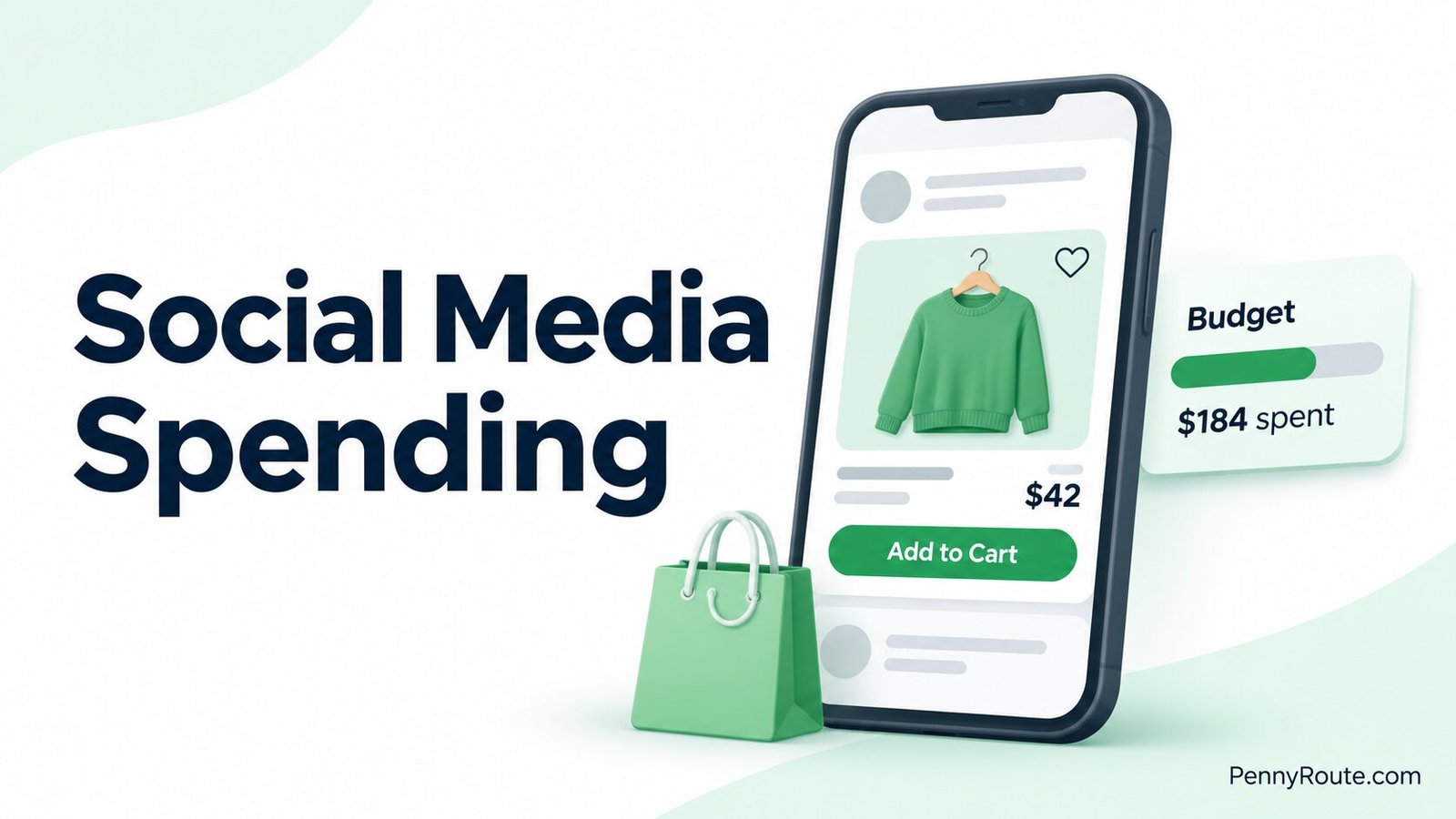
A $32 home item from Instagram probably won’t wreck your budget. Neither will the $45 skincare product you kept seeing on TikTok.
Then there’s the $38 shirt, the $27 kitchen gadget, and something else that was “only” $42.
Individually, none of those purchases looks especially dramatic. Together, they add up to $184.
That’s where social media can quietly affect your spending. The issue isn’t that buying something you discovered online is automatically a bad decision. It’s that repeated exposure, recommendations, trends, urgency, and easy checkout can move purchases from “this wasn’t even on the shopping list” to “might as well order it” surprisingly quickly.
The question is not whether social media influences people in general. It’s whether it’s changing what you buy, how often you buy it, and what that spending is replacing in your budget.
Disclaimer: This content is for informational purposes only and does not constitute financial advice. Please consult a qualified professional when needed.
The Cost Is Easier to Miss When You Look at One Purchase at a Time
Most social-media purchases don’t arrive with a warning that says, “This will interfere with your savings goal.”
They usually look more ordinary than that.
You see a product several times. Someone you follow recommends it. The comments are full of people saying they love it. There’s a discount. Maybe the item costs $29, not $290.
So you buy it.
A week later, something else catches your attention.
This is why looking at each purchase on its own can hide what’s happening.
Say one month includes these purchases:
| Purchase | Cost |
|---|---|
| Clothing item | $38 |
| Kitchen gadget | $27 |
| Beauty product | $45 |
| Home item | $32 |
| Skincare product | $42 |
| Total | $184 |
There’s nothing automatically irresponsible about spending $184 on those things.
The important part is what the $184 means in your budget.
If your bills are covered, your savings are on track, and you intentionally chose those purchases, the number may be completely workable.
But suppose you planned to put $200 into savings and ended up transferring $25 because most of the rest went toward things you discovered while scrolling.
That tells you something useful.
The problem is no longer a vague feeling that you need to “stop spending money.”
It’s much more specific:
Social media is creating purchases that weren’t part of the plan.
That’s a problem you can actually work with.
Notice What Happens Between Seeing Something and Buying It
You don’t need to analyze every post that appears on your screen.
It helps, though, to notice what happens between first seeing an item and deciding to pay for it.
Different triggers call for different fixes.
You keep seeing the same product
The first video might not interest you much.
Then the product appears again. Another creator uses it. A friend shares something similar. A few days later, the item feels familiar even though you never went looking for it.
Repeated exposure can keep a product in your attention long enough for curiosity to turn into a purchase.
That doesn’t mean you were manipulated into buying something you didn’t want. You may genuinely like it.
A better question is:
Would you have searched for this product if it hadn’t repeatedly appeared in your feed?
Sometimes the answer is yes.
Sometimes it’s clearly no.
That difference matters.
Other people make the purchase feel normal
A $180 pair of shoes can start to feel less expensive when everyone in your feed seems to own them.
The price didn’t change.
The reference point did.
Social media can put you around spending patterns that don’t look unusual because you see them constantly. You usually can’t see the rest of the person’s budget, whether the item was gifted, whether they used credit, what they earn, or what they aren’t spending money on.
You don’t need that information to enjoy someone’s content.
You do need your own numbers before deciding whether the purchase makes sense for you.
The purchase feels urgent
“Only today.”
“Almost sold out.”
“Everyone is buying this.”
“Use my code before the sale ends.”
Urgency shortens the amount of time between wanting something and deciding whether it belongs in your budget.
Sometimes the deal is real. Sometimes the item really will sell out.
That still doesn’t make an unplanned purchase affordable.
If buying it today means using money already meant for groceries, a bill, or a savings goal, the discount hasn’t solved that problem.
Buying takes almost no effort
You can go from watching a video to checkout without putting your phone down.
Saved cards, shopping links, autofill, in-app stores, and one-click purchasing are convenient when you already know what you want.
They’re also convenient when you haven’t thought much about the purchase yet.
That matters because a little inconvenience can be useful.
Having to search for the product later, enter payment information again, or wait until tomorrow gives the initial urge time to cool down.
Not every purchase needs a 48-hour financial committee meeting.
But when spending is happening faster than you can think about it, a pause before checkout can help.
Track What Social Media Is Actually Costing You for One Month
Before changing your apps, unfollowing half your feed, or setting strict spending rules, get a number.
For one month, keep track of nonessential purchases that you first discovered through social media.
You don’t need an elaborate spreadsheet.
Record:
- What you bought
- How much it cost
- Where you first saw it
- Whether you planned to buy something like it beforehand
- What pushed the purchase forward
- Whether you still think the purchase was worth it
That trigger might be repeated exposure, a creator recommendation, a friend or comment section, a limited-time offer, easy checkout, or something else.
For example:
| Item | Cost | Planned beforehand? | Platform / main trigger |
|---|---|---|---|
| Water bottle | $34 | No | Instagram — repeated exposure |
| Running shoes | $95 | Yes | YouTube — creator review |
| Storage containers | $28 | No | TikTok — limited-time offer |
| Hair product | $24 | No | Instagram — creator recommendation |
At the end of the month, total the purchases.
Then look at them individually.
The running shoes may have been something you already needed. Social media simply helped you discover an option.
The water bottle may have been different. You weren’t looking for one, already had one at home, and bought it after seeing similar versions several times.
Those purchases shouldn’t automatically be judged the same way just because both started online.
The useful part is figuring out which purchases social media actually added, rather than counting everything you happened to discover online.
The trigger column matters too.
If most of your unplanned purchases followed repeated exposure, that points toward a different solution than if they mostly happened during flash sales or immediately after creator recommendations.
Check What the Spending Is Replacing
Once you have the total, look beyond the category.
Suppose you spent $160 during the month on items you probably wouldn’t have bought without seeing them online.
Where did that $160 come from?
Maybe it came from your normal fun-money budget.
Fine. That category exists to be spent.
But perhaps it came from money that was supposed to cover:
- An emergency-fund contribution
- Extra debt payment
- An upcoming insurance bill
- A vacation fund
- Groceries later in the month
- A purchase you had already planned
This is an important distinction because the same $160 can have very different consequences.
Someone with $400 intentionally available for discretionary spending may decide that $160 of social-media purchases fits comfortably.
Someone who regularly reaches the end of the month short by $100 may need to look at the same behavior differently.
The price of the product is only part of the decision.
What the money can no longer do is the other part.
Before Buying Something You Found on Social Media, Check the Purchase
You don’t need to interrogate every $8 purchase.
But when you notice that social media is regularly adding things to your cart, a few questions can slow the decision down enough to make it intentional.
Would you have looked for this if you hadn’t seen it online?
This is one of the most useful questions because it separates a need you already had from a new desire created by exposure.
Maybe you’ve needed a desk chair for months and a creator introduces you to one worth considering.
That’s very different from discovering a $90 desk accessory you had never thought about until thirty seconds ago.
Was something like this already in your budget?
A purchase can be unplanned at the product level but still fit the budget.
You may not have known which pair of shoes you were buying, but you already set aside $100 for shoes.
That’s different from pulling $100 from another category because a pair appeared in your feed.
Do you want the product or the life around the product?
Sometimes the item is doing a lot of work in the post.
A new set of cookware is surrounded by a beautiful kitchen. A suitcase appears alongside an overseas trip. A jacket comes with a whole carefully styled wardrobe.
The product may genuinely appeal to you, but part of that appeal can come from everything surrounding it in the post.
Try separating the two.
Would the item still appeal to you sitting by itself on a plain store page?
If the answer changes, you’ve learned something useful about what attracted you to the purchase.
How much have you already spent this way this month?
A $36 purchase can look small until it’s the sixth $36 purchase.
Check the running total.
If social-media-discovered spending is already at $170 this month, the next $30 item isn’t really happening in isolation.
It’s taking the total to $200.
What would the money do if you didn’t spend it here?
You don’t need to pretend every skipped purchase will become retirement savings.
Maybe the money simply stays available for something you care about more.
That’s enough.
The question helps you compare the purchase with a real alternative rather than with nothing.
Match the Fix to What Is Actually Making You Spend
“Use less social media” is possible advice.
It’s not always very useful advice.
You may use these platforms to talk with friends, follow hobbies, find recipes, watch tutorials, keep up with local events, or simply relax.
Instead, change the part of the buying process that is causing trouble.
If repeated exposure is the trigger, change what keeps reaching you
You don’t have to leave the platform.
Start with the accounts and content that repeatedly lead to purchases.
That might mean:
- Muting certain creators
- Unfollowing shopping-heavy accounts
- Marking some recommendations as not relevant
- Leaving promotional groups
- Unsubscribing from brand alerts
- Turning off shopping notifications
Pay attention to which changes actually reduce the urge to browse or buy.
If you notice that the urge to shop drops after muting or unfollowing certain accounts, that tells you the change is doing something useful.
If urgency is the trigger, create some distance
Save the product instead of checking out while the sale, countdown, or trend is still pushing the decision.
Come back later.
If you still want it and it fits the budget, you can reconsider it without the same pressure around it.
Some items will still seem worthwhile.
Others will become strangely forgettable by tomorrow afternoon.
If easy checkout is the trigger, make buying slightly less automatic
Removing stored payment details or turning off one-click purchasing can add a small pause before an unplanned order.
You can still buy something you decide is worth buying.
The point is simply to stop convenience from making the decision for you.
If influencer recommendations are the trigger, separate discovery from evaluation
A creator can introduce you to a product without being the final reason you buy it.
Once something interests you, leave the post.
Check the price elsewhere. Read information beyond the creator’s content. Look at alternatives. Ask whether the feature being promoted is something you would actually use.
Some creators have commercial relationships with the brands or products they mention. That doesn’t automatically make the recommendation bad, but it gives you another reason to treat the post as a starting point rather than the whole buying decision.
If your budget already allows the spending, decide how much space you want to give it
You may discover that social media influences your spending, but the spending itself isn’t causing a problem.
Maybe you intentionally keep $150 a month for hobbies, clothes, restaurants, or other discretionary purchases.
That money is already there for optional spending. Using it isn’t a budget problem by itself.
In that case, the useful boundary may simply be:
Social-media purchases come out of the money already set aside for optional spending.
When that category is gone, new purchases wait.
That’s a lot more practical than trying to eliminate every impulse or pretending you should never buy something because you first saw it online.
Be Careful When “Small” Purchases Start Using Credit
The picture changes when these purchases don’t fit the cash available.
A $40 item may still feel inexpensive when you put it on a credit card or split it across several payments.
But the purchase still has to be paid for.
When Social Media Spending Starts Using Credit
If several social-media purchases are being carried on a credit-card balance, or multiple installment payments are stacking up, look at the total amount you owe for them rather than the size of each checkout.
Five small purchases can become several separate payments competing with next month’s income.
At that point, the problem isn’t just that social media influenced a purchase.
The spending has started reaching into future money.
That deserves a stronger response than simply unfollowing a few accounts. New optional purchases may need to pause while you get the existing payments back under control.
Not Every Social Media Money Problem Is the Same Problem
Sometimes tracking your purchases will show that buying isn’t really the main issue.
Maybe you scroll through other people’s homes, vacations, salaries, or savings milestones and come away feeling as though your own finances are falling behind. That’s financial comparison, even if you don’t buy anything.
Maybe your income has risen and expensive restaurants, upgraded travel, a nicer car, and higher-end shopping have gradually become normal. That’s closer to lifestyle creep.
Maybe it’s closer to emotional spending, with shopping showing up when you’re anxious, bored, upset, or discouraged, whether social media is involved or not.
Those differences matter because the fix needs to match the problem.
Removing a saved credit card can help with fast checkout.
It won’t do much if the real issue is feeling financially inadequate every time you see someone else’s lifestyle.
Make the Spending Visible Before You Try to Eliminate It
You don’t need to treat every product you discover online as a financial trap.
Some purchases will be useful. Some will fit your budget. Some may even be things you would have bought anyway.
Start with the ones that wouldn’t have happened without the feed.
Track them for a month. Add up the cost. Notice what pushed the purchase forward and what the money replaced.
Once you can see that pattern, you don’t have to fight every shopping temptation with willpower. You can change the specific part of the process that keeps turning scrolling into spending.