If you’re trying to figure out how to stop overspending, cutting every optional expense is rarely the best place to start. The more useful question is why you keep spending more than you planned in the first place.
Sometimes the limit you set was unrealistic. Sometimes purchases happen so quickly that you notice the damage only after the money is gone. Irregular expenses can also keep pushing a perfectly reasonable month off course.
The fix depends on the cause. Once you know where the extra spending is coming from, you can change the part of your system that is actually breaking down instead of making the entire budget more restrictive.
Disclaimer: This content is for informational purposes only and does not constitute financial advice. Choose spending and budgeting decisions that fit your own financial situation.
Quick Overview
- Find the category where spending is consistently going over.
- Check whether the limit itself is realistic before cutting more.
- Use a fix that matches what is actually causing the overspending.
- Give flexible spending a clear boundary you can see and use.
- Account for irregular costs before they become another surprise.
- If necessary expenses are causing the gap, stricter spending rules may not solve it.
How Do You Know If You Are Overspending?
Spending a lot of money does not automatically mean you are overspending. A $900 car repair can make one month expensive without saying much about your everyday spending habits.
Overspending is more useful to think about as repeatedly using more money than you intended or comfortably had available for a particular purpose.
That can show up in several ways:
- A flexible category regularly finishes above the amount you planned.
- Optional purchases force you to move money away from bills or other priorities.
- Your checking balance is consistently lower than expected before the next paycheck.
- Savings or credit repeatedly fills gaps created by ordinary spending.
High necessary expenses are different. If rent, groceries, insurance, transportation, or childcare have simply become more expensive, making your entertainment budget $20 smaller will not necessarily fix the larger problem.
Find Where the Extra Spending Is Actually Happening
Before changing several categories at once, find the one that is creating the clearest gap.
Compare what you expected to spend with what actually happened. You do not need a detailed audit of every transaction if the problem is already obvious, but a quick review of your recent spending can help when the pattern is less clear.
Example
You planned to spend $180 on restaurants and takeout this month, but the total reached $295. The gap is $115.
Instead of immediately cutting the category to $100 next month, look at what created the difference. A few expensive meals, frequent delivery fees, or a limit that was too low from the start would each call for a different response.
If you need a clearer picture of where your money is going, tracking your expenses can help you identify the pattern without turning this problem into guesswork.
Figure Out Why You Keep Going Over
Finding the category tells you where the problem appears. The next step is working out why it keeps happening.
Your Spending Limit Is Too Low
A category that goes over every month is not automatically evidence that you need more discipline.
Suppose you budget $400 for groceries, but your normal grocery spending has been closer to $540 for several months. If the purchases are reasonable for your household, repeatedly trying to force the category back to $400 may leave you moving money around every month without solving anything.
Look at what the category realistically costs, then decide whether the limit needs to change or whether there are specific expenses within it that you genuinely want to reduce.
A useful limit should create a boundary, not require an unusually cheap month just to work.
Purchases Happen Before You Think About the Limit
Sometimes the amount is reasonable, but it disappears too quickly.
You may have $150 available for shopping and still spend most of it during the first week because buying takes only a few taps. In that case, reducing the monthly limit to $100 does not address the part that is causing trouble.
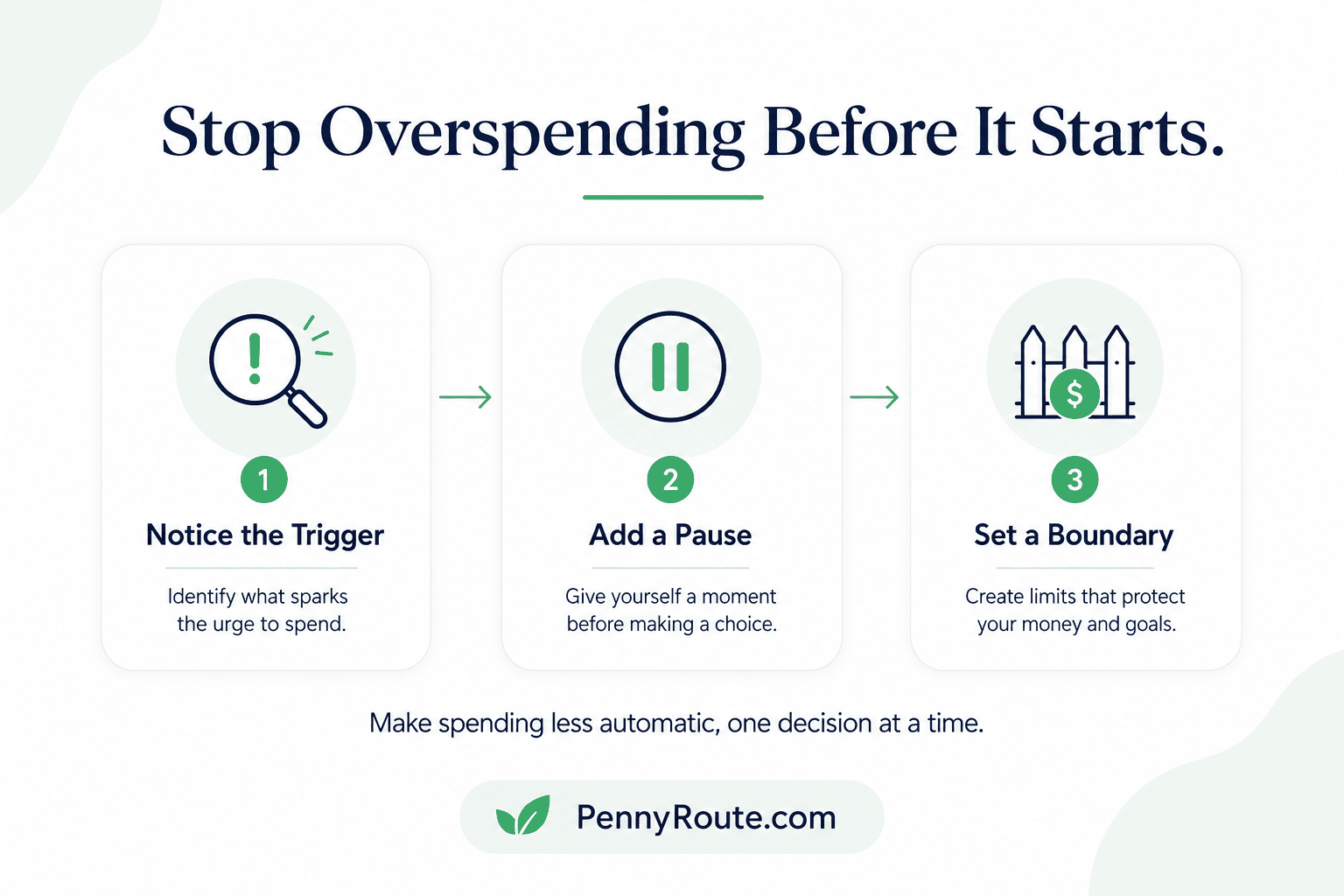
Adding a little friction can help. That could mean removing saved payment details, waiting before nonessential purchases, or staying away from shopping apps when you are only browsing.
If the same situations repeatedly lead to purchases you later question, the deeper issue may be a spending habit rather than the dollar amount alone.
One Category Has No Clear Stop Point
Some expenses are easy to control because the bill arrives with a fixed amount. Flexible categories such as restaurants, entertainment, hobbies, and shopping work differently.
If there is no clear stopping point, each individual purchase can seem affordable even when the total is not.
A monthly limit helps, but a shorter boundary can be easier to use in everyday life. A $240 monthly restaurant budget, for example, could become roughly $60 per week.
What helps is knowing when you are getting close to the limit, while there is still time to adjust.
Irregular Expenses Keep Looking Unexpected
An expense does not have to happen every month to be predictable.
Annual subscriptions, birthday gifts, school costs, seasonal expenses, car maintenance, holiday spending, and similar costs can make an ordinary month look as though you overspent even when the real problem was that the expense was never included in the plan.
Look back over the past several months. If the same type of “surprise” keeps appearing, it probably deserves its own place in your budget.
For known future expenses, setting money aside gradually in a sinking fund can keep the full cost from landing on one paycheck.
You Are Spending Money That Already Has Another Job
A checking-account balance can look available even when part of it is already needed for rent, utilities, insurance, or another upcoming bill.
Suppose your balance is $1,400, but $950 needs to remain for expenses due later in the month. Treating the full $1,400 as spendable makes it easy to use money that was never really available.
Separating committed money from everyday spending can make that boundary easier to see. You do not necessarily need several bank accounts, but the money needed for upcoming obligations should be clearly distinguishable from what you can spend freely.
Match the Fix to the Overspending Problem
Once you know what is causing the gap, choose the simplest change that addresses it.
| If this keeps happening | Try this first |
|---|---|
| The category limit is unrealistic | Adjust it using recent actual spending |
| Unplanned purchases keep appearing | Add a waiting rule before buying |
| Spending is too easy | Remove payment shortcuts or shopping triggers |
| A category runs out too early | Use a weekly or shorter spending limit |
| Irregular costs disrupt the month | Plan for them ahead of time |
| Bill money gets used for other spending | Separate committed and spendable money |
| One optional category needs a temporary reset | Pause that category for a short period |
Use the fix that matches the problem you found. If restaurant spending is running over, tightening an unrelated category does not solve it.
How to Stop Overspending Without Making Your Budget Too Restrictive
A spending limit is easier to live with when it leaves room for normal life. If every optional purchase requires an exception, the plan probably needs adjusting.
Use a Limit You Can See
Knowing that you have “some money left” is not very useful when you are deciding whether to spend another $35.
Choose a way to make the remaining amount visible. Depending on how you manage money, that could be:
- a budgeting-app category
- a weekly amount
- cash or a digital envelope
- a separate spending balance
- a simple note where you subtract purchases
You do not need the most detailed system. You need one that tells you how much room is still available before you make the next purchase.
If clear category boundaries are what you need, the envelope budgeting method is one way to separate spending amounts without changing your entire financial plan.
Leave Room for Spending You Actually Value
A budget that removes every enjoyable expense can look excellent on paper and still be difficult to follow.
If restaurant meals, hobbies, entertainment, or occasional shopping matter to you, give them an amount that fits alongside your other priorities. The purpose is not to make discretionary spending disappear. It is to keep it from quietly using money you wanted somewhere else.
This also makes tradeoffs clearer. Spending more in one flexible category is easier to evaluate when you know what that extra amount will leave available elsewhere.
Decide What Happens When You Reach the Limit
The most important moment often comes after the category is almost empty.
You have a few options:
- Stop spending in that category until the next period.
- Move money intentionally from another flexible category.
- Decide that the original limit was unrealistic and adjust it for the next month.
Any of those choices can work. The problem is letting the spending continue without deciding where the extra money will come from.
What to Do After You Overspend
Going over once does not mean the entire budget has failed.
Protect What Still Needs to Be Paid
Start with the immediate situation. Make sure upcoming essential bills and required payments are still covered, then see how much room is left for the rest of the month.
If the overage leaves another category short, decide where that difference will come from rather than continuing to spend and dealing with it later.
Fix the Cause Before the Next Month
Look at what pushed the category over.
If the original limit was too small, adjust it based on what you learned. If the spending was optional and happened too easily, add a boundary that makes the next purchase less automatic.
Avoid responding to a $100 overage by creating an extremely restrictive plan for the following month unless your finances genuinely require it. A sharp cut can create another unrealistic limit and send you through the same cycle again.
You do not necessarily need to “make up” every dollar immediately. It is more useful to change what caused the overage before the next month begins.
When a Temporary Spending Pause Can Help
Sometimes one category needs a cleaner break.
If takeout, online shopping, convenience purchases, or another optional expense has been happening almost automatically, pausing that category for a short period can give you room to reset the pattern.
A no-spend challenge can work well when the pause is built around the specific spending you want to interrupt while necessary expenses continue normally.
A temporary pause is less useful when the category limit itself is unrealistic. If you need $500 for a normal expense and budget only $300, a short spending freeze does not fix the missing $200.
When the Problem Is Not Really Overspending
There is a point where stricter limits stop being the useful answer.
If housing, food, transportation, insurance, childcare, minimum payments, and other necessary expenses already use nearly all of your available income, the gap may exist even when discretionary spending is modest.
Reducing optional purchases can still free up some money, but it may not be enough to solve the larger cash-flow problem.
For example, cutting $40 of entertainment spending cannot close a recurring $350 monthly shortfall caused mainly by essential expenses.
In that situation, focus on the numbers creating the largest gap. That could involve reviewing major expenses, adjusting saving targets temporarily, checking whether any bills can realistically be reduced, or looking at ways to increase available income.
A broader saving plan can help you decide where reductions are realistic and what to do with any extra room you create.
Revisit Your Limits When Your Finances Change
A spending limit that worked six months ago does not automatically still fit today.
A move, childcare change, new commute, income change, higher recurring bill, or another shift in your finances can change how much room you realistically have.
When something significant changes, revisit the categories it affects instead of waiting for several months of overages to prove that the old numbers no longer work.
You do not need to rebuild the entire budget each time. Adjust the parts that changed and see whether the new limits hold up in everyday life.
Fix the Part That Keeps Causing Trouble
Getting spending back under control does not mean stripping every enjoyable expense from your budget.
Start with the area that keeps causing trouble and make one change that fits what is actually happening. A spending plan is much easier to live with when the limits reflect real life and you can see when you are getting close to them.
Frequently Asked Questions
How much overspending is too much?
There is no single dollar amount that counts as too much for everyone. A more useful sign is whether spending regularly exceeds what you planned or starts taking money away from bills, savings, debt payments, or other priorities.
Should I use cash to stop overspending?
Cash can help if physically seeing the amount left makes a spending limit easier to follow. It is not necessary, though. A digital envelope, separate spending balance, or budgeting-app category can provide a similar boundary.
Can a budget be too restrictive?
Yes. If your limits regularly fall below what necessary or realistic spending actually costs, you may keep going over even when you are trying to follow the plan. Adjusting an unrealistic category can be more useful than repeatedly cutting it further.