Seeing $2,000 in your checking account does not necessarily mean you have $2,000 available to spend. Some of that money may already need to cover rent, groceries, an insurance payment, savings, or a bill that has not arrived yet.
A budget gives those dollars a plan before they disappear into separate purchases and payments. It helps you see what your income needs to cover and whether those numbers actually fit together.
Disclaimer: This content is for informational purposes only and does not constitute financial advice. Your budget should reflect your own income, expenses, priorities, and financial obligations.
Quick Overview
- A budget is a plan for how you expect to use the income available to you.
- It can include everyday spending, bills, savings, debt payments, irregular expenses, and a buffer.
- A useful budget compares the plan with what actually happens and adjusts when needed.
- You can keep the budget broad or detailed depending on what helps you make better decisions.
What Is a Budget?
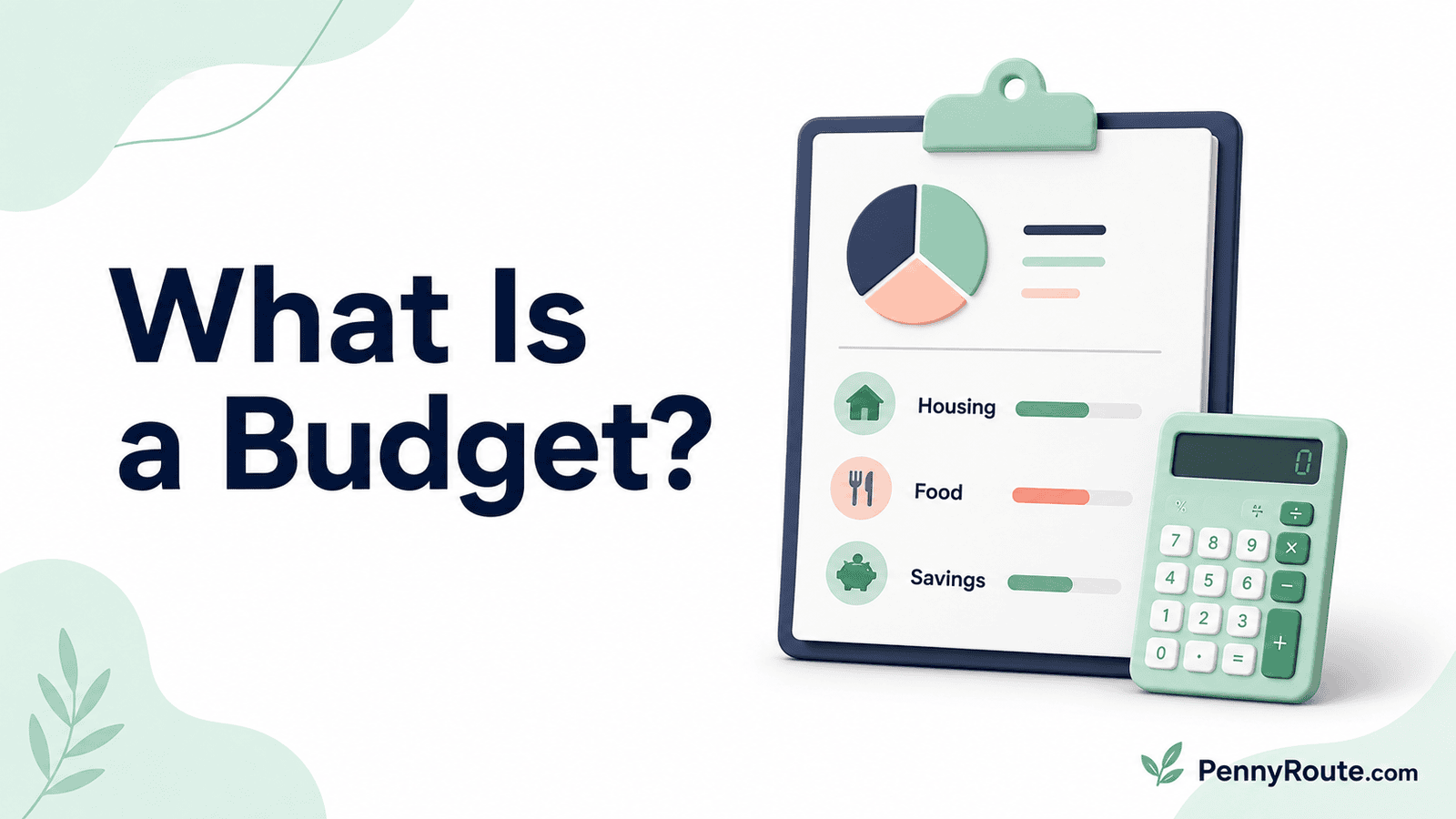
A budget is a written, forward-looking plan for how you expect to use your money over a set period, often a month.
It tells you how much money is available and how much you plan to put toward spending, saving, debt payments, and other priorities.
The plan does not have to predict every expense perfectly. It gives you a starting point for deciding what your income needs to cover.
You also do not have to assign every last dollar. Money left after your planned spending, savings, and debt payments can remain as a buffer or go toward another priority.
What Does a Budget Include?
The exact categories depend on your life, but most personal budgets need to account for a few basic things.
Income: Start with the money actually available to use. For an employee, that often means take-home pay after payroll deductions.
If retirement contributions or other savings already come out before your paycheck reaches you, do not subtract them from take-home income again. They are already reflected in the amount available for the rest of the budget.
When your income changes from one paycheck or month to the next, budgeting with irregular income works better when you plan around a realistic income baseline instead of assuming every month will look the same.
Planned spending: This includes regular bills and everyday costs such as housing, utilities, groceries, transportation, insurance, phone service, household purchases, and personal spending.
Savings: Money set aside for an emergency fund, upcoming purchase, annual expense, or another financial goal can have its own place in the budget.
Debt payments: Include required payments on credit cards, loans, and other debts. Extra payoff amounts can also be planned if the rest of the budget supports them.
Irregular expenses: Not every cost arrives monthly. Car registration, annual memberships, gifts, school expenses, home repairs, and other expenses people often forget to budget for can create problems when the budget only accounts for recurring bills.
A buffer: A small amount left uncommitted can help absorb minor differences between estimates and actual costs.
A buffer should not become a permanent home for predictable expenses. If the same cost keeps appearing, give it its own category instead of repeatedly calling it miscellaneous.
How a Budget Works in Real Life
A budget works best as a cycle rather than a one-time calculation.
1. Plan
Start with the income available for the month and decide what it needs to cover.
One simple way to look at the numbers is:
Available income − planned spending − savings − debt payments = amount left unassigned
Here, planned spending means bills and everyday expenses. Savings and debt payments are shown separately so the same money is not counted twice.
The amount left over might become a buffer, additional savings, extra debt repayment, or another priority.
If the result is negative, the current plan requires more money than the income available.
2. Compare
During or after the month, compare the plan with what actually happened.
Suppose you planned $450 for groceries but spent $525.
Maybe grocery prices were unusually high. Maybe $450 was simply too low for your household. Or perhaps spending in that category changed temporarily.
One month does not always tell you enough to change the budget, but repeated differences usually do.
3. Adjust
Use what happened to improve the next budget.
If groceries repeatedly cost about $525, continuing to budget $450 will not make the expense smaller. The plan needs to reflect reality, which means finding the extra $75 somewhere else.
That is where a budget makes trade-offs visible.
If one category needs more money, the total still has to fit within the income available. You may use some of the buffer, reduce another spending category, change a savings contribution, or increase income.
The budget does not make the trade-off disappear. It helps you see the decision before the money is gone.
Simple Monthly Budget Example
Suppose your monthly take-home income is $3,000.
One possible plan could look like this:
| Category | Planned amount |
|---|---|
| Housing and utilities | $1,200 |
| Food | $450 |
| Transportation | $300 |
| Insurance and health | $200 |
| Debt payments | $250 |
| Savings | $300 |
| Flexible spending | $200 |
| Buffer | $100 |
| Total | $3,000 |
These are example numbers, not recommended percentages.
Another person earning the same $3,000 might have higher housing costs, no debt payment, larger medical expenses, or a different savings goal.
The budget is useful because it forces those priorities to share the same limited pool of income.
Budgeting vs. Expense Tracking
Budgeting and expense tracking work together, but they answer different questions.
| Budgeting | Expense tracking |
|---|---|
| Plans how you expect to use money | Records how money was actually used |
| Looks forward | Looks backward or at current activity |
| Sets amounts for categories and goals | Shows actual transactions and spending |
| Helps you decide before spending | Helps you compare reality with the plan |
You can make a budget without recording every transaction, but actual spending gives you better information for the next plan.
Without knowing what you actually spent, it is difficult to tell whether a category was realistic.
That is where tracking your expenses becomes useful. The tracking provides the evidence; the budget decides what to do with it.
A Budget Does Not Have to Be Complicated
There is no requirement to use a named budgeting system.
A simple budget with a handful of broad categories can work well when those categories give you enough information to make decisions.
More detail becomes useful when a broad category starts hiding a problem.
For example, “Food: $800” may be enough if your spending stays predictable. If the category keeps running over budget, separating groceries from dining out may show where the difference is coming from.
The same principle works in reverse. If splitting one category into six smaller categories does not change any decision you make, the extra detail may simply create more work.
Formal systems such as zero-based budgeting, the 50/30/20 approach, envelope budgeting, or pay-yourself-first budgeting organize the same basic numbers in different ways. Different budgeting methods can provide more structure when you want it, but choosing one is not a requirement for having a useful budget.
When Should You Update Your Budget?
Checking the budget and changing it are two different things.
A regular review helps you see whether the plan and actual spending are still reasonably close. You do not need to rewrite the budget because one grocery trip cost more than expected.
An update makes more sense when something meaningful changes, such as:
- your income increases or decreases;
- rent, insurance, or another major bill changes;
- the same category repeatedly runs over budget;
- you take on or pay off a debt;
- you add a new savings goal;
- a recurring expense disappears;
- your household situation changes.
A one-time difference does not necessarily require rewriting the budget. A buffer may be enough to handle it.
A repeated mismatch usually means the plan itself needs attention.
Start With the Numbers You Actually Have
Your first budget does not have to solve every money decision at once. Start with the income and expenses you can identify now, then improve the numbers as you see how the month actually unfolds.
When you’re ready to put those numbers together, making a budget starts with your take-home income and builds the plan from there.